What one broken New Hampshire bridge tells us about America
Oct 14, 2026 | 4:55 am ET
Description
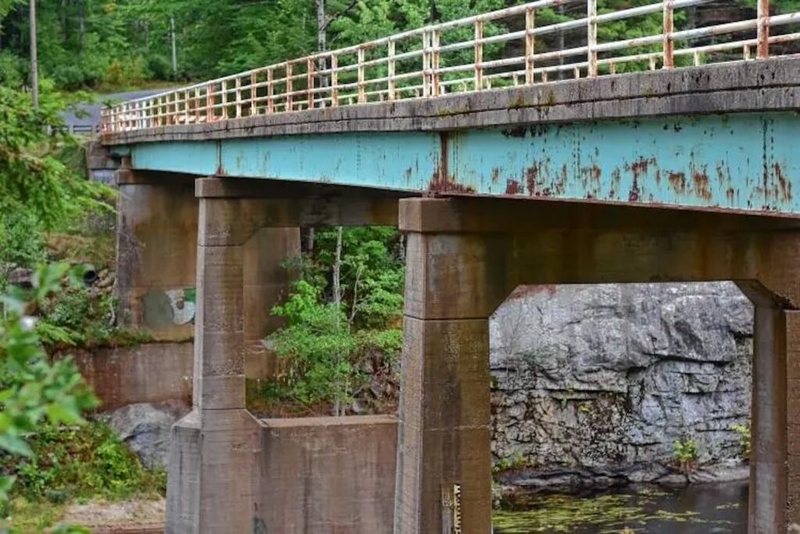
The bridge on Windy Row in Hancock over the spillway for Halfmoon Pond, photographed in 2020. (Photo by Abbe Hamilton/Monadnock Ledger-Transcript)
I have a bridge that I’d like to sell you — maybe you’ve heard that one before. Actually, you’ve bought this bridge once before, long ago. I want you to buy it again. There’s a catch: this bridge has moved — not physically — but it’s in a different country.
In 1936, Peterborough flooded. The New Hampshire town sits down low where the Nubanusit Brook runs into the Contoocook River, a good spot when the textile mills were powered by flowing water, but water power had its revenge in the wet spring of 1936. In the old black and white photos, the river is a torrent, flooding the main streets.
Peterborough wasn’t alone in these floods. After a snowy winter, weeks of heavy March rain and ice jams in the rivers led to flooding in much of New England. In places the Connecticut River jumped its banks, cresting at almost 38 feet in Hartford, the highest ever recorded. As many as 200 people across the Northeast died in the floods, and 14,000 were homeless.
In response Congress passed the Flood Control Act of 1936. Getting enough votes was a wrangle. Everyone wanted a piece of it — a needed dam or levee if it was in your district, pork if it was in someone else’s district. Peterborough would get the Edward MacDowell Dam, but not before the town flooded again in the great hurricane of 1938. It would take 12 years before the $2 million dam was built, creating a reservoir covering 165 acres linked to a spillway to the north of Peterborough’s downtown to discharge flood waters. It was a big, landscape-shifting project, one that is managed today by a full-time staff from the U.S. Army Corps of Engineers.
As a small part of the dam, the Army Corps of Engineers built a bridge, just 224 feet long, to carry a dirt road over the spillway. In 1948, the Corps gifted the Windy Row Bridge to the town of Hancock and the town voted to accept it. “We thought we were getting a million-dollar bridge for free,” one old-timer told me.
All good in 1948, but today the bridge is closed. (You can still walk across or, if you dare, ride a horse.) The steel bridge has rusted into obsolescence, earning a troubling engineering score. The Windy Row Bridge is “structurally deficient.” On a scale in which nine is excellent and zero is failed, the concrete deck and the steel substructure (which distributes the weight to the foundation) rates a five, and the superstructure — the main load-bearing support — just a four. Recent inspections have found potholes in the concrete roadway, exposed rebar, missing nuts and bolts, “large holes” in the beams and bridge railing, broken welds, “hollow soundings” at the joints, peeling lead paint, and overall, extensive rust. This report card lands this deteriorating bridge in bottom 12% of all New Hampshire bridges.
The spillway bridge joins 1,294 others in New England that are “red listed,” about 9% of all the bridges we may be driving over. (There are 42,000 bridges across the country that are “poor,” about 6.8% of the total.) It may cost $3 million to replace this short bridge and that may not happen for 20 years — or ever. It’s not even in line on any list. With a traffic load of only 243 cars daily, and another 180 bridges in the state needing work, it could be stuck in the back of the queue forever.
The U.S. economy is 10 times larger today than when the federal government stepped in to protect the small town of Peterborough, and yet today we say we can’t afford to repair thousands of bridges, dams, roads, schools, wastewater plants, drinking water plants, ports, railroads and public parks. Welcome to the land of the red-listed, white, and blue.
We have moved to a triage model for public life. The public realm is shrinking. Consider, for example, the Rural Electrification Act of 1936. The goal was to bring power to every home. In our time, the build-out of broadband internet access in the 1990s created winners and losers. That’s how we proceed: Some schools, public parks and museums gleam with new construction, and the rest, serving the less fortunate, limp along on life-support.
What you see in this rusting, broken bridge depends on your politics. Maybe you see government overreach, pork barrel projects c. 1936, or environmental overreach — you don’t like dams, even though this one saved Peterborough from flooding in 1987. Or you see the ghost of the American Century, the long-gone, ruined shell of the can-do industrial colossus that triumphed in World War II.
I see a monument to our fractious republic as it stands, rotting away, and I see a different future. Imagine an America where all the bridges, roads and dams are in good order. There is no “red list.” An America where your flight leaves on time — every time — and where you can catch a train between cities, fast and frequent. But to get there, first we’d have to cross one “structurally deficient” bridge. We’d have to admit that this rusting bridge is us.
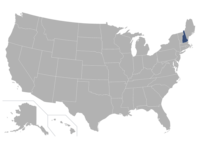
Concord, NH