‘We don’t need Democratic votes’: Republican budget slashes spending to pay for tax cuts
Apr 28, 2026 | 9:35 pm ET

Description
Image via Getty Images
The annual battle over the state budget is heating up again, after the Republicans who control the Arizona Legislature released their plan to cut taxes and to slash funding for state agencies.
As lawmakers took up the bills for the first time on Tuesday during a joint hearing of the Arizona House of Representatives and Arizona Senate appropriations committees, Republicans claimed that the tax cuts in their nearly $18 billion budget will benefit ordinary, hardworking Arizonans.
But legislative Democrats denounced the GOP plan that they said pays for hand outs to billionaires and corporations by cutting safety net programs that are vital to low-income Arizonans. The Republican plan, they said, will force state departments to do more with less.
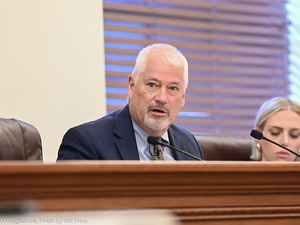
“To me, this is the people’s budget, because we’re returning money to the people,” House Appropriations Committee Chairman David Livingston said during the hearing. The committee meeting was tense, and full of snide comments from members of both parties, including numerous declarations from Livingston that claims from Democrats were merely “their opinions.”
Passing a budget by the June 30 deadline is the Arizona Legislature’s only statutory duty each year. With a split government — Republicans control the legislature but Democrat Katie Hobbs is governor — it is an arduous process.
The Republican budget would cut 5% across-the-board from state agencies, excluding the Department of Public Safety, the Department of Corrections and the Department of Child Safety. It would also bring Arizona’s tax code in line with changes made by the federal government via President Donald Trump’s “One Big Beautiful Bill.”
This is Republican legislators’ third try at getting tax conformity passed, after Hobbs vetoed their first two attempts.
Hobbs released her own $17.7 billion budget proposal in January, which Republicans panned as “based on fantasy revenue” because it counted on a $760 million reimbursement from the federal government for Arizona’s actions in securing the border that the state is not guaranteed to receive.
It also relies on the passage of an extension of Prop. 123, a vital source of K-12 funding for a decade that expired last year and would have to be approved by the voters in November. Hobbs walked away from budget negotiations more than a month ago after Republicans said that an extension of the $300 million school funding mechanism is off the table this year.
Two weeks ago, Hobbs increased the pressure, saying she would veto all bills that Republicans sent to her until they publicly released their own budget plan.
In a written statement on Tuesday, Hobbs applauded Republicans for releasing their plan and including some of her priorities, like $800 million in middle class tax cuts and continued funding to lower the cost of child care. But the governor had no lack of complaints about the proposal.
“Their budget proposal doubles down on reckless and dangerous policies being forced on us by Washington, DC politicians,” she said. “Just like in Washington, they’re paying for tax breaks for billionaires, data centers and special interests by kicking Arizonans off their healthcare and taking food off their tables.”
The Republican budget reintroduces numerous proposals from legislation that they passed along party lines earlier this year and that Hobbs already vetoed.
That includes restrictions on the Supplemental Nutrition Assistance Program, formerly known as food stamps, that is already facing deep cuts and administrative burdens due to federal cuts.
The budget bill would require SNAP to get its payment error rate below 3%. The Arizona Department of Economic Security is already working to get the error rate below 6% before penalties in Trump’s One Big Beautiful Bill Act kick in. In 2024, Arizona’s payment error rate was 8.8%. The national average was 10.9%
SNAP’s payment error rate includes over and under payments of benefits, which are mostly due to administrative errors and incorrect application of eligibility rules. Over the past 20 years, no state have had sustained error rates under 3% and Arizona has never had an error rate below 3%.
More than 420,000 Arizonans have lost access to SNAP benefits since last July, as the state works to comply with federal requirements.
“I look forward to Republicans joining me back at the negotiating table so we can deliver a budget that protects Arizona from Washington, DC policies instead of copying them,” Hobbs said in the statement. “I will be closely monitoring the situation in the coming days to determine whether the legislative majority is willing to engage in good-faith, bipartisan negotiations and have the bill moratorium lifted.”
Rep. Lorena Austin, D-Mesa, said that Republicans and Democrats could agree on things like middle class tax cuts and no taxes on tips, but that the Republicans who have controlled the legislature for 60 years should take responsibility for their fiscal policies that have led to the budget crunch. That includes a 2.5% flat tax rate implemented in 2023 that pulled $2 billion from the budget and gave benefits mostly to the wealthy.
“This budget is not a haircut,” Austin said. “This is a hack job.”
Austin added that people have been waiting 40 years for trickle down economics to trickle down to them, and they’re still waiting.
“This is a corporations-first Arizonans-last budget, and we’re not here for large corporation handouts,” they said. “We’re supposed to be here for Arizonans.”
Hobbs’s budget would eliminate tax exemptions for the data centers that make AI possible to bring in $38.5 million in tax revenue, and it would give the director of the Arizona Department of Environmental Quality the power to place fees on data center water usage. The Republican budget would extend the data center tax exemptions, while eliminating tax breaks for solar energy.
Rep. Jeff Weninger, R-Chandler, along with other Republicans, repeatedly reminded Democrats that there were fewer than 15 billionaires living in Arizona, and that focusing on them was misguided.
Livingston argued that the top 10% already pay a large share of the nation’s taxes, and he went on to pander to California billionaires.
“I want you to move your businesses to Arizona,” he said. “If you’re a millionaire or billionaire, instead of 10, I would love to have 20 of you here in Arizona. Please, move here, because we know how much money you do pay in property tax and income tax. We know how much money that you donate to charities in the cities that you live in. We want your business here in Arizona.”
Many representatives from state agencies, along with concerned voters, attended Tuesday’s hearing to let legislators know how their budget plan would impact Arizonans.
Nurse Kristi Korn said that nixing presumptive Medicaid eligibility for patients who can’t pay their bills and don’t have insurance will hurt hospitals and patients.
“We have a duty to care,” she said. “Sick and injured people will show up regardless of their ability to pay.”
If Medicaid doesn’t pay their bills, the hospital and other patients will pay instead, she said.
“When a hospital faces budget cuts, what gets cut is quality of care,” Korn said. “Nurses are seen as an expense, and if a budget needs to be cut, that means I’m expected, as a nurse working on the floor of the hospital, to take care of more patients at a time, to have patients who are sicker, who I’m accountable for, and there’s only one of me at a time. And that requires tough decisions, instead of being made here by you people in the comfort of your office chairs and computers, to then be made by me.”
The Republican budget would kick thousands off of Medicaid and SNAP benefits but Livingston argued that more frequent eligibility determinations would only impact people who don’t qualify for benefits. Senate Majority Leader John Kavanagh, R-Fountain Hills, agreed.
“What throws you off is if you’re not working,” Kavanagh said. “So, if you’re a hard-working person, you can easily produce proof that you’re working, so that working people aren’t subsidizing food for people who could work.”
Democratic Rep. Nancy Gutierrez of Tucson pointed out that someone who works multiple jobs might struggle to provide the proper paperwork to prove eligibility.
The Arizona Agenda reported that the state is already denying SNAP benefits to people who likely qualify because their system is too difficult to navigate and there aren’t enough workers to help people who struggle with it.
“We do not believe any new employees are needed,” Livingston said, when Democrats asked how agencies should be expected to handle bigger administrative burdens with smaller budgets.
Rep. Matt Gress, R-Phoenix, the former budget director for Gov. Doug Ducey, said that Hobbs had made a grave mistake in walking away from budget talks. Last year, the budgeting process was marked by infighting between Republicans in the House and Senate, but now they’re in lockstep after a month of working on their plan without input from Democrats.
“We don’t need Democratic votes to pass this budget,” he said. “I understand the Democrats believe the governor will veto this bill. And then what? We have a unified Republican majority.”
Gress listed the wins for Republicans in their budget plan, including tax conformity, tax cuts, tax deductions for child care expenses, and full funding for the Division of Developmental Disabilities.
“When we talk about affordability, Republicans mean giving the money back to the people,” he said. “Affordability for the Democrats is another government program. That’s the difference here. We trust people, they trust the government.”
***CORRECTION: This story has been corrected reflect that Gov. Hobbs left budget negotiations more than a month ago, and began a bill-signing moratorium two weeks ago.
Phoenix, AZ