Washington governor, AG and state lawmakers get 7% pay hikes
Jul 01, 2026 | 4:48 pm ET
Description
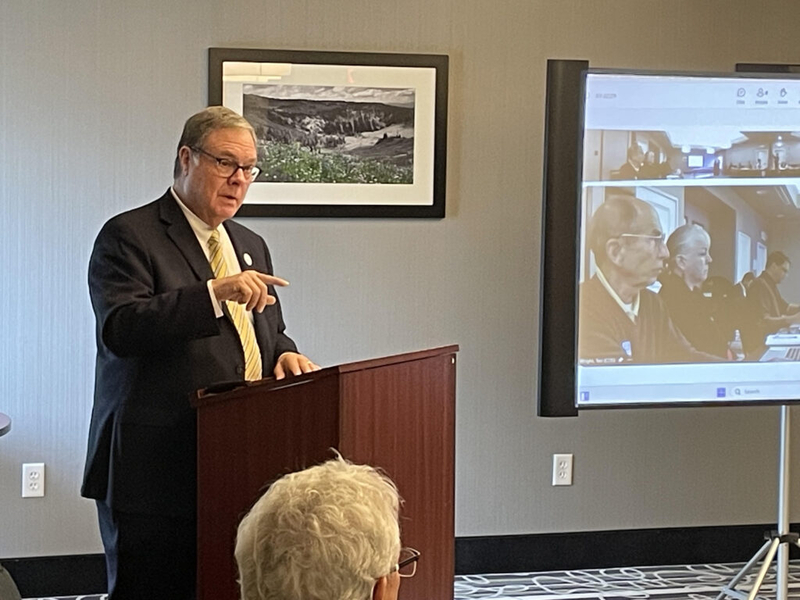
Washington Gov. Bob Ferguson, Attorney General Nick Brown and state lawmakers all received a 7% raise on Wednesday as a result of decisions by a citizen salary-setting commission. Lt. Gov. Denny Heck (above) asked the panel in October 2024 to increase the pay of state lawmakers, saying their compensation was not commensurate with their responsibilities. (Photo by Jerry Cornfield / Washington State Standard)
Gov. Bob Ferguson received a 7% raise on Wednesday.
Combined with a similar-sized pay bump a year ago, his annual salary is $234,275, roughly $30,000 more than when he took the oath as Washington’s 24th governor in January 2025.
It’s not his doing.
The Washington Citizens’ Commission on Salaries for Elected Officials, a panel established by voters in 1987, ended the practice of politicians deciding their own pay.
This panel of unelected individuals from across the state approved a new two-year salary schedule in March 2025 that awarded double-digit pay hikes for the offices of the governor, attorney general and state lawmakers.
It agreed to give members of the legislative, executive and judicial branches an across-the-board cost-of-living adjustment of 3% on July 1, 2025 and 2% on Wednesday. That’s what thousands of state workers secured in collective bargaining agreements.
Commissioners tacked on additional increases each year for some offices.
Legislators got an extra 5% on Wednesday, for a total increase of 7%. That’s on top of a 6% boost a year ago. A lawmaker now earns $72,494, roughly $10,000 more than two years ago. Leaders of the four caucuses continue to receive a stipend for added responsibilities.
Ferguson and Attorney General Nick Brown each received 7% raises this year and in 2025.
Washington’s seven other executives — lieutenant governor, secretary of state, state auditor, superintendent of public instruction, insurance commissioner, treasurer and commissioner of public lands — got only the cost-of-living adjustments.
Several people, including present and past Democratic and Republican lawmakers, and a statewide officeholder, urged commissioners to improve lawmakers’ compensation.
“The members of the Legislature are the board of directors of our 8 million-person state and the entire state workforce,” Democratic Lt. Gov. Denny Heck said at a 2024 meeting where the panel deliberated over the pay changes. “Simply put, state legislator pay is not commensurate with the magnitude of their responsibilities and the time demands.”
His views haven’t changed.
Despite the state constitution outlining a “part-time legislature,” the lieutenant governor is “hard pressed to identify any member of the legislature who treats their responsibility as an elected official as such,” a spokesperson said in a Monday email.
Sen. Yasmin Trudeau, D-Tacoma, also appealed to commissioners, saying compensation should be enough to interest residents from all walks of life in serving. If salaries are too low, some people, like working parents, small business owners and young adults, will feel they cannot afford to do so.
She said Wednesday that this remains a problem.
The commission must continue to be cognizant of why “regular” people find it hard to serve, she said. At the same time, she acknowledged people frustrated with rising costs and inadequate wage growth may react negatively to the pay hikes.
The statewide median wage in Washington in 2026 is about $73,000 a year, according to figures from the state’s Economic Services Administration.
“My role was to convey the reality for younger people and mothers that public office should not just be for those that can afford it,” she said.
Commissioners will meet in September to start the next round of salary-setting. Final salary recommendations for 2027 and 2028 will be made early next year.
Olympia, WA