Washington agrees to join carbon market with California and Quebec
Jun 25, 2026 | 10:22 pm ET
Description
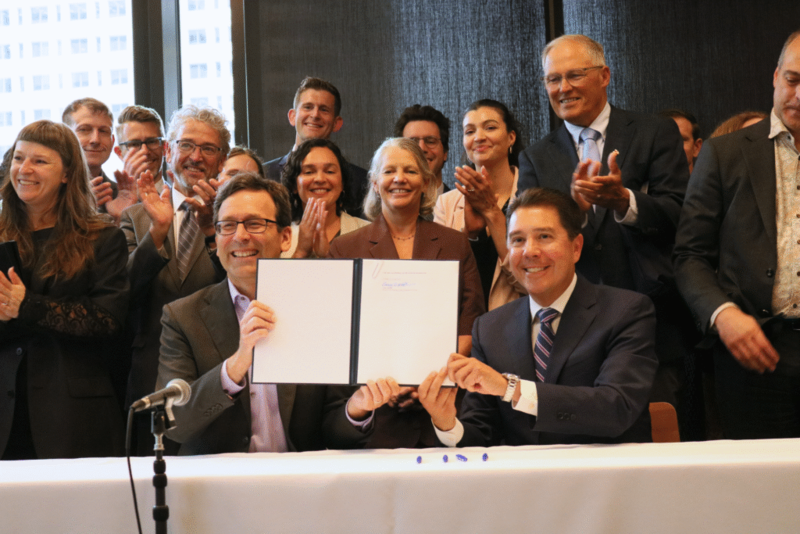
Gov. Bob Ferguson, left, and director of the Department of Ecology, Casey Sixkiller, right, hold the signed agreement to link Washington's carbon market with California and Quebec's. (Photo by Aspen Ford/Washington State Standard)
Washington took a key step Thursday to combine its carbon market with one operating in California and Quebec, a move expected to drive down costs for carbon-emitting businesses once the programs are joined.
State Department of Ecology Director Casey Sixkiller signed the so-called linkage agreement during a ceremony in downtown Seattle. California and Québec still must complete additional steps, including adopting regulations, before a linked market can take effect. Officials say the markets should be operating together by 2027.
Once the joint auctions begin, Washington will be part of the world’s largest sub-national carbon market.
This was expected. When Washington established the Climate Commitment Act in 2021, it required the Department of Ecology to seek to join the California and Quebec market.
“By creating a large market, we create a more stable, predictable carbon market that helps to reduce emissions, spur innovation, and ensures that we continue to generate revenue that can be reinvested in communities across Washington,” Sixkiller said.
Both supporters and critics of Washington’s Climate Commitment Act agree that linking markets will likely improve stability, lower allowance prices and reduce costs passed on to consumers.
“With more certainty about future allowance prices, businesses can invest more in emissions reductions,” said Caroline Halter, communications manager at the Department of Ecology. “The more they invest, the cheaper clean technology gets for everyone.”
Prices lower in California and Quebec
Each quarter, Washington auctions off a finite number of carbon allowances, priced per ton of carbon emitted. Roughly 100 entities, mostly companies, are required to buy them. As time goes on, fewer allowances will be available and prices will increase.
Since its first auction in 2023, the state has raised nearly $5 billion. And, since the beginning of this year, four auctions have raised $644 million.
The state uses the revenue to invest in projects designed to reduce greenhouse gas emissions and improve public health.
Washington’s young carbon market had a somewhat bumpy start.
In its first year, the conservative political committee Let’s Go Washington backed a ballot initiative to repeal it. The measure failed with 62% of voters opposed. Waiting to see if the market would survive, buyers pulled back and allowance prices plummeted to below $30 a piece.
Since then, prices have bounced back, hovering around $60 to $70 per allowance in the past year. In California and Quebec’s joint market, the most recent price per allowance was $28. When the auctions link, all allowances will be available in all three places at a shared price. It is expected to be lower than Washington’s current prices.
“Linking these markets is an important step toward improving the affordability and stability of the Climate Commitment Act,” said Peter Godlewski, government affairs director at the Association of Washington Business. “But today’s news should not reduce the urgency for lawmakers to continue looking for ways to refine the program.”
House Majority Leader Joe Fitzgibbon, D-West Seattle, a strong advocate of the program, called on other jurisdictions to join the carbon market.
“We know that no matter how much Washington, California and Quebec do together, we’re only going to solve the climate crisis with more partners,” he said.
Gas prices
Fitzgibbon said that once the markets are joined, allowance prices are expected to fall, but it’s up to fuel suppliers to determine how much the costs will be passed on to consumers.
Todd Myers, vice president for research at the Washington Policy Center and a frequent critic of the program, says linking markets will reduce gas prices and that Washingtonians “have been massively overpaying up to this point.”
Myers noted that, unlike Washington, California releases updated information on how much its carbon market program adds to gas prices, which was around 23 cents per gallon for retail gasoline in April.
Last month, as prices at the pump soared amid the U.S. war in Iran, state Sen. Chris Gildon, R-Puyallup, urged Ferguson to temporarily suspend the Climate Commitment Act to ease affordability concerns for Washington residents.
Ferguson dismissed the idea then, and again at Thursday’s signing.
“We’re moving on,” Ferguson said.
“If I hear one more Republican legislator complain about gas prices, I’m going to lose my mind,” he said.
“There’s a simple call they can make: the White House,” Ferguson added. “If they want to do something about gas prices, reach out to the leader of their party.”
Olympia, WA