Want a job that helps you with childcare? Some New Hampshire businesses are doing it.
Jul 27, 2026 | 5:00 am ET
Description
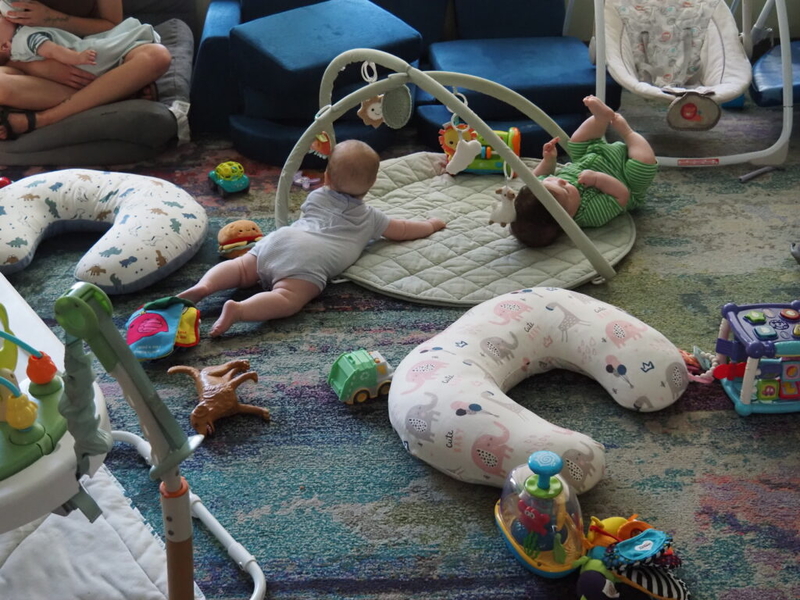
Two infants play during nap time at FitKids Childcare at River Valley Club in Lebanon. Their dad works as a personal trainer at the club's fitness center. (Photo by Maya Mitchell/ New Hampshire Bulletin)
As a businesswoman and a young mother, Elizabeth Asch knew she would need someone to watch her young children. She owns the River Valley Club, a health and wellness facility in Lebanon that offers fitness classes, tennis and pickleball, a day spa, a hair salon, and other amenities to its adult clientele.
Initially, the club operated a babysitting service where parents could drop off their children while they worked out. But after feedback from patrons and employees, Asch decided to open FitKids ChildCare at River Valley, a childcare center. Twenty-eight years later, FitKids has 15 classrooms, and her teachers enjoy childcare at no additional cost to them.
“I was pregnant when we opened, and I just knew how important it was for me to have access to my child. Like, I could do it there and nurse them, and our employees can do that, and I know how important that is for peace of mind for community building,” Asch said.
Childcare in New Hampshire is sparse and expensive. According to the New Hampshire Fiscal Policy Institute, about 25% of a married couple’s income with two children under age 5 in center-based care went to childcare in 2025. The number of available programs in the state has been shrinking since before the pandemic, leaving families with fewer options.
Granite State employers say housing, childcare, and the cost of living are the biggest problems affecting their workers, and each issue challenges their ability to recruit and retain young employees.
In an economy where employment and childcare go hand in hand, and in a state where the government continues to look to the private sector for solutions, some employers have gone the extra mile to help their staffs.
Where it’s working
Dartmouth Health, anchored by Dartmouth Hitchcock Medical Center in Lebanon, is one of New Hampshire’s largest employers, with more than 15,000 workers. Its regional clinics can be found throughout New Hampshire and parts of Vermont.
The health system operates and partners with five childcare centers, four in New Hampshire and one in Vermont, for its employees and the surrounding community. The centers support about 300 childcare slots.
“It is really hard to go to work and be able to give it your all and be the professional that you want to be if you’re worried about, ‘Are my kids OK?’” said Carolyn Isabelle, vice president of talent and career development for Dartmouth Health. “That’s the stuff that matters and that people worry about, and I think has a really direct impact on their ability to come to work.”
Isabelle said the hospital has a strong pipeline of young talent who, when they take a job, are not yet looking to have a child or buy a house. However, she said the organization has invested in housing and childcare improvements because it helps retain employees.
As a result, the organization has become “more actively involved than they ever thought they would need to” in those areas. Dartmouth offers relocation assistance, financial well-being services, and help with other family-related concerns, like evaluating school systems.
For smaller businesses that lack the resources of Dartmouth Health, the trick is to play to their strengths.
At River Valley Club and FitKids ChildCare, the Lebanon childcare program owned by Asch, employees have an array of benefits, including on-site, discounted childcare and “steep” discounted access to the club’s fitness offerings.
After the terrorist attacks of Sept. 11, 2001, Asch said she saw how important it was for her employees to be able to reach their children quickly, especially as a mother of young children herself. That’s when her babysitting service turned into licensed childcare with employee perks, creating a better community within her business.
“Our mission is very simple,” Asch said. “It’s to improve the lives of the children and families at FitKids, and our clients at the hair salon, and our fitness members at the club. In order to improve the lives of all of the people who work for us, we all have to feel good about ourselves.”
Kristen Wood is the executive director of FitKids. Every day, she sees the impact of working in a family-friendly workplace, and how not having to pay for childcare contributes to overall well-being.
“It’s a building block for our staff,” Wood said. “It’s a benefit they can utilize, and it becomes home for all of us. I mean, what’s better than being next door to your baby? Whether you’re at the (health) club or you’re in the classroom next door, being able to breastfeed, all of those types of things we’re able to offer.”
Asch said she does not promise free childcare when she’s hiring providers, but she’s never had to turn anyone away. FitKids accomplishes that feat by using the child-to-teacher ratios to its advantage. If a teacher is not present, their child can’t be either. It is a system that helps attract talent, and keep it.
“We’ve never had to turn away the child of someone who works as one of our teachers, we’re proud of that,” she said.

Employers could do more
A 2025 survey from Stay Work Play New Hampshire, a nonprofit advocacy group, found that childcare availability and costs are major stressors for young families, and parents cannot fully participate in the workforce without childcare accessibility. The survey also found that young people value “workplace currency” benefits, such as paid family leave and flexible work arrangements.
“Childcare consistently comes up as an obstacle when relocating young families for jobs,” said Corinne Breton, the organization’s executive director. “But also, we’re seeing a lot of workforce displacement as well, driven by cost of living factors like housing, but certainly early care and education as well.”
According to Breton, employers “see the need and feel the need” to improve efforts to attract and retain their employees, scale their businesses, and nurture their employees. She said that childcare stipends, for example, would help lighten the cost load and show employees that their employers understand how difficult things can be.
“The top two benefits that young people value all revolve around flexibility. So that’s paid family medical leave, generous paid time off, but also flexible work environments, employers who recognize and understand address their needs,” she said.
MacKenzie Nicolson, co-director for Moms Rising NH, said New Hampshire is not on par with its neighbors, and as a result, the state is losing a “decent amount” of its workforce to neighboring states with better benefits.
“I think any solution that we come up with needs to be multifaceted. … Offering a stipend for childcare, I think, is a great solution.” Nicholson also said flex scheduling, creating parent-friendly workspaces, paid sick time, and raising the state minimum wage could also help make work easier for young families.
Organizations like the Business and Industry Association have made childcare a top legislative priority due to its impact on the workforce. But given the state’s limited involvement in the funding landscape and the challenges of opening a childcare program, implementation remains an uphill battle.
This year, Gov. Kelly Ayotte championed legislation that would give tax credits to businesses that helped create more childcare slots or had on-site childcare. In a recent bill signing, she said her next biennial budget will include more childcare initiatives.
While Asch looks forward to more state involvement in employer-involved childcare, she knows her strength lies in what she can do as an individual.
“We’ve been here almost 30 years. I’m looking at the next 30 years,” she said. “I can’t control what’s happening in Washington. I can’t even control what’s happening in Concord. But what I can do is help build my own community.”
Concord, NH