Waitlist, policy changes stir worries among families of Arkansans with disabilities
Aug 03, 2026 | 6:00 am ET
Description
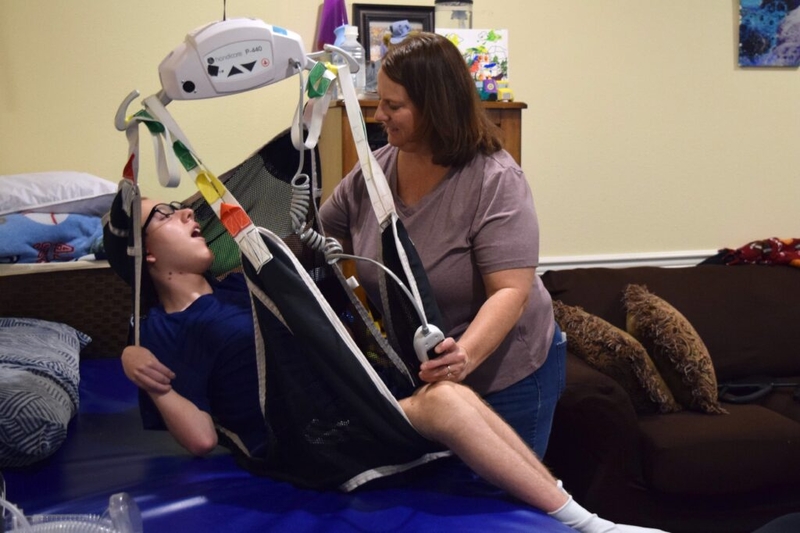
Susan Roberts uses a device hanging from their ceiling to help lift her 16-year-old son, TJ, into his bed on July 29, 2026. The device is covered by a Medicaid waiver for people with disabilities that need supportive living services. (Photo by Antoinette Grajeda/Arkansas Advocate)
Laura Hellinga moved to a new house in Highfill two years ago, hoping it would be more accessible for her 15-year-old daughter, who was born with a rare joint disorder and uses a motorized wheelchair.
Their previous house had a track attached to the ceiling that could lift her daughter, Landry, in and out of her chair more safely than her mother could. But when Hellinga informed Landry’s health insurance provider that she wanted to move the contraption to the new house, she was informed it wouldn’t be covered anymore.
“The lift goes into the shower and holds her, but [without it] we’ve slipped and fallen,” Hellinga said. “I’ve broken three or four toes since we moved here.”
Landry’s insurance comes from the Provider-Led Arkansas Shared Savings Entity program, also known as PASSE, a Medicaid program that serves Arkansans with complex disabilities. The Department of Human Services launched the managed care program in 2018, and the four participating insurance companies cover 46,564 Arkansans as of July 1, department spokesperson Gavin Lesnick said.
To get coverage for Landry’s ceiling track again, she would have to be one of the 8,233 Arkansans on the Community and Employment Services Medicaid waiver. Hellinga said she doesn’t expect the family to get off the waitlist for several years, and she’s not alone.
Managed care focuses on low-cost preventative care that saves money in the long term, and that’s not always right for people with complex disabilities, said Syard Evans, CEO of the disability advocacy group Arkansas Support Network.
Arkansas has struggled for decades with long waitlists for services for people with disabilities, but the shift to managed care over the past several years and changes in federal policy are heightening worries for families around the state.
“[The CES] waiver really is about ensuring that people receiving services are empowered to choose the lives that they want to live and receive the support necessary to live those lives,” Evans said. “That’s not necessarily always in line with provider priorities.”
If all you have is a hammer, everything’s a nail. Well, we’ve gotten stuff accomplished in the past with just a hammer... What the PASSE system has done for our industry is it turned that hammer into liquid dish soap.
Long waits for services
Information about the Community and Employment Services waiver tends to spread via news coverage and word of mouth rather than a coordinated effort by the state, Susan Roberts said. Her 16-year-old son, TJ, has cerebral palsy and was on the waitlist for 11 years before being approved for the waiver in 2021.
As of July 1, there were 2,268 Arkansans on the waitlist and those at the top of the list have been waiting for three years, Lesnick said.
Other Arkansas parents of children with disabilities have recently urged state officials to direct more funding to long-term support services in order to clear the waitlist. The federal government would also have to take action, since Medicaid is a joint state-federal program.
Despite public frustration over the wait for services, the waiver program isn’t widely known, Roberts said, so she’s taken it upon herself to spread the word.
“I’m continually telling parents to keep applying, because it’s better to be on the list, even if you’re not moving, than to not be on the list at all,” Roberts said.
She said she appreciates the non-medical supportive services TJ has received, but the waiver still has its downsides.
TJ uses a motorized wheelchair, and the Roberts’ home in Bella Vista has a lift system similar to the one Landry used. Roberts said it was a challenge to get required three quotes from three different companies before the state could approve installing the lift system.
Landry would also benefit from a service dog, but there aren’t three distinct companies in Arkansas that could provide cost estimates for the services, Hellinga said. Additionally, the state covers only medical services for people on the waitlist.
Cost of care
Regardless of waiver coverage, caring for people with severe disabilities is a full-time job, which Hellinga and Roberts know firsthand since they quit their jobs years ago to care for their children.
Both are employed as caregivers by their children’s insurance providers, but Hellinga is a single mother and said her pay of $11 per hour — a recent decrease from $14 per hour — isn’t enough.
Roberts and Hellinga both said there’s no one they trust more with their children’s care than themselves. Roberts has hired people she knows and trusts to care for TJ, but demand is often much higher than supply, she said.
“I’ve been successful so far to have staffing during every summer, which is my biggest need when he’s out of school, but other than that, I have not been able to find people,” Roberts said.
The insurance companies have care coordinators as reference points for beneficiaries, but Hellinga said she hasn’t had one in months after the previous one left, and Roberts said she only needs to contact hers in emergencies.
“A lot of the money that the state is putting into the PASSEs goes to paying these care coordinators, and most of them are not helpful,” Roberts said. “I would rather that money go towards our care, rather than paying people to supposedly watch over us and help us, and they don’t.”
The state’s priority when adopting the PASSE system was for coverage reimbursement rates to be appealing enough that for-profit insurance companies would get involved with the program, Evans said.
“They established a contract that is highly beneficial to the PASSEs, and in doing that, it really lacks the accountability that’s necessary to ensure that nonprofit providers, and most importantly, the beneficiaries of services are actually getting what they need,” she said.
She also said caregivers are being paid the same rates they were in 2018, but a DHS study last year showed that supportive living services cost 23% more than what the PASSEs reimburse.
The law mandating the study also required the state to increase reimbursement rates, but so far the state hasn’t done so.
Evans said one of the most frustrating things about the PASSE system is that it “completely nullified” the strategies disability advocates once used to support providers and beneficiaries.
“The old saying [is] if all you have is a hammer, everything’s a nail. Well, we’ve gotten stuff accomplished in the past with just a hammer,” Evans said. “…What the PASSE system has done for our industry is it turned that hammer into liquid dish soap.”
I’m continually telling parents to keep applying, because it’s better to be on the list, even if you’re not moving, than to not be on the list at all.
Looking toward the future
Public outcry over the waitlist for disability services is not new. In 2003, an Arkansas family successfully sued to get their 5-year-old daughter off the waitlist. The state raised the cap on the waitlist, but the need for care eventually exceeded the number of slots.
In 2021, then-Gov. Asa Hutchinson directed funding to disability support services in an effort to clear the waitlist, which had more than 3,000 people on it at the time. All of those people received services by 2025, but the waitlist filled up again.
Hellinga said she has petitioned state and federal officials to put more money into disability services, but has received few to no responses.
She also said the U.S. Department of Justice’s June announcement that states are no longer required to provide home- or community-based care for people with disabilities frightened her and her daughter. Disability advocates nationwide have said removing this requirement could lead to institutionalization.
Roberts said she is far less concerned about a hypothetical federal policy change than about TJ having a support system if anything happens to his parents.
“Right now we don’t really have a plan in place, and I thought the waiver would provide us some more options with that,” Roberts said.
Meanwhile, Hellinga is still determined to get her daughter a service animal even without insurance coverage.
“For the last year and a half, Landry and I have baked cookies [to sell] at $5 apiece to raise money to get her something that will change her life,” Hellinga said.
Little Rock