USC professors question college’s involvement in push to create new university accreditor
Sep 04, 2025 | 10:34 am ET
Description
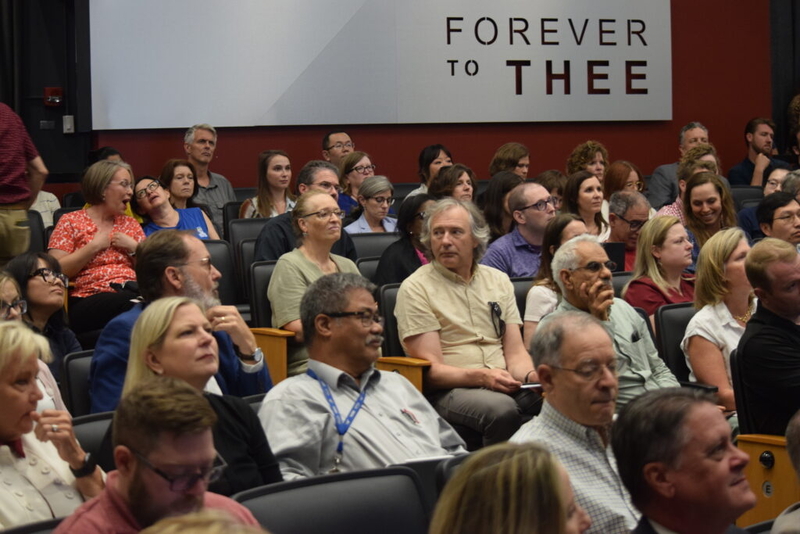
University of South Carolina professors fill the theater of Russell House on the Columbia campus Wednesday, Sept. 3, 2025, to hear from Board Chairman Thad Westbrook on the college's involvement in a new accrediting agency. (Photo by Jessica Holdman/SC Daily Gazette)
COLUMBIA — Hundreds of University of South Carolina professors packed a campus theater to hear from college leadership — many for the first time — on the involvement of the state’s largest university system in a new college accrediting commission under development in Florida.
It was standing room only in the 300-seat Russell House theater Wednesday during an event to introduce new faculty members — a meeting that in the past has been sparsely attended by the school’s nearly 1,800 teaching faculty.
Most were there to hear from the chairman of the school’s governing board, Thad Westbrook, about USC’s partnership with state schools in Florida, Georgia, North Carolina, Tennessee and Texas to form the new Commission for Public Higher Education.
Politics and higher education
Republicans have billed the commission as a way to end “woke indoctrination” on the campuses of the University System of Georgia, the University of North Carolina system, the University of Tennessee system, and the Texas A&M University system, as well as USC.
USC joins DeSantis’ push to create new university accreditor to ‘upend’ ‘woke accreditation cartels’
While the board chairman has sidestepped politics in explaining what drew USC to this new partnership, those sentiments by politicians, including Gov. Henry McMaster, are what caused major consternation among the professors in attendance Wednesday.
Those who spoke worried what it could mean for their ability to teach and conduct research related in any way to race, gender, climate science and other matters that have morphed into a political football in recent years.
“I know there’s been political rhetoric around it, and some politicians have talked about it,” Westbrook said. “I would hope that there’s nothing political related to (Commission for Public Higher Education.)”
The comment earned mocking laughter and groans of disbelief from the crowd. Someone shouted “come on” while others whispered under their breath that the new organization was a farce.
Westbrook stood behind the podium quietly absorbing the criticism and waiting for the murmurs to die down before continuing.
If politics are involved, he said, “that’s a problem for higher education.”
‘No where near the final exam’
Westbrook spoke for about 10 minutes, offering some new details not previously publicized, before fielding questions from faculty for the remainder of the hour.
This fall, 10 schools are expected to take part in the commission’s initial round of pre-accreditation.
The organization must complete this before the U.S. Department of Education will fully recognize it as an accreditor. No USC system schools are in that initial batch, Westbrook said, and the full approval process with federal regulators will take at least two years.
The soonest a USC school would even consider seeking accreditation through the new organization would be 2029, when USC Beaufort is up for renewal.
Until then, USC will gauge the experience of the other schools before making a final decision.
“The bottom line is it’s very early in this process, and we’re not at a point where we’re ready to make a decision,” Westbrook said.
“We’re nowhere near the final exam,” he added, making an analogy to college coursework.
‘Judge us by our record’
About 20 professors lined up along both aisles of the theater waiting for what would be their first opportunity to ask a board member directly about the effort.
Each received loud applause and head nods from their colleagues after voicing their questions and airing their concerns. Westbrook waited each time for the noise to stop and answered questions from all who came to the microphones.
Mindy Fenske, an English professor, asked about the commission’s business plan, which calls for member schools to contribute $4 million each.
Westbrook responded that the commission has not yet asked USC for funds.
Questions from others — Kirk Randazzo, a political science professor; education professor Susi Long; English professor Mark Minett; and Bret Kloos, a psychology professor — followed similar themes.
All raised concerns about whether their subject matter might be construed as “woke” or categorized as diversity, equity and inclusion and therefore face restrictions. They worried about the university’s independence from outside influence. They called it risky to go from a long-established accreditor to one that’s untested.
And Laura Brashears, a sociology professor, pointed to vague language in the first draft of 24 proposed accreditation standards the new organization began circulating last month. She said they call for faculty with a “diversity of viewpoints” without defining what that means and how it will be measured.
Westbrook repeatedly tried to allay fears, suggesting USC’s board has steered away from heavy-handed policies on diversity, equity and inclusion or denial of tenure to those who teach controversial subjects, as seen in other states.
“I know there is a national conversation going on,” Westbrook said to one speaker. “I would ask you just to judge us by our record.”
“We here at the university, we’ve done anything we can to protect academic freedom. I haven’t seen anything we’ve done as an institution to impact what you’re teaching,” he replied to another.
“Those are things that are not happening in South Carolina,” he said again.
Westbrook also encouraged the professors to provide feedback on the draft standards, which are open for public comment through Sept. 16.
How it started and changes to come
Florida Gov. Ron DeSantis announced the proposal for the new accreditation agency in June. Referring to the Southern Association of Colleges and Schools, which accredits schools across the Southeast, DeSantis blasted what he called the “woke accreditation cartel,” which has been “hijacked by radical ideology.”
On the campaign trail, President Donald Trump called accreditation his “secret weapon” in reshaping higher education to end what he considers ideological bias.
In April, he signed an executive order to expedite the federal approval of new accreditors, which is what the Commission for Public Higher Education is relying on for its own process. The order also threatens to suspend accreditors that take into account a college’s diversity programs.
Asked whether the USC board was unhappy with the current accreditation under Southern Association of Colleges and Schools, Westbrook repeated past statements that the process is “overly burdensome.”
He went on to tell the crowd that the southeastern accreditor recently came under new leadership and the recently hired president, Stephen Pruitt, has told the USC board his organization is working on making its own changes.
More information on those changes is expected later this month.
DRAFT CPHE ACCREDITATION STANDARDS WITH EXPLANATORY MEMO 20250819
Columbia