USC to establish center for civics education, following national trend
Jul 21, 2025 | 9:29 am ET
Description
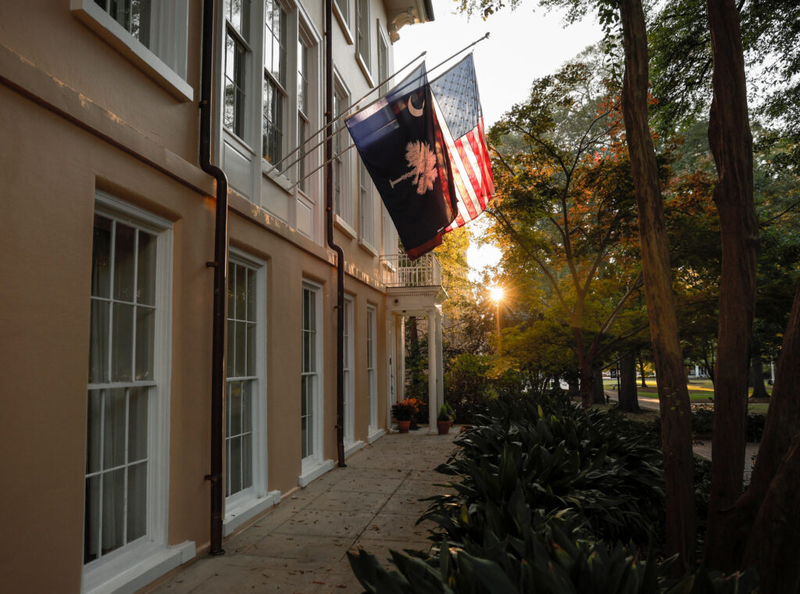
The United States and South Carolina flags are seen at the president's house at the University of South Carolina Horseshoe at sunset on Monday, Oct. 28, 2024 in Columbia, S.C. USC is one of a growing number of schools nationwide establishing a center focused on civics education and encouraging civil debate amid political polarization in the country. (Photo by Travis Bell/STATEHOUSE CAROLINA/Special to the SC Daily Gazette)
COLUMBIA — The University of South Carolina is one of a growing number of schools nationwide establishing a center focused on civics education and encouraging civil debate amid political polarization in the country.
South Carolina’s largest university system is establishing its Center for American Civic Leadership and Public Discourse following approval from the school’s governing board late last month.
According to a statement from the university, the center is in response to “a growing need for civil discourse, cooperation across partisan lines, and a greater understanding of the core ideals and values that shaped America.”
“The value this new academic center brings is its focus on equipping students with the knowledge, perspectives, and reasoning skills for meaningful interactions as citizens and community leaders,” added USC President Michael Amiridis.
These centers popping up at colleges across the country come as surveys and academic studies show a declining rate of civics knowledge and understanding of the core functions of government.
Less than half of Americans can name most of the rights protected under the First Amendment and under two-thirds can name the three branches of government, according to an annual survey conducted since 2014 by the University of Pennsylvania’s Annenberg Public Policy Center.
“I do think that these centers speak to a real need and a desire that a lot of students have — learning for the sake of learning — but also includes a real interest in pursuing questions such as the nature of citizenship, how people can be more attuned to what the responsibilities of citizenship and civic leadership are all about,” said Christopher Tollefsen, a professor of philosophy at USC who is serving as the center’s interim executive director until a permanent director can be hired.
Tollefsen said these centers have also opened up a space for debate, discussion and disagreement, rather than “just shouting each other.”
“Polarization is a dominant theme that we see whenever people talk about what our political life and our political language is like,” Tollefsen added. “Everybody has a sense that it’s no longer possible to engage in a free exchange of ideas and arguments and to fully participate in discussion with their neighbors without a feeling that the situation is very fraught. I think we’re trying to address that.”
For example, as protests erupted on college campuses in the wake of a surprise attack on southern Israel by Hamas militants on Oct. 7, 2023, and the subsequent war that broke out between Israel and Palestine, a student group at Yale University gathered in small groups to talk about the conflict.
At USC, Tollefsen expects to bring on between six and eight new professors over the next five years who will teach within various departments at the university in addition to working within the center.
Similar to other student organizations, students can sign up to participate in what the center is calling a scholars program in addition to events that will be open to public.
Tollefsen also eventually hopes to offer a couple of academic minors, such as one focused on philosophy, politics and economics, through the center.
While some, such as Stanford University’s Hoover Institution and the James Madison program at Princeton University, where Tollefsen was a visiting fellow, have been around for decades, there’s been a more recent movement nationwide to establish such centers.
A good number of these in recent years have come out of a push from state legislatures, starting with Arizona State University in 2016. Paul Carrese, the ASU school’s founding director, will serve as one of several external advisors to USC’s new center.
And in 2022, backed by Gov. Ron DeSantis, the massive Hamilton Center started at the University of Florida.
What SC law requires
Forming a center dedicated to civic education appears as something of a course reversal from the South Carolina university that initially opposed legislation to update a 1924 state law that required students to take a year-long class on America’s founding.
Most state colleges hadn’t followed the law for years when Sen. Larry Grooms wrote a letter to USC officials in 2013 asking why.
Changes ultimately signed into law in 2021 included reducing the course length to a semester.
“I’m thrilled to learn they are moving forward with civics education, particularly since USC was ground zero for the fight to have founding documents taught,” said Grooms, R-Bonneau Beach.
USC, in its opposition, raised concerns about a clause in the then-nearly-century-old law about the course’s final test serving as a loyalty oath to the United States for students who are American citizens, Grooms said, as well as the added cost of teaching such a class.
The update eliminated the oath clause. Mandated reading for the course includes the U.S. Constitution, the Declaration of Independence, and the Emancipation Proclamation in their entirety, as well as at least five essays from the Federalist Papers. An amendment adding at least one document considered “foundational to the African American freedom struggle” to the required reading got the legislation to the governor’s desk.
“As the flagship university of the state, it’s comforting to know they’re taking seriously their mission to educate our citizens, not just in the humanities and sciences, but on the foundation of democracy and where we came from so we’ll know where we’re going,” Grooms said.
While the center is concerned with civic literacy, USC spokesman Collyn Taylor said the center’s work is separate from the founding documents course requirements.
“It’s more wanting to elevate the conversation about things going on around the world right now,” he said.
Rather than a direct study of the founding documents, participants are meant to learn about the rule of law and how government works through the broader, expert-led discussions of current events.
Existing centers in SC and other states
At least 13 public university campuses across eight states — Arizona, Florida, Ohio, Mississippi, North Carolina, Tennessee, Texas and Utah — have established civics units, according to reporting by Inside Higher Education. Legislatures in Iowa and West Virginia also passed requirements for centers, according to reporting by States Newsroom affiliates.
Private and Ivy League schools, such as Harvard, Johns Hopkins and Yale universities, have also joined the trend.
And in South Carolina, Allen University started the Boeing Institute on Civility with a $1.5 million gift from the aerospace giant that renovated a former hospital building in the neighborhood surrounding the historically Black university in Columbia. The institute held its first event in 2024 with Russell Wigginton, president of the National Civil Rights Museum, and Della Britton, president of the Jackie Robinson Foundation, discussing social justice issues.
Tollefsen said USC’s center is different from those at several other public colleges in that it is not legislatively mandated. He said university board Chairman Thad Westbrook is among those leading the push at USC.
“Studying the American civic order and teaching our students to be good citizens should be a core function of higher education in America,” Westbrook said in a statement. “Over the past few years, we have strengthened our policies supporting free speech on campus, and we believe this center will elevate that work with a renewed focus on civil discourse.”
Westbrook, in his statement, also cited the upcoming 250th anniversary of the signing of the Declaration of Independence and planned celebrations in South Carolina around the sestercentennial and the state’s role in the Revolutionary War as a reason for launching the center.
The center’s first public event is set for Sept. 12, featuring Cornel West, of New York’s Union Theological Seminary, and Robert George, of Princeton University, whom USC described “well-known for their collaboration and friendship, despite their disagreement on many issues.”
Both are also on the center’s advisory board.
Emory University law professor and First Amendment scholar John Witte Jr. is also set to hold a Sept. 17 Constitution Day lecture about religious freedom.
Columbia