US Supreme Court in Virginia case says police need warrants for cellphone location data
Jun 29, 2026 | 11:53 am ET
Description
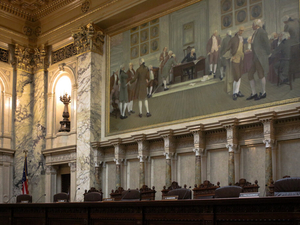
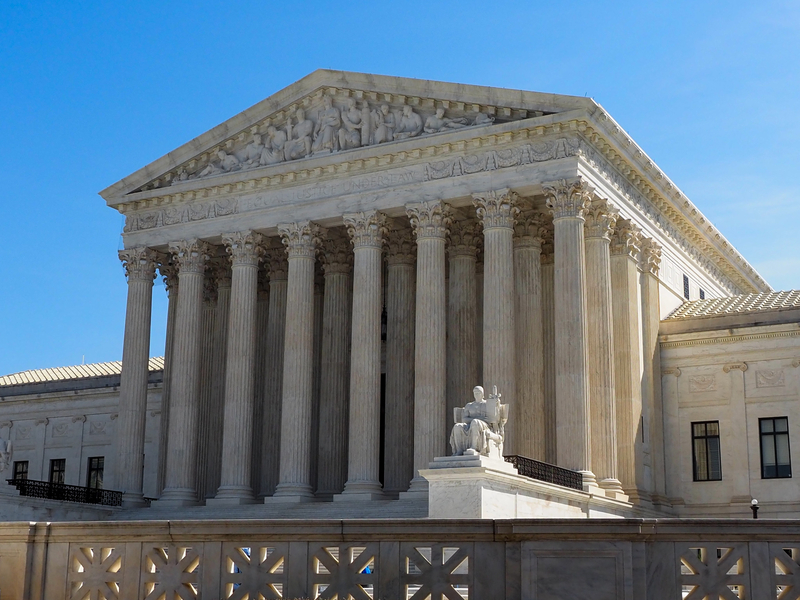
The U.S. Supreme Court on April 9, 2026. (Photo by Ashley Murray/States Newsroom)
The U.S. Supreme Court ruled Monday that law enforcement searches for the location history of cellphones near crime scenes are covered by the Fourth Amendment, requiring warrants to obtain the data.
But the high court left unsettled when searches for the information are reasonable — likely meaning the justices will eventually weigh in again on the privacy rights of Americans in the electronic era.
In a 6-3 decision, the Supreme Court ruled that police officers conducted a search for the purposes of the Fourth Amendment when they obtained cellphone location history data during an investigation into a bank robbery in Virginia. The amendment protects against unreasonable searches and seizures by the government.
“An individual has a reasonable expectation of privacy in records about his cell phone’s location, and police intrude on that constitutionally protected interest when they demand the information — even though for only a limited time, and from a third-party tech company,” Justice Elena Kagan wrote in the majority opinion.
Kagan was joined by Chief Justice John Roberts and Justices Sonia Sotomayor, Brett Kavanaugh and Kentanji Brown Jackson. Justice Neil Gorsuch concurred in the judgment but did not join the majority opinion.
Justice Samuel Alito dissented, joined by Justices Clarence Thomas and Amy Coney Barrett.
States ask warrants be upheld
Over the past two decades, geofence warrants have become a major tool of law enforcement. At a basic level, they allow police to identify phones within a geographic area for a certain period of time. The data can be tremendously valuable to investigators, offering a way to develop suspects in crimes where their identities aren’t otherwise known.
Civil liberties advocates warned that geofence warrants ensnare people in digital dragnets, handing the government data on anyone who happens to be in the wrong place at the wrong time. They argued that accessing data on anyone within a certain area — the geofence — amounts to a general warrant prohibited by the Constitution.
A broad bipartisan coalition of states urged the justices to uphold the warrants. Thirty-one states and the District of Columbia filed a brief with the court arguing that geofence warrants can be more precise than many traditional investigative methods when supported by probable cause and appropriately tailored. In the brief, they urged the justices not to prohibit geofence warrants altogether.
Geofence warrants can generate critical leads when the perpetrators of crimes are otherwise unknown, they wrote. When suspects are unknown but the suspected wrongdoing is linked to a specific place and time, location data provides one of the narrowest available tools for finding leads, the brief argues.
Credit union robbery in Virginia
The case centered on a 2019 robbery of a federal credit union in Midlothian, Virginia. Okello Chatrie was convicted of armed robbery after surveillance footage showed the robber using a cellphone. A detective then obtained a geofence warrant directed at Google for devices within 150 meters of the credit union within an hour of the robbery.
Google initially provided anonymized data in response to the warrant. The detective then requested and received additional location data on nine users. Finally, the detective received de-anonymized information on three users, without obtaining an additional warrant.
While Google has since changed the way it stores location history data to limit geofence warrants, other apps and tech firms collect the data. Lawyers for Chatrie argued that geofence warrants open the door to the authorities requesting information on everyone at a sensitive location — perhaps an abortion clinic or a political convention — at a particular time.
The records serve as a “personal journal of a user’s movements,” Kagan wrote. Location history resembles other private materials like emails, documents, photos and calendars that, even if stored on Google’s servers, users reasonably view as their own, she wrote. Users, in turn, expect the data to be shielded from the “inquisitive eyes” of the government, Kagan wrote.
‘Reasonable’ question unanswered
But Kagan and the court’s majority didn’t wade into whether the search of Chatrie was reasonable under the Fourth Amendment. While the warrant in the case was an uncommon, multi-step warrant, Kagan wrote, the lower appeals court found that a search did not occur, so it did not decide whether the warrant was reasonable.
“We are, as we have said many times before, ‘a court of review, not of first view,’” Kagan wrote. “It is therefore now up to the Court of Appeals to decide whether, at each step of the search process, the warrant satisfied the Fourth Amendment’s requirements of particularity and probable cause.”
In his dissent, Alito wrote that the Supreme Court’s decision “further destabilizes” longstanding jurisprudence on the Fourth Amendment. He accused the majority of issuing an advisory opinion by not addressing whether the search of Chatrie’s data was reasonable.
“Indeed, by refusing to review the one question that could have at least theoretically given Chatrie some hope of relief, the Court carefully set the stage for its planned performance: striking a pose as a great champion of privacy in the digital age. I cannot support this irresponsible escapade,” Alito wrote.
All States Newsroom content is free to republish. Read our republishing policy for more information.