US Supreme Court needs more security funding amid threats, justices tell lawmakers
Description
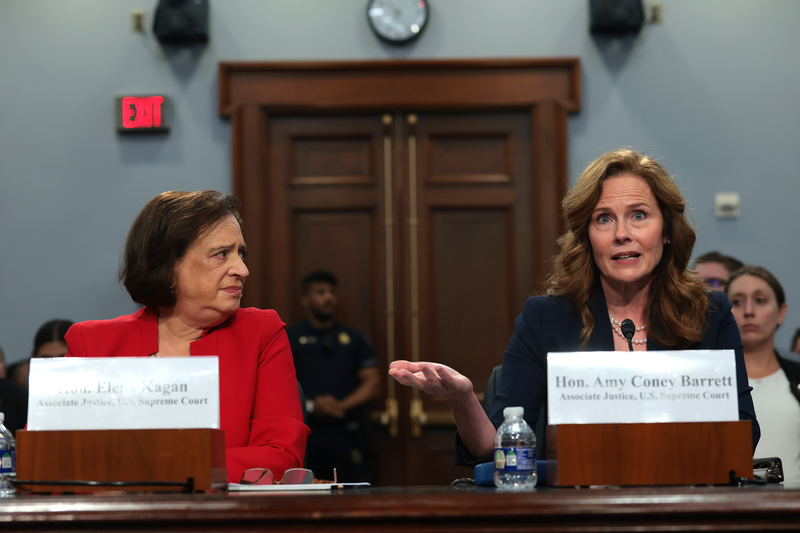
U.S. Supreme Court Justices Elena Kagan, left, and Amy Coney Barrett testify before the House Appropriations Financial Services and General Government Subcommittee on July 14, 2026. (Photo by Anna Moneymaker/Getty Images)
WASHINGTON — Members of Congress from both parties indicated Tuesday they will support additional security funding for the U.S. Supreme Court after two justices testified about a sharp rise in threats.
Associate Justices Elena Kagan and Amy Coney Barrett told lawmakers on the House panel that writes the court’s annual funding bill an increase is needed to ensure around-the-clock security wherever they go and for upgrades to the building.
“Maybe I lack imagination, but I didn't expect that performing this service was going to put me in the position of explaining to my children what a bulletproof vest was and why I had to wear one,” Barrett said.
Kagan told members of the House Appropriations Financial Services and General Government Subcommittee during the hearing that the court’s budget has increased, on average, by 15% per year during the last five years, mostly due to safety concerns and inflation.
“I first joined the court in 2010. Our security was very different at the time. The Supreme Court police focused almost exclusively on protecting the building. And our (information technology) department focused on supporting the latest BlackBerry devices,” Kagan said. “I didn't have a security team of my own, and I was accompanied by security personnel only when I participated in work-related public events.”
The court, she added, began increasing its security spending around 2017 after members of Congress encouraged the justices to take their safety more seriously.
Security threats have steadily increased since then.
“The Capitol Police Chief recently testified that threats against Congress are up 50% this year,” Kagan said. “The Supreme Court police expect a smaller but still very substantial 38% annual increase in threats this year, which follows a 25% increase last year.”
Proposed $29M increase
Subcommittee Chairman David Joyce, R-Ohio, said that regardless of how the court rules on any given case, the justices “must be able to do their jobs without fear for their safety or their family's safety.”
Maryland Democratic Rep. Steny Hoyer, ranking member on the panel, said that given the “deeply divided country and increasingly violent rhetoric being directed at judges, Congress must provide sufficient funding to ensure the safety of all judicial personnel.”
The House subcommittee, he said, appropriated $207 million for the Supreme Court, which included a $28.9 million increase for security, in the bill it approved earlier this year. That legislation hasn’t yet gone to the floor for a vote.
The Senate Appropriations Committee hasn’t yet released any of its dozen government funding bills for the next fiscal year ahead of the Oct. 1 shutdown deadline.
Kagan rejects ‘shadow’ docket label
Lawmakers on the House panel pressed the justices about the court’s ethics policy and raised concerns over the increase in cases it takes up as part of its emergency, or shadow, docket.
Hoyer said the justices deciding cases without a full briefing or oral arguments and then issuing a ruling with little or no explanation has had a negative impact on Americans’ trust in the court.
Barrett noted that people “have long had the ability to seek interim relief from the court,” though she agreed with Hoyer that the justices have “seen a big change in the volume and the nature of such requests.”
Kagan responded she doesn’t believe it’s “appropriate” to refer to those cases as the shadow docket instead of the emergency or interim docket because the justices have done “a better job in the recent past” of “explaining ourselves at least to a moderate degree.”
She added that a year ago she might have answered the question differently because the Supreme Court was providing such little explanation in those specific cases “that lower courts had a great deal of difficulty trying to figure out what” exactly the justices had addressed.
"I don't think that that's so much a problem anymore,” Kagan said. “I think that as we've gotten more experienced in these constant requests that are coming to us for emergency relief, that we better recognize that at least sometimes there is a need for additional information. And we have issued opinions and sometimes majority and dissenting opinions accordingly."
Ethics policy
Connecticut Democratic Rep. Rosa DeLauro, ranking member on the Appropriations Committee, encouraged the justices to figure out a way to enforce the ethics policy the court instituted in 2023.
Kagan testified the court “should work hard to try to figure out some enforcement system,” but emphasized any changes need to come from the justices themselves.
“I will say that that's an extremely difficult question for a pretty obvious reason, I think, which is that I don't think that you would want an enforcement system that was controlled by the executive branch or by the legislature,” Kagan said. “And this is because of what you said in your opening statement about the importance of judicial independence.”
Barrett testified she was “completely committed to” the ethics code but that she was “less certain” about whether and how to enforce it.
“I’m just not quite sure. The judiciary moves slowly. The court moves slowly. We have turtles everywhere because of that,” Barrett said. “And I think that if we had a body to enforce the code it would have to come from within the judiciary. And I just think then it’s a question of who selects the judges, how is the panel comprised. There’s just a lot of complexity.”
Proposed screening center
The two justices testified before the Senate Appropriations Financial Services and General Government Subcommittee in the afternoon. And while they addressed many of the same questions and concerns raised during the morning House hearing, they provided some additional details about security.
The Supreme Court would like Congress to provide $6.5 million to begin the process of building an external security screening center, which Kagan said could be similar to the Capitol Visitor Center that sits underground just east of the building.
“Right now visitors walk into the court and that’s where they are checked. That’s where they are sent through the magnetometer and checked for weapons and so forth,” Kagan said.
As far as personnel, Kagan testified the Supreme Court has a goal of reaching 477 police officers but that the justices are “a ways away from that right now.”
“If we include people we get through contracting, we can probably do it within a couple of years,” Kagan said. “But in order to have our own employees get up to that mark, then we’re talking more about six years.”
Kagan was unable to answer a question from Senate Appropriations Committee ranking member Patty Murray, D-Wash., about the types of training those police officers must complete and the facilities they would need.
“I’m confident that the kind of training programs that we’ve put in place are good ones, but I can’t give you a whole lot of detail about that,” she said.
Barrett told senators the need for more dedicated police officers comes, in part, from the U.S. Marshals Service telling the court months earlier than expected their officers could no longer provide security at the justices’ homes.
“They themselves were just stretched thin,” Barrett said. “So we had always wanted to take it over ourselves, but we were forced to do that on a quicker timeline. And we are now fully doing it within the Supreme Court police through a combination of our full-time officers and contractors.”
All States Newsroom content is free to republish. Read our republishing policy for more information.