UA’s withdrawal of law dean’s offer signals new reality for Arkansas higher education
Jan 25, 2026 | 6:00 am ET
Description
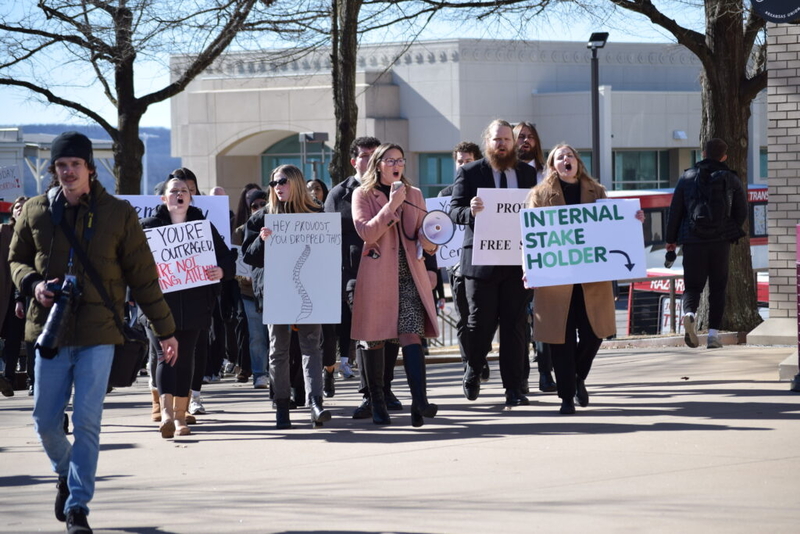
University of Arkansas students marched around the Fayetteville campus on Jan. 20, 2026 to protest the revocation of a job offer to the incoming law school dean. (Photo by Antoinette Grajeda/Arkansas Advocate)
Lawmakers lodging complaints to Arkansas’ colleges and universities isn’t necessarily anything new. Legislators have no qualms telling school leaders when they or their constituents are displeased.
In recent years, it’s likely had more to do with football coaches than law school deans.
But the swiftness by which the University of Arkansas withdrew its offer to incoming Law School Dean Emily Suski is a sign of the new reality for higher education in the state. And it signals to lawmakers how quickly schools could bow to pressure.
The UA’s about-face has become the latest flashpoint over academic freedom as schools around the country face increased Republican scrutiny, from President Donald Trump down to state officials.
The backlash over the school’s decision to withdraw Suski’s offer has created unwanted headlines nationally for the UA. Closer to home, the decision prompted a walkout by students and sparked fears from professors about their own freedom of speech.
An Arkansas Supreme Court decision last year that could open the door to the Legislature taking further control over higher education and direct say over hiring and firing officials.
The court unanimously ruled last year that the Legislature has the authority to scale back constitutional amendments that were proposed and approved by the people.
Most of the attention following that decision was on progressive measures the state had approved because of citizen initiatives, including the 2016 amendment that legalized medical marijuana. The ruling raised concern among groups that have been trying to put proposals on the ballot dealing with redistricting and reproductive rights.
But it might also mean the Legislature can revisit the constitutional amendment that was aimed at giving higher education the kind of independence that Suski’s defenders say is now at risk.
That amendment, also known as Amendment 33, was ratified in 1942 in response to a different kind of political meddling. The University of Arkansas back then faced the ire of Democratic Gov. Homer Adkins and his efforts to fire then-president and eventual U.S. senator J. William Fulbright.
In a bit of irony, it was another law school dean who took center stage in that fight over higher education’s independence. Then, it was Robert Leflar.
Even before the court’s ruling on constitutional amendments last year, the Legislature had a political advantage that was clear.
Republican Gov. Sarah Huckabee Sanders has made targeting “indoctrination” at all levels of education a clear priority. That line of attack has found favor with legislators, especially those facing primary fights in March.
The UA’s flagship school had already taken steps that appeared to be in response to higher ed’s role as a culture war battleground. That includes the school’s decision to close its diversity, equity and inclusion office in 2023. Late last year, the school removed the head of its Middle East Studies office over comments made about Israel.
The school’s posting of Ten Commandments displays on the Fayetteville campus — in compliance with a 2025 state law — led an alumnus to pull two scholarships he had funded.
Republicans hold an overwhelming majority that could turn the normal holds on budgets that are a headache for schools and other state agencies into an outright nightmare when the fiscal session begins in April.
The challenge facing UA leaders is how they can reassure nervous faculty and students that they’re not effectively handing over every administrative decision to lawmakers. Or that faculty’s curriculum vitae won’t be scoured for any material politically unpopular in a deeply Republican state.
At the same time, they’ll have to provide that reassurance in a way that doesn’t threaten opening up a deeper fight with the Legislature over who controls the higher education system.
It’s a difficult if not impossible balancing act that could define not just the Fayetteville campus’ future but that of higher education overall in Arkansas.

Little Rock