The grocery tax must go. But Alabama’s tax system needs a complete overhaul.
Sep 21, 2026 | 5:59 am ET
Description
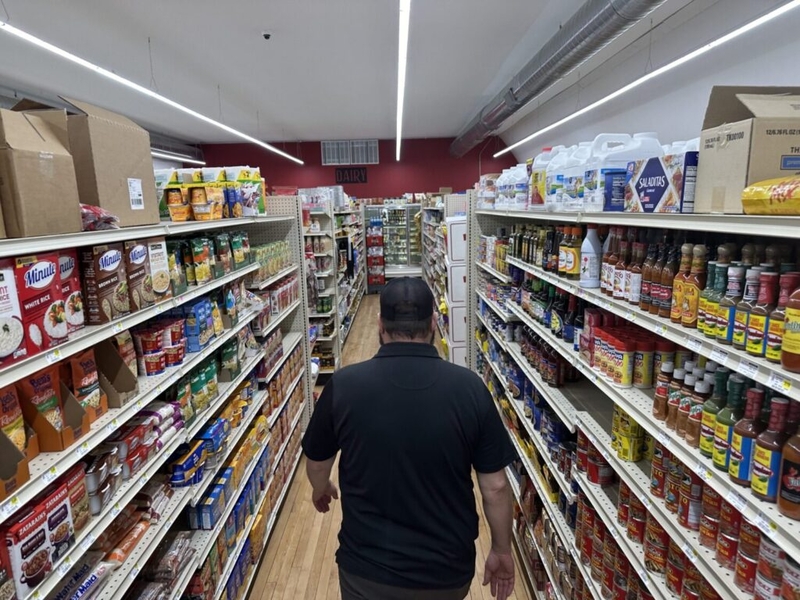
General Manager Brian Horak walks down an aisle at Post 60 Market in Emerson, Nebraska in 2024. A growing number of Alabama politicians are calling for the abolition of Alabama's grocery tax, which has been in place since 1939. (Kevin Hardy/Stateline)
There’s a political ad I’d like to see. I know it’s just a dream.
But let’s break out the Alabama Campaign Spot Construction Set anyway. Get my candidate in a field with 64 spotlights on him. Put him in a $90,000 pickup truck. Play that 2003 bar band guitar riff.
Burmp ba-da-da-da burp-bum bop.
“My name is Bill Fratbrother. And I work for hard-working Alabamians. That’s why I’m going to shift taxes to people who can pay them.”
Cut to my man in a polo shirt next to a barn. For political authenticity.
“When I’m in Montgomery, I’m going to make sure rich Alabamians start shouldering the burden they’ve pushed on us.”
Shred that guitar like you’re being paid in beer. Burmp ba-da-da-da burp-bum bop.
“No grocery tax. No breaks for timber barons. And no welfare for wealthy families paying federal taxes. Because this is our government, not theirs.”
Cut. Upload. Play a bazillion times on Saturday afternoons through November.
This was inspired in part by the growing consensus that it’s time to bounce Alabama’s grocery tax. And I’m all for grabbing it by the shirt collar and throwing it out the door. State officials with hair-trigger tempers over the slightest federal regulation have intruded on this essential household expenditure for decades, with zero sense of irony.
The fate of the grocery tax will depend on next year’s budget and whether state officials can swallow losing $230 million in a year where everyone expects money to be short.
I’d cut it regardless. Find another solution. Don’t tax hunger.
But this push to dump the food levy stands out for another reason. We’re talking about cutting a tax that hurts Alabamians outside of the country clubs.
You could believe from our state’s political culture that Alabama soaks people like a Scandinavian country, where personal tax rates approach 60%. If that were the case, you’d have a lot fewer worries about paying for childcare, higher education and medical emergencies. In fact, Alabama consistently appears on lists of states with the lowest tax burdens.
But this is a bit misleading. We’re not Sweden, but most people in Alabama don’t really experience low taxes. That state sales tax is insidious. Worse, it’s applied in a ham-fisted manner, with a raft of business exemptions that tell you who counts in our state. We have taxed human food since 1939. We don’t tax chicken feed.
Compare that to New York, which I am informed is a Stalinesque hellscape. They don’t tax groceries. Nor do they tax clothing purchases under $110.
That’s a helpful exemption for families with children.
But not the kind Alabama ever thinks about extending. For all the pickup truck preening and agricultural playacting, our state government generally believes that taxes should be borne by those least able to pay.
So if you own a forest, send your children to private school or (shudder) find yourself in the highest federal income tax bracket, Alabama lawmakers will trample the masses to help you.
If you rent your house, send your kids to public school or drive to work each day? Sorry. Hope you find your way into a higher caste.
And those tax breaks for some raise the cost of living for the rest of us. Many local government services get funded through vehicle registration taxes — excuse me, “fees.” Fees that are often raised in local bills that slide frictionlessly through a Legislature allegedly filled with low-tax advocates.
The reason for that dependency? Our property tax caps.
Do Alabama homeowners pay less tax than those in other states? Yes. Do families experience a lot more anxiety about the quality of education in a resource-strapped public school? Particularly in rural areas forbidden from properly taxing property owned by a handful of timber barons? You bet.
So you may feel compelled to pay thousands or tens of thousands of dollars a year to put your kids in private academies, even though modest property tax hikes would almost certainly be cheaper, give your local school adequate resources and maybe raise your home value.
But we can’t do that. Racist white planters who hated public education put those caps in the state constitution at the end of Reconstruction. Groups built to protect big landholders, like the Alabama Farmers Federation, laser-eye anyone who dares to address them.
Nor can we do much with the state income tax, with rates and income thresholds frozen in a 1933 constitutional amendment. Tinkering with exemptions eased some of the regressivity. But it can’t be called a fair tax system by any stretch of the imagination.
So don’t tell me Alabama’s taxes should be cut. I want Bill Fratbrother and every other aspiring official to make taxes fair.
Tell me how you’re going to shift the burden to the Big Mules. Show me that you have the fortitude to tell the exalted Alabamians that they have to give back to a state where they’ve prospered.
Because that’s the actual problem with Alabama taxes: some people are too important to pay. Which means the rest of us have to make up the difference.
Montgomery