Turtle Bay Resort Plans Paused After Judge Ruling
Jul 15, 2026 | 6:01 am ET

Description
Photo courtesy of Honolulu Civil Beat
A planned expansion of the Turtle Bay resort will have to wait as Honolulu conducts a deeper environmental review ordered by a judge who said the city hadn't adequately assessed the project's impacts as required under state law.
The ruling is a significant victory for a coalition of environmental and community groups that had argued in a lawsuit that the environmental guardrails for the project were outdated and posed a threat to several endangered species of Hawaiian native bees, nalo meli maoli, who inhabit parts of the coastline.
“Our community is thrilled that the court has upheld our environmental protections today,” said Jessica dos Santos of the group Kūpa‘a Kuilima, a plaintiff in the suit.
“Kuilima is not only one of the last stretches of pristine coast on O‘ahu, it’s also a place of cultural significance that’s beloved by residents throughout the area,” she said.
Judge Shirley Kawamura of the 1st Circuit wrote that a confirmation letter sent by Honolulu permitting director Dawn Takeuchi Apuna to attorneys for the Ritz-Carlton Oʻahu in December was “arbitrary and capricious” because it failed to show whether the department had properly considered whether additional environmental review was needed.
Instead, the department said that a supplemental environmental impact statement issued 13 years ago was sufficient to approve the plans by Host Hotels & Resorts for 375 residential and hotel units on 50 acres of Kawela Bay on a parcel known as H-1.

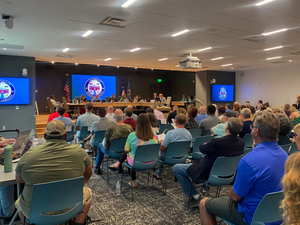
But the judge said evidence presented by lawyers representing a coalition of environmental groups in a hearing on July 2 showed there had been an increased presence of the endangered Hawaiian yellow-faced bees in the project area since 2013.
Two species of the native bees – Hylaeus anthracinus and Hylaeus longiceps – placed on the federal endangered species list in 2016 have been found in the area surrounding the H-1 parcel including during preliminary surveys by the stateʻs Division of Forest and Wildlife.
The increased presence of Hawaiian native bees constitutes new circumstances or evidence under the stateʻs environmental protection act or HEPA, the judge found, and triggered the requirement for the update.
The plaintiffs had shown that the development was “more likely than not” to have impacts on colonies of nalo meli maoli and that at a minimum, the new environmental review had to address their presence and how those impacts could be mitigated during development.
The court did not reach the same conclusion about the presence of Hawaiian monk seal or Laysan albatross, which the plaintiffs also cited, but the Honolulu Department of Planning and Permitting will be required to account for all the relevant environmental changes that could also include factors like coastal erosion and changes to vegetation and land use in the development parcel.
Although the summary judgment for the new impact statement pushes the onus back on the permitting department, the EIS requirement usually falls to the applicant, in this case Host Hotels & Resorts, which took ownership of the parcel in May 2024.
The project was outlined in the resortʻs 2024 urban design plan but without a firm start date for building.

On Tuesday afternoon, permitting department spokesman Davis Pitner said the agency is reviewing the judgment and had no additional comment.
Host Hotels & Resorts spokeswoman Amy Hamstead said in an email Wednesday the company was evaluating its options.
"Our focus remains on sustainable and responsible ownership and long-term environmental stewardship across our Hawaiʻi portfolio — reflected in significant conservation efforts, ongoing sustainability and resilience investments and continued support for public shoreline access and community engagement on the North Shore," Hamstead said.
Environmental groups, however, were not holding back.
“Weʻre thrilled with the ruling today,” said attorney Dru Hara of Earthjustice. “The judgment just really affirms that the stateʻs environmental laws have meaning, our agencies are beholden to them and that endangered, near-threatened, native species deserve the protection that's required under the law.”
The ruling also means that the permitting department may no longer be able to rely on the 2013 environmental review for any future projects that it would have covered, Hara said. That could impact developments on land parcels adjacent to a 634-acre conservation easement approved a decade ago.
The 2013 environmental impact statement was used to greenlight a 350-unit development by Arete Collective along the coastline between the current resort and Kahuku Point that began in August. This ruling doesn't immediately impact those plans, however, Hara said.
The timeline for an environmental impact statement varies, but according to the city guidelines will require the applicant, Host Hotels, to consult with the permitting department, community groups such as the neighborhood boards and other stakeholders – a process that can take months to over a year.
There also are two periods of public comment on the draft environmental review, which has to be approved by the state's Environmental Review Program.
In addition to Kūpaʻa Kuilima, the plaintiffs included the Center for Biological Diversity and the Conservation Council for Hawaiʻi, with the permitting department and Host Hotels & Resorts named as defendants.
This story has been updated with comment from Host Hotels & Resorts.
Read the full order below or click this link.
Honolulu, HI