Trump rapid third-country removal policy blocked at appeals court
Sep 18, 2026 | 5:35 pm ET
Description
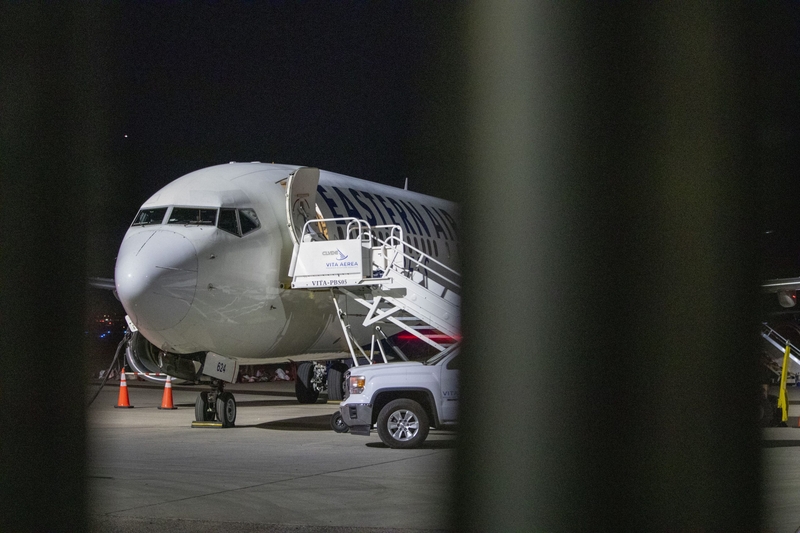
An airplane sits on the tarmac at Mesa Gateway Airport on the evening of April 9, 2026, outside of the Arizona Removal Operations Coordination Center, an ICE facility where detainees are temporarily housed before they are put on a plane to either be deported or moved to a different ICE facility. (Photo by Jerod MacDonald-Evoy/Arizona Mirror)
WASHINGTON — A federal appeals court Friday struck down the Trump administration’s policy to quickly send noncitizens to countries they are not from, finding that immigrants must have an opportunity to challenge their removal if they fear for their safety.
The decision largely upheld a Boston federal judge’s February ruling that found the Department of Homeland Security's policy unlawful. But the immigration officers can still conduct third-country removals if they follow the proper procedures, such as adequate notice and an opportunity for an immigrant to raise a fear-based claim to that country of removal.
Third-country removals, deportations from the United States to a nation other than an immigrant’s home country, occur when the immigrant’s home country does not accept the person’s repatriation.
Once rare, the procedure has spiked under the second Trump administration that has entered into partnerships with several countries, some with human rights concerns, to take third-country removals from the U.S.
The three-judge panel of the U.S. Court of Appeals for the 1st Circuit also raised doubts that a country that accepts a person that is not their own citizen could “credibly provide blanket assurances that all removed noncitizens will not be persecuted or tortured there unless it intends to provide them with some sort of affirmative protection against rogue agents and non-state actors.”
The panel also upheld the lower court's finding that the notice to a third country was inadequate – about 24 hours – and that the policy was unlawful.
It gives “no notice at all of an impending third-country removal when the country to which the noncitizen is to be removed has provided credible (in the State Department's judgment) diplomatic assurances that noncitizens removed there from the United States will not be persecuted or tortured,” the panel wrote.
The panel included circuit judges Lara E. Montecalvo, Jeffrey R. Howard and Seth R. Aframe. Former President Joe Biden nominated Montecalvo and Aframe. Former President George W. Bush nominated Howard.
The Trump administration in May 2025 made an emergency request to the Supreme Court after U.S. District Judge Brian Murphy blocked the policy. The Supreme Court in June 2025 temporarily allowed for the removals, before sending it back to the lower court.
Murphy again in February issued an order that blocked the policy and required DHS to carry out the statutory obligations of proper notice of removal to a third country and to give a noncitizen enough time to raise any concerns for their safety to their removal to a third country.
The Trump administration later appealed to the First Circuit, and could appeal again to the Supreme Court.
DHS did not respond to States Newsroom’s request for comment Friday.
All States Newsroom content is free to republish. Read our republishing policy for more information.