Administration asks US Supreme Court to uphold sweeping Trump order restricting vote-by-mail
Description
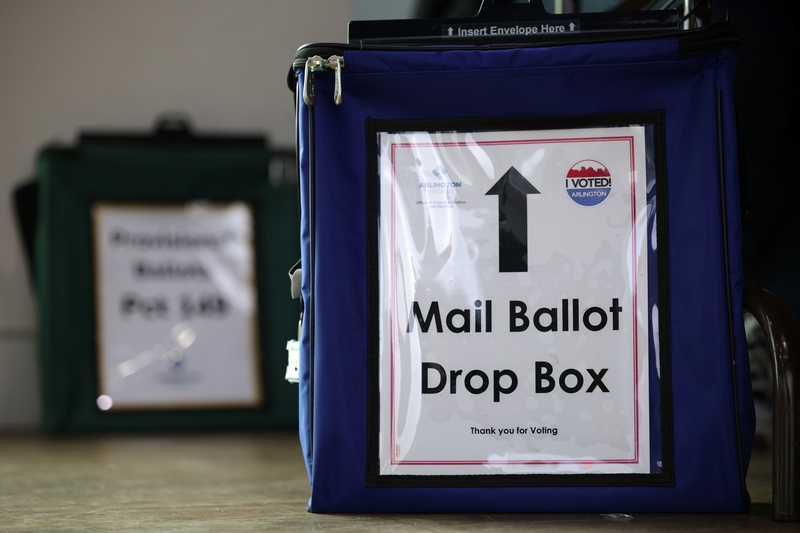
A mail ballot drop box is seen at a polling station on Nov. 4, 2025 in Arlington, Virginia. (Photo by Alex Wong/Getty Images)
The Trump administration on Monday asked the U.S. Supreme Court to halt a district court ruling that blocked President Donald Trump’s broad March 31 executive order restricting vote-by-mail.
The move came just two days after a federal appeals court denied the administration’s request to resume the controversial plan, which would force significant limits and voter information collection requirements on states in regard to vote-by-mail.
It also sets up a high-stakes confrontation at the high court between the administration and the 23 states that sued over the Trump order, a little more than three months before the midterm elections that will determine control of Congress.
“The district court has issued an extraordinary injunction barring federal agencies from implementing an Executive Order promoting election integrity in the upcoming federal elections in November,” wrote Solicitor General D. John Sauer in his petition to the high court.
Sauer argued the executive order should not be blocked because, among other things, the U.S. Postal Service has not yet come up with a final rule on how it would be implemented.
Appeals court ruling
A three-judge panel of the 1st U.S. Circuit Court of Appeals agreed with a lower court ruling last month that blocked the order because the U.S. Constitution grants states — not the president — authority to administer elections.
The executive order “directs unprecedented levels of involvement by federal officials in how states administer elections,” two appeals judges, Gustavo A. Gelpí and Julie Rikelman, wrote in a Saturday order. Both were appointed by President Joe Biden.
Gelpí and Rikelman considered and rejected the administration’s argument that states could not challenge the order because the Postal Service rule was not finalized.
The order directed the agency’s final rule to contain a requirement that states start submitting citizenship rosters 60 days from the general election, which is Sept. 4 this year. Allowing the order to go into effect would force states, which have been preparing for the election for months, to use considerable time and funding to create a new election system in mere weeks.
“The Government has failed to convince us that the impact of the (executive order) on the Plaintiff States is ‘hypothetical,’” Gelpí and Rikelman wrote.
The panel’s third judge, Joshua D. Dunlap, concurred in part and dissented in part, noting that the Postal Service rule mandated by the executive order had not been finalized. The timeline suggested by the order, though, would have required states to take immediate action related to mail ballots, he added.
Consequences for states
Time is running out for Trump’s administration to successfully place the restrictions on vote-by-mail before November’s midterm elections 99 days from Monday.
The 1st Circuit panel pointed to the approaching midterms as a reason to block the order for now. A full analysis of the executive order could be considered on a longer timeline, but state election officials faced imminent consequences if they did not begin preparing for the order’s requirements in time for the November general election and September primaries, the judges found.
The order directed the U.S. Postal Service to require states to notify the agency 90 days before an election if they plan to use mail-in ballots and, if so, to send the federal government a list of eligible voters at least two months before the election and before sending ballots to those voters.
Democratic officials in 23 states — California, Massachusetts, Nevada, Washington, Arizona, Colorado, Connecticut, Delaware, Illinois, Maine, Maryland, Michigan, Minnesota, New Jersey, New Mexico, New York, North Carolina, Oregon, Rhode Island, Vermont, Virginia, Wisconsin and Pennsylvania — and the District of Columbia brought the suit challenging the executive order.
Twelve states with Republican attorneys general — Alabama, Missouri, Florida, Indiana, Kansas, Louisiana, Montana, Nebraska, Oklahoma, South Carolina, South Dakota and Texas — joined the appeal on the federal government’s side.
Citizenship lists
The executive order also required the Department of Homeland Security, with help from the Social Security Administration, to compile lists of voting-age citizens living in each state, and then provide that information to state officials at least 60 days before each federal election.
The list of citizens would be drawn from naturalization and Social Security records, according to the order. It would also include data from SAVE, a powerful computer program maintained by Homeland Security that verifies citizenship by checking names against information in federal databases.
The district court judge, Indira Talwani, said the executive order did not cite relevant constitutional or legal authority to support the creation of the lists.
Trump erodes faith in mail ballots
Trump has consistently raised unfounded concerns about mail-in voting, which nearly every state allows and some use exclusively.
The practice, especially common in Western states, enjoyed strong bipartisan support until Trump sought to undermine its credibility during the 2020 election cycle.
In 2018, the Pew Research Center found 71% of voters, including 57% of Republicans, supported vote-by-mail.
By the time of an April 2026 poll, Democrats’ favorable opinion of vote-by-mail remained high, but Republican support cratered to 34%.
In the executive order, Trump said restricting mail-in voting would limit voting by noncitizens, another voting issue Trump has often raised without offering evidence it has created a significant integrity problem in any election.
All States Newsroom content is free to republish. Read our republishing policy for more information.