Top Republicans embrace anti-trans measure as a wedge in November races
Aug 10, 2026 | 10:21 pm ET

Description
(Photo by Bruce BennettGetty Images)
The Republican candidates hoping to flip Arizona’s top three statewide positions in November are lining up behind an anti-trans ballot measure that critics say will force schools to police bathrooms and locker rooms.
Proposition 318, which GOP lawmakers named the “Protect Girls Sports in Arizona,” threatens schools and athletic associations with lawsuits if trans girls are allowed to join a team designated for girls.
Arizona law already forbids transgender girls from joining school sports teams consistent with their gender identity, but the new proposal would extend the prohibition to private youth recreational organizations like Little League Baseball.
It would also require schools and athletic associations to ensure that bathrooms, locker rooms, shower rooms and other “private spaces” aren’t used by people of the opposite biological sex, which opponents argue will lead to intrusive enforcement policies. The school facilities separated by biological sex are restricted if they’re “integral to athletic engagement,” which pulls in facilities used by athletic teams and even affects members of the public who visit during sports events. Critics say the language may even be used to apply the rule to all of a school’s bathrooms.
While proponents of Prop. 318 argue that allowing trans girls to play on girls athletics teams will result in cisgender girls missing out on opportunities, LGBTQ advocates say it’s creating a solution for a problem that doesn’t exist. Between 2017 and 2022, when Arizona’s trans athletic ban was passed, the Arizona Interscholastics Association approved just 16 applications from transgender students to play on teams consistent with their gender identity. About half of those appeals were from trans girls. The AIA oversees more than 170,000 student athletes across the state.
Republicans across the country have advanced anti-trans proposals to rile up voters and recruit their support for key races. November will be the first time the political strategy is tested in Arizona.
While it’s still too early to tell if the controversial proposal will draw voters to the polls, previous research on the issue suggests a majority of voters in the Grand Canyon State would approve of the ballot measure. In 2023, a joint survey conducted in partnership with Arizona State University, Stanford University and the University of Houston found that 63% of voters in Arizona disagreed with trans participation in women’s sports and 54% opposed trans people using bathrooms that align with their gender identity.
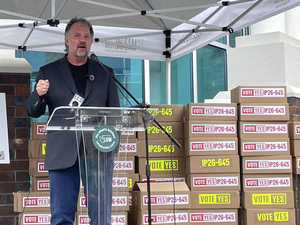
During a Monday news conference promoting the ballot measure, Republican nominees for governor, secretary of state and attorney general announced their full-throated support of the proposal, highlighting the public perception of the topic.
“This is an 80-20 issue,” said U.S. Rep. Andy Biggs, who is running to unseat Gov. Katie Hobbs.
“The Democrat delegation is completely out of touch on this issue,” echoed Gilbert Republican Warren Petersen, who is aiming to convince voters to award him the attorney general’s office.
“It’s a very commonsense idea that almost everybody outside of politics can agree on,” said state Rep. Alex Kolodin, the Republican nominee for secretary of state.
Biggs and Petersen both face contests in a state where the Democratic incumbents won four years ago by narrow margins. In 2022, Kris Mayes was elected attorney general by a mere 280 votes, while Hobbs won by just over a percentage point. In a bid to set themselves apart from their Democratic rivals, Biggs and Petersen sought to label them as unfit to lead because of their unwillingness to restrict trans girls from playing sports.
Biggs lamented the need to go to voters in November to enshrine the provisions in Prop. 318 into state law, saying that Hobbs had the opportunity to do so more easily but failed. Hobbs has consistently vetoed anti-LGBTQ legislation sent to her by the Republican-majority legislature, including several bills that would have barred trans students from using school facilities consistent with their gender identity.
A large part of the reason Republicans crafted Prop. 318 was to circumvent that veto power.
“She puts in jeopardy the opportunity for fair competitive athletics for women and it’s really astounding,” Biggs said.
The existing law that forbids trans girls from participating in school sports in a way that reflects who they are was passed before Hobbs was elected. Since then, Republicans have not pushed legislation to further restrict trans athletes that Hobbs could weigh in on, instead focusing on the use of school facilities.
Petersen similarly criticized Mayes over her refusal to defend Arizona’s trans athletic ban, saying it amounts to supporting “men playing in women’s sports.” In 2023, two trans girls filed a lawsuit against the law that prevented them from playing with their cisgender peers. Mayes, who is charged with defending the laws passed by lawmakers, declined to do so. Petersen, along with then Speaker of the Arizona House of Representatives Ben Toma, took up the challenge instead.
During her tenure, Mayes has also refused to go to bat for other state laws, most notably those that restrict abortion care, including a Civil War-era law that outlawed virtually all abortions and a ban on abortions performed after 15 weeks of pregnancy. Petersen, who fought to preserve those laws, too, has frequently pointed to Mayes’ decisions not to back them as proof that she shouldn’t be given another four year term.
But Delaney Corcoran, Mayes’ campaign manager, dismissed Petersen’s criticisms of the Democrat’s choice to step back from the lawsuit against Arizona’s trans athletic ban as nothing more than an attempt to deflect from the problems voters actually care about.
“These attacks are designed to divide and distract Arizonans from the issues that matter most to Arizonans and their families,” she said.
Petersen called on voters to support Prop. 318, touting it as a long-term solution to trans sports participation that can’t be undone by future legislatures. Democrats have for years tried to flip control of the state legislature, without success. The party hopes voter discontent with the Trump administration will yield a different result in November.
But if voters approve Prop. 318, even a Democratic majority won’t be able to walk its provisions back unless the party wins a supermajority. That’s because the Arizona Constitution requires a three-fourths supermajority vote before lawmakers make any change to a measure passed by voters. And that change must advance the measure’s original intent, ruling out any attempt to replace Prop. 318’s provisions with trans-inclusive policies. That could only be done by sending the question directly to the voters.
Campaigns heat up
Before voters have a chance to weigh in on what the future looks like for trans students and athletes, political campaigns aiming to persuade Arizonans on how to cast their ballots are beginning to make their pitches to voters.
The Protect Girls Sports in Arizona is heading a “Yes on 318” campaign. Its website includes a webpage entitled “rational voices” with quotes on opposition to trans athletic participation from figures like Bill Maher, Caitlin Jenner and Meghan McCain. The committee also released an ad on Monday, posted onto its website and YouTube, that spotlights a viral video clip of a Massachusetts girls’ basketball game in which an allegedly trans player can be seen shoving down an opponent while wrestling the ball away.
“Vote yes on Prop. 318 to protect girls’ sports and female spaces from those ‘pretending’ to be someone they’re not,” says a voice over as the video plays.
When the Massachusetts girls’ basketball video went viral in 2024, opponents of trans sports participation seized on it to justify discriminatory policies. LGBTQ advocates responded by noting that one athlete’s poor sportsmanship should not be used to villainize an entire group.
On the same day that the ad was published, supporters of the Arizona ballot measure sent a letter to Fontes alleging that a new website advocating against Prop. 318 has violated state election laws and should be referred to the state attorney general for legal action.
The website shares a near-identical logo and color scheme with the pro-Prop. 318 campaign and also closely mimics its url: The anti-Prop. 318 site has the URL protectgirlssportsaz.vote, while the pro-Prop. 318 site uses protectgirlssportsinaz.vote. GOP election attorney Timothy La Sota, a campaign chairman for Yes on 318, wrote in his complaint to Fontes that the anti-Prop 318 campaign is defrauding voters. Under state law, intentionally misleading voters is punished with a class 5 felony.
“This group is also making the ridiculous claim that a ‘NO’ vote protects girls’ sports in Arizona,” LaSota wrote. “It is a clear attempt to trick and defraud voters into voting against Proposition 318.”
LaSota also pointed out that the website has no information about which groups are funding it and does not have a required statement disclosing who paid for the website, raising questions about campaign finance violations because no campaign finance reports have been filed on behalf of an associated political action committee, either.
Despite vocal criticisms of the website on Monday, however, Republicans expressed a lack of confidence that state leaders would take action.
“(Mayes) has been incessantly not defending our laws, so it’s hard to have any faith in this,” Petersen said.
Phoenix, AZ