A tie for the Glocester School Committee highlights a shortcoming in state law
Nov 25, 2026 | 2:42 pm ET

Description
Glocester School Committee candidates Sheri Lynn Chandler, left, and Gary King, right, tied for the third and final open seat on the school board following a recount and reconsideration of an additional ballot by the Rhode Island Board of Elections Tuesday. (Courtesy photos)
Every vote counts. Unless there’s a tie.
Two Glocester School Committee candidates received the exact same number of votes in the Nov. 3 election after a recount and final certification by the Rhode Island Board of Elections Tuesday. The board’s 5-0 vote to accept a previously disqualified extra ballot created a tie between candidates Gary King and Sheri Lynn Chandler for the third and final open seat on the nonpartisan, six-member school board.
Now it’s up to Glocester Town Council to fill the seat by a majority vote within 30 days, according to the town charter.
How and when the council will choose is still undetermined, as town officials await guidance from Town Solicitor Dave Igliozzi. Igliozzi said Wednesday morning he needed to review the town charter before contacting council members.
But what would have happened if the tie had been in a state legislative race?
Rhode Island’s expansive election law never addresses how to break a tie in a state legislative race, according to John Marion, executive director of Common Cause Rhode Island.
“This is something I’ve known was going to happen for a long time, and we need to be better prepared for,” Marion said in an interview Tuesday. “When incidents like this happen, a window opens to do some policymaking.”
Secretary of State Gregg Amore’s office offered a different interpretation in an email to Rhode Island Current Wednesday.
Even though there is nothing in state law that explicitly mentions a tie, there is a section on what happens when there is a “failure to elect” state officeholders and legislators. If there is no state general officer elected, including if no candidate gets a plurality of election votes, the Rhode Island General Assembly chooses between the top two vote-getters. In the case of no election for a state legislative seat, there is a new election
Marion said the absence of an election, as stated in the law, is not the same as a tie and stressed the need for further clarity.
From coin tosses to card flips, runoff elections or new elections altogether, the intrigue and excitement of settling an election tie has attracted attention in local and state races nationwide. Yet neither Marion nor the Rhode Island Board of Elections could recall any previous examples of a tied race in Rhode Island.
Despite the extraordinary chain of events that led to the deadlock, King was calm and nonchalant when contacted by Rhode Island Current Tuesday night.
“I guess we’ll see,” he said.
King, a 55-year-old millwright and welder, previously served one term on the Glocester School Committee, from 2003 to 2007. His now-adult sons both attended town and regional public schools.
His comeback bid came from his frustration over the regional school district’s handling of a former Ponaganset High School teacher accused of having an inappropriate relationship with a student. The teacher was indicted on two counts of third-degree sexual assault following an investigation by the Rhode Island State Police and Attorney General’s office. The incident also spurred an independent investigation by the regional school committee — which includes all the members of the Glocester school board –- along with staff training and other policy changes.
“I don’t tolerate that behavior,” King said of the former teacher. He also criticized the school committee for “overspending” on various budget items.
Chandler, a first-time candidate with two children still in the public school system, also emphasized student safety and fiscal responsibility in an interview with The Valley Breeze.
Chandler did not attend Tuesday night’s election board meeting due to a scheduling conflict. In a statement to Rhode Island Current Wednesday morning, she thanked the voters who supported her and other school committee candidates.
“A tie shows how deeply our community cares about our schools,” she said. “As election officials work to resolve this properly, my focus remains on fully supporting students and schools, keeping communication clear for families and taxpayers, and asking critical questions to analyze options before making informed, sound decisions.”
No hesitation
In the initial tally of Nov. 3 election results, Chandler led King by two votes for the third-place spot on the school committee.
King requested and was granted a recount by the Rhode Island Board of Elections. After refeeding every ballot into the tabulating machines on Nov. 13, he was still one vote behind Chandler.
Recounts are open to the public. King observed and identified a single ballot that went initially uncounted, though he thought it should be counted. The ballot, cast at Ponaganset High School during the 20-day early voting period, was rejected because the voter appeared to select four of the seven school committee candidates, when the maximum choice allowed was three.
One of the four ovals was only partially filled in. The other three — including the one in front of King’s name — were completely darkened.
The ballot-counting machine initially flagged the submission as an overvote, but the error was overridden, meaning the voter chose to not alter their choices when they had the chance. As a result, the voter’s school committee picks were left out of the initial results, and the recount.
King contended the fourth selection counted as a “hesitation mark” under the state elections board’s voter intent guide, meaning it was not an actual selection, and that the ballot should count based on the voter’s selection of the three other candidates.
“I believe this board will see it the same way,” he said in an interview before the election board’s meeting.
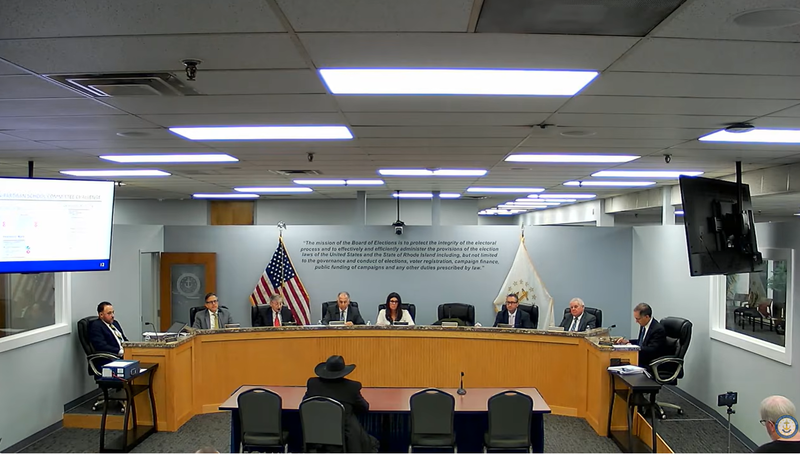
They did. Following a brief discussion and review of the rest of the ballot in question, the board voted unanimously to accept the previously uncounted ballot, putting King and Chandler in a deadlock at 1,293 votes apiece.
This is something I’ve known was going to happen for a long time, and we need to be better prepared for. When incidents like this happen, a window opens to do some policymaking.
The elections board certified all results, including in the school committee race, at the same meeting, leaving it up to the Republican town council to break the tie.
Rhode Island Current contacted all five members of the council. Councilor Jonathan Burlingame, a former school committee chair before he won a seat on the council in 2022, remained noncommittal. He knew King, but not Chandler, and said he wanted to learn more about both candidates’ views before making a decision.
“It’s definitely an important position, where a lot of our money is put forth in the town,” he said of the seat. “They control a good 50% of our taxes.”
The other four council members had not responded as of early Wednesday afternoon.
In search of solutions
Inspired by the Glocester case, Marion is looking ahead to the start of the 2027 legislative session in January to advocate for changes to state elections law.
In local races, he said, it makes sense for municipal officials to determine the winner in the event of a tie. But enshrining that practice in state law would be a good idea, he concluded.
As for statewide races that end in a tie, Marion suggested something that gives both candidates an equal chance. At least 28 states use random methods like drawing lots or dice rolls, while another 12 hold runoff elections, according to the National Conference of State Legislatures.
The cost and historically low turnout associated with runoff elections make them problematic, Marion said.
Miguel Nunez, executive director for the elections board, deferred to the election board’s legislative subcommittee to review and make recommendations on potential policy changes.
Marion’s legislative to-do list includes setting more comprehensive guidelines for how to determine voter intent on ballots like the one King brought forward.
The elections board currently relies on a single-page ballot interpretation guide, developed by Common Cause in 2022 as part of its input on the state’s risk-limiting audit, a biennial post-election review to confirm accuracy of ballot tabulator machines.
But the guide offers few examples of overvotes, undervotes, stray marks and other scenarios where a voter’s choices on the ballot might be open to interpretation.
“We need to develop regulations for voter intent before this becomes a bigger controversy,” Marion said.
He hoped to incorporate a better detailed voter intent guide into forthcoming legislation enshrining federal protections against voter suppression into state law.
A Rhode Island Voting Rights Act was introduced during the 2026 session but failed to advance out of committee in either chamber, despite strong support from good government advocates. At the time, advocates pledged to reintroduce the bill in 2027, with the intent of passing protections before the 2028 election cycle.
Louis DeSimone Jr., vice president of the election board, abstained from the vote on whether to include the additional ballot in the Glocester School Committee race because he participated in the original audit determination to reject it.
Election board member Marcela Betancur did not attend the meeting.

Providence, RI