Battleground poll reinforces what Lawrence heard from voters about healthcare
Nov 25, 2026 | 12:58 pm ET

Description
Democratic Congressional candidate William Lawrence announces his final push to mobilize voters as he stands outside of U.S. Rep. Tom Barrett's (R-Charlotte) former office in Lansing on Oct. 27, 2026. (Photo by Kyle Davidson/Michigan Advance)
Beginning in January, Democrats will hold majorities in both the U.S. House and Senate, taking power back from Republicans as voter frustrations over everyday costs resulted in a nationwide rebuke of President Donald Trump and Republican policies.
While inflation and prices were a top issue for voters, polling from Hart Research commissioned by the advocacy group Protect Our Care and the Service Employees International Union, found that frustrations around healthcare helped deliver wins for Democrats in battleground districts across the country.
Between Nov. 4 and Nov. 8, Hart Research surveyed 1,230 voters from 59 congressional battleground districts. Survey results found that healthcare was a “very important” factor in deciding 71% of participants’ votes.
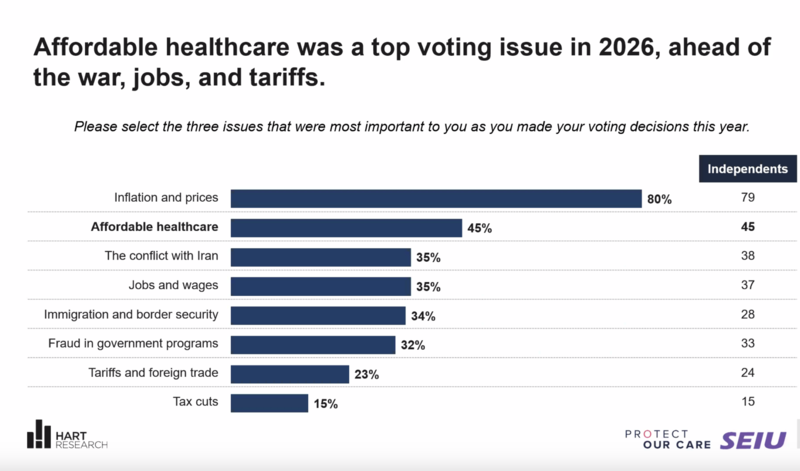
When voters were asked to rank their top issues, healthcare ranked second only to inflation and prices, polling above concerns around the war in Iran and jobs and wages.
On a press call discussing the survey’s findings, U.S. Rep.-elect William Lawrence (D-Lansing) who ousted U.S. Rep. Tom Barrett (R-Charlotte) in Michigan’s 7th Congressional District, said the polling data tracked with what he heard on the campaign trail.
“We talked to tens of thousands of voters and we heard again and again that healthcare is simply unaffordable, unreliable and it creates this cloud of anxiety over people’s lives,” Lawrence said. “Even those who have high-quality coverage now have no confidence that they’re going to be able to keep that coverage in the future, or that it will remain affordable because of how much volatility there has been in the healthcare markets and how Republicans have made this a political football that they seek to cut at every opportunity.”
Guy Molyneux, a partner at Hart Research, explained that while Democrats held a modest 6% advantage among the voters they polled, with 52% voting for Democrats and 46% voting for Republicans, voters who rated healthcare as their top issue overwhelmingly voted for Democratic candidates.
Additionally, when voters were presented with a list of policy actions Republicans and President Donald Trump had taken in recent years, the three items that voters largely rated as a reason to vote against Republicans in Congress were all tied to healthcare.
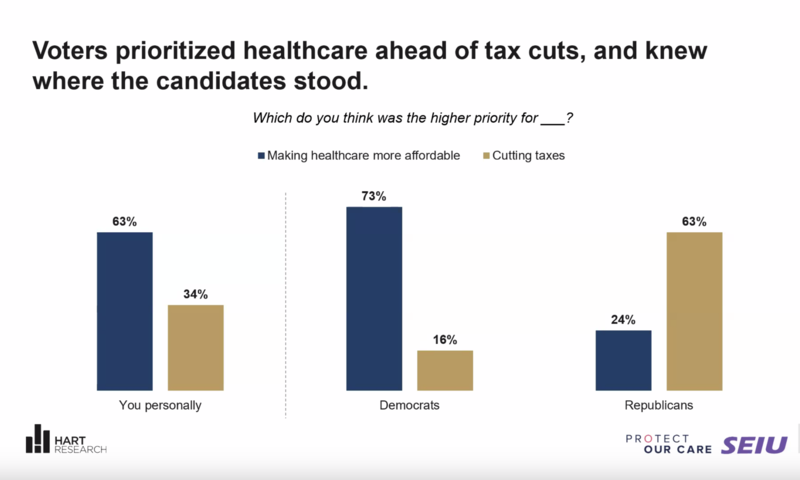
The poll also asked voters which issue was a higher priority, healthcare or lowering taxes – a major theme in Republican campaigns. Sixty-three percent of voters rated healthcare as their personal priority, while 34% said cutting taxes was more important.
When asked which issue was of higher priority to each party, a broad majority of voters said healthcare was more of a focus for Democrats, while Republicans were more concerned with cutting taxes.
Looking ahead to what voters want from their elected officials, 83% of voters said it was important for Congress to take action on the cost of healthcare.
While 95% of Democrats surveyed said they’d like to see Congress act on healthcare costs, Molyneux noted that this issue was also vital to most Republicans, with 71% saying Congress should take action.
As for what Congress should do specifically, the survey presented voters with six issues that Democratic candidates and party leadership have identified as possible priorities for the caucus.
Each proposal drew support from at least two-thirds of the voters surveyed, with participants showing particularly strong support for capping insulin costs at $35, adopting reforms to bar insurance companies from overriding decisions made between doctor and patient and restoring funding to local hospitals.
While survey data showed voters trusted Democrats far more than Republicans to deliver on affordable healthcare, the survey also found that voters were more concerned with Republicans blocking solutions than Democratic overreach.
Forty-eight percent of voters said they were concerned about congressional Republicans or the president impeding efforts to make healthcare more affordable while 34% worried that Democrats would go too far in imposing government-run healthcare.
Lawrence also noted that healthcare costs have put the squeeze on small business owners who provide healthcare to their employees, placing them in a situation of having to choose to either cover these rising costs or pass them on to their employees.
Additionally, 23 Michigan health facilities have announced cuts, closed, or are at risk of closure, Lawrence said, while noting that care itself is becoming less available.
Upon joining his Democratic colleagues on Jan. 3, Lawrence said he looked forward to undoing Republican cuts to the Affordable Care Act and Medicaid, “and doing so immediately before those cuts begin to bite deeper.”
From there, Democrats need to work toward expanding healthcare access and increasing affordability, working down the road to universal and guaranteed healthcare, Lawrence said.
Gabriella Jones-Casey, an executive vice president for SEIU Healthcare Michigan stressed that the voters gave members of Congress a mandate to put people first, and deliver affordable healthcare.
“We are not asking. We are not begging. We are not pleading,” Jones-Casey said. “We voted for those who committed to improving care for our families in our communities, and we will not back down. Lawmakers must put care ahead of corporate tax breaks and strengthen the care that allows Michiganders to be healthy and to thrive.”
Lansing, MI