Supporters of Colorado’s graduated income tax measure declare victory
Nov 05, 2026 | 6:41 pm ET
Description
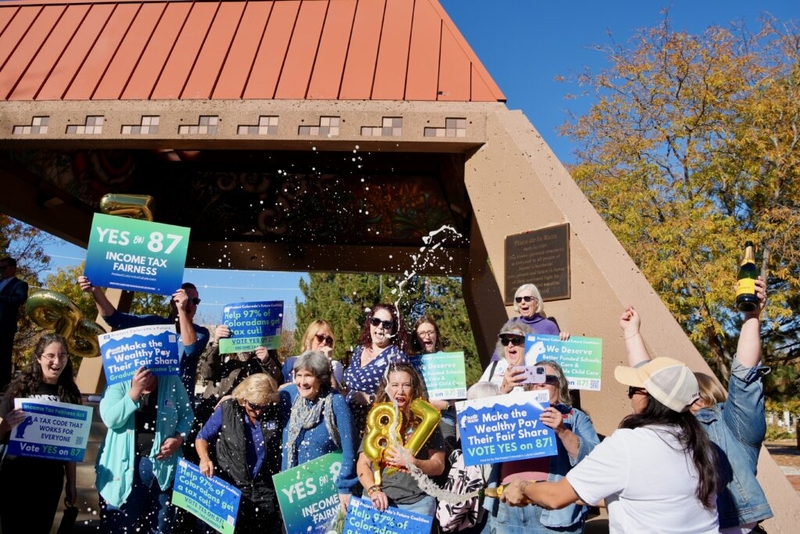
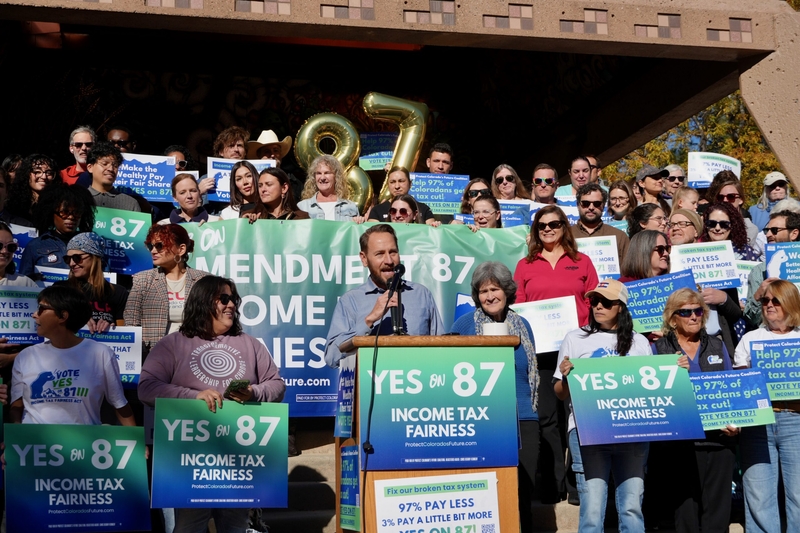
Supporters of Amendment 87, a graduated income tax measure, celebrated in Denver's La Raza Park on Thursday, as election results showed the measure on track to be narrowly approved by voters. (Photo by Chase Woodruff/Colorado Newsline)
With their narrow lead holding steady with an estimated 90% of the statewide vote counted, proponents of a ballot measure to establish a graduated income tax system in Colorado declared victory on Thursday, heralding the most seismic shift in state fiscal policy in decades.
Amendment 87 would remove the Colorado constitution’s flat-tax requirement and establish a tiered system under which higher earners pay higher marginal income tax rates. With more than 2.4 million ballots counted as of 4 p.m. Thursday, the measure’s lead stood at 1.5 percentage points, a slight increase since late on election night, and many of the ballots remaining to be counted are in populous Front Range counties where the measure has been running ahead.
Unlike other constitutional amendments on the ballot this year, because it only repeals, and does not add, constitutional language, it needs only a simple majority to pass. Its tiered income tax structure would be added to state statute.
“This is a huge day for Colorado,” said Chris deGruy Kennedy, president of the liberal Bell Policy Center and one of the leaders of the campaign in support of the measure. “It’s a signal by voters that we are fundamentally changing the direction of how we are going to make sure Colorado’s economy supports every hardworking person, every older adult, every child and everyone in between.”
Supporters of the Protect Colorado’s Future Coalition, who included many progressive lawmakers at the state Capitol, said the new revenue will put an end to years of painful cuts, including those forced on the state by President Donald Trump and congressional Republicans’ 2025 package of tax and spending cuts. Kathy White said the GOP-backed law had delivered a “body blow to our state budget.”
“We are looking at next year cutting $600 million out of Medicaid alone,” said White, speaking at a press conference held by proponents at Denver’s La Raza Park. “We have a $1.6 billion budget deficit, on the back of a $1 billion budget deficit last year, and the year before that. And that stops today.”
Sweeping set of changes
Amendment 87 proposes to hike corporate and individual income tax rates to 7.4% for income above $500,000 and gradually increase the rate to 8.4% for income above $1 million. Those higher rates would apply to the top 3% of earners, while the 97% of Coloradans who earn less than $500,000 per year would see a slight income tax reduction. A fiscal analysis by nonpartisan state legislative staff estimated that the measure would raise $2 billion in additional revenue for the state by the 2027-28 fiscal year.
Together with Proposition NN — a measure also approved by voters this year to raise the annual revenue growth cap established by the state constitution’s Taxpayer’s Bill of Rights — Amendment 87 marks the most sweeping set of changes to Colorado tax policy since voters passed TABOR in 1992.
In the decades since, advocates for public education, healthcare and other social spending programs have struggled to surmount TABOR’s strict anti-tax requirements, including its revenue cap and its requirement that all tax increases be approved at the ballot box. Two previous attempts to pass a progressive income tax, 2013’s Amendment 66 and 2018’s Amendment 73, were rejected by voters.
Lisa Weil, executive director of advocacy group Great Education Colorado, was involved in both efforts, and said Thursday that Amendment 87 will allow Colorado to “turn the page” on an era of scarce public funding. She applauded the years of organizing that preceded Protect Colorado’s Future Coalition’s victory.
“It may look like stars aligned, and suddenly this happened in Colorado,” Weil said. “That is not how it works. Stars do not align by themselves — it requires shoving. And there are some incredible star-shovers in this group.”
Conservative opposition
To win, proponents of Amendment 87 needed to overcome a powerful, deep-pocketed network of Colorado conservative policy advocates, who have increasingly prized TABOR and the ballot initiative process as one of their last remaining checks on a state government dominated over the last decade by Democrats.
Led by Advance Colorado, a “dark money” nonprofit that does not disclose its donors, opponents sought to block Amendment 87 at every possible stage, including challenging it at the state’s Title Board and suing the secretary of state to remove the amendment from the ballot in a case that was decided just days before Election Day.
Conservative groups spent millions on an opposition campaign that blasted Amendment 87 and Proposition NN as multibillion-dollar “blank checks” for state government, and spread the false claim — repeated by Democratic Gov. Jared Polis, who also opposed the measure — that Amendment 87 would eliminate deductions for Social Security income and other state tax breaks.
Finally, Advance Colorado backed a countermeasure, Proposition 136, which aimed to block Amendment 87 by capping income tax rates at their current level of 4.4%. The measure was on track Thursday to lose by a 5-point margin.
Advance Colorado didn’t respond to a request for comment.
“Whenever we organize, we turn out. Whenever we turn out, we win,” said Christina Soliz, executive director of New Era Colorado and another campaign co-chair. “The volunteers, the organizations who were part of this, who were on the ground since Day 1, making sure this was a truly people-powered measure, deserve this win today.”
The Protect Colorado’s Future Coalition relied on a combination of volunteers and paid canvassers to collect the signatures necessary to qualify a constitutional amendment for the ballot, including signatures equal to 2% of the registered voters in each of Colorado’s 35 state Senate districts. As of Oct. 28, the campaign had reported $3 million in contributions from donors including the Bell Policy Center, the Colorado Fiscal Institute and philanthropist Merle Chambers.
Unlike amendments 66 and 73, this year’s progressive income tax campaign did not receive support from the Colorado Education Association, which instead backed Proposition NN, referred to the ballot by Democratic majorities in the Legislature. Proposition NN was on track Thursday to pass by a nearly 12-point margin after a $10 million campaign overwhelmingly funded by teachers unions.
In addition to Polis, Democratic Gov.-elect Phil Weiser announced last week that he opposed Amendment 87, adding that if it passed, he “will implement it effectively.” Both Polis and Weiser backed Proposition NN.
State Rep. Lorena Garcia, a Democrat from Westminster and director of the Colorado Statewide Parent Coalition, alluded to the doubts the campaign faced throughout the process as she addressed the dozens of supporters and volunteers on hand for Thursday’s victory celebration.
“When they said, ‘Not this year,’ what did we say? We said, ‘Yes, this year.’ When they said, ‘You’re gonna get in the way of other things,’ we said, ‘No, we are adding to it,'” Garcia said. “When they said, ‘OK, you barely got it on the ballot. Now how are you going to win?’ Like this. It’s with people.”
Denver, CO