Three constitutional amendments on Wisconsin ballots this fall
Sep 28, 2026 | 4:45 am ET

Description
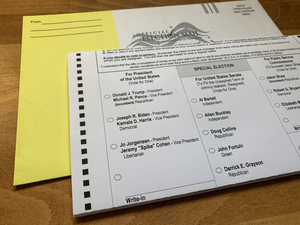
Boxes of ballots wait to be counted at Milwaukee's central count on Election Day 2024. (Photo by Henry Redman/Wisconsin Examiner)
Wisconsin voters will decide if three proposed constitutional amendments should be enacted when they head to the polls this fall — marking 15 times Republican lawmakers have put potential amendments to voters during the two terms of Gov. Tony Evers.
Voters have approved seven of the previous 12 proposed amendments. Republicans have said they continue to use the amendment process to make policy changes while avoiding Evers’ veto pen.
“There are lots of things that I would do that Tony Evers would have vetoed. There are very few things that I would bring as a constitutional amendment to try to get around that,” Rep. Dave Murphy (R- Hortonville) told Wisconsin Watch. “I’m glad that I can take this to the people for a signing rather than to Gov. Evers because I think the people will support this, but I think he maybe would have vetoed it.”
But opponents say that these Republican end runs around the governor’s office are a misuse of the amendment process that flout good governance ideas and that the language of the amendments is intentionally designed to confuse voters.
“Right, wrong or indifferent, saying to the people that you want their voices in these ‘important’ decisions is — that sells pretty well, but it’s not the job of the Legislature,” Debra Cronmiller, executive director of the League of Women Voters of Wisconsin, told the Wisconsin Examiner, who is critical of state legislators for trying to legislate by constitutional amendment instead of using the regular lawmaking process.
Voters, unlike state lawmakers, cannot propose amendments to the Wisconsin Constitution and get them onto the ballot, as voters have done in other states. Wisconsin’s process to amend the state constitution requires that voters decide on the proposed amendment after the language is set and the proposal is passed as a resolution in two consecutive sessions of the Legislature.
“Putting anything in the constitution just makes it more difficult to undo,” Cronmiller said.
On the ballot this year are proposed amendments to ban state and local governments from enacting diversity, equity and inclusion policies; limit the governor’s use of the partial veto to raise taxes and fees and prohibit the closure of places of worship during public health emergencies.
Democratic gubernatorial candidate David Crowley has expressed his opposition to all three proposed amendments while Republican candidate Tom Tiffany has said he supports them all.
Anti-Equity
The anti-equity program amendment will appear on voter’s ballots asking if “section 27 article 1 of the constitution be created to prohibit governmental entities in the state from discriminating against, or granting preferential treatment to, any individual or group on the basis of race, sex, color, ethnicity, or national origin in public employment, public education, public contracting, or public administration?”
Amanda Merkwae, the policy and advocacy director at the ACLU of Wisconsin, said that the question is written in such a way that most voters would say yes, of course they don’t want the government to discriminate against people.
“I think this question has this misleading language that’s really intended to eliminate opportunity,” Merkwae said. “The text of prohibiting discrimination or preferential treatment, on its face, sounds like of course we’d want to do that, but doesn’t give voters this full picture and understanding that federal and state laws already strictly ban discrimination.”
Merkwae pointed to several federal and state laws that already protect against discrimination, including the Civil Rights Act and the Americans with Disabilities Act, and added that locking the amendment’s language into the state Constitution could severely limit the ability of future lawmakers to address policy problems.
“What the amendment is ultimately designed to do is eliminate proactive programs geared towards equity, like minority and women-owned business recruitment, or targeted workforce development, or retention initiatives in higher education that are designed to ensure that everyone gets a fair shot,” she said. “And by embedding this broad language into the state constitution, it just locks in these rigid restrictions that lawmakers in the future and local communities can’t change, even if you know data shows that there is a deep need in the future.”
Republicans are putting the amendment to voters after years of opposing programs aimed at helping minority groups. Rep. Shae Sortwell (R-Two Rivers) released a report in January highlighting hundreds of thousands of dollars local and county governments have spent to attract diverse pools of employees and provide them with training on equity and inclusion.
Cronmiller said that in the League of Women Voters’ advocacy against the amendment, the group has been pointing to the Sortwell report to show people which programs in their community are likely to be cut if the amendment passes. The League’s messaging on the amendment states that if passed “60 years of progress for women and people of color” will be lost due to the end of programs meant to address disparities in health outcomes, make accommodations for kids struggling in school, support poor families and victims of domestic violence and provide government contracts to diverse pools of businesses.
“This amendment is not prohibiting governmental entity discrimination,” Cronmiller said, adding that the consequences of the amendment could reach further than intended.
“This amendment is eliminating preferential treatment for all sorts of groups that have systemically been disenfranchised, and we’re just trying to even up the score,” she continued. “Women’s health issues, government contracting with minority-owned businesses. So many things could be on the chopping block because they give preferential treatment. I think even government programs like Head Start that targets young people. Well, guess what? Age is a prohibited category. So does Head Start go away? Do programs intended for geriatrics go away? I don’t know.”
Opponents of the bill have also pointed out that the state and federal constitutions already have anti-discrimination provisions. The conservative legal outfit the Wisconsin Institute for Law & Liberty, for example, has in recent years successfully sued on several occasions to end government programs meant to provide aid to specific minority groups.
Murphy, who is not running for reelection, said he wrote the proposal because he wants the government to make decisions about hiring and spending based on merit.
“I’m just very much of a supporter of the idea that when people put government in charge of something, they want it to be the best it can be,” Murphy said. “One of the ways to do that is not to put a bunch of things that get in the way of picking based on merit.”
Partial veto
The proposed amendment to strip the governor of the power to partially veto pieces of the state budget asks voters if the constitution should “be amended to prohibit the governor, in exercising his or her partial veto authority, from creating or increasing or authorizing the creation or increase of any tax or fee?”
Republicans proposed the amendment after Evers used his partial veto power to change the 2023-25 biennial budget to allow schools to raise revenue limits by $325 per pupil per year for the next 400 years.
The Wisconsin Supreme Court affirmed Evers’ authority to make that change, but Republicans have been upset about it ever since. Tiffany, the Republican candidate for governor, has built his campaign in part around reversing what he calls a “400-year property tax increase.”
The amendment to limit executive authority is in line with Wisconsin Republicans’ actions during the 2018 lame duck session to strip powers from Evers and then-incoming Attorney General Josh Kaul.
Wisconsin’s unique partial veto authority has been rolled back a number of times over the state’s history through the courts and the constitutional amendment process. While the Evers 400-year veto is the most recent controversy, former Republican Gov. Scott Walker used the power to extend a one-year moratorium on school referendum requests for energy efficiency projects, transforming it into a 1,000-year moratorium.
With the possibility that the party in control of both the governor’s office and Legislature could change hands this fall, the current amendment is timed for exactly the moment in state politics when it’s unclear which party will benefit from its passage.
Sen. Chris Kapenga (R-Delafield), the author of the resolution, told Wisconsin Watch the goal of the amendment is to protect the separation of powers.
“It’s always about separation of powers,” Kapenga said. “This is a mechanism put in place specifically for this reason, so that if we feel that those other two branches breached their authority in that separation, we say we’re going to go directly to the people and let them make that decision.”
But Cronmiller said the partial veto is a valuable tool for a governor who has been stymied by the Legislature, as Evers has been by Republicans during his nearly eight years in office, and that it shows a lack of long-term thinking to assume a Republican governor will never be in the same position.
“I think that some Republicans right now maybe don’t have the long-term lens on, because this is a moment in time right now where they’re trying to stifle a Democratic governor,” she said. “But if changed and made permanent in the constitution, this is going to impact every governor.”
She added that the Legislature acting to take a power long held by the governor is not good practice, even if people disagree over the specifics of the governor’s veto authority.
“Does the League have a long-standing position on what the veto powers of a governor should be? No,” Cronmiller said. “But the powers of the governor, as defined, should be upheld. So that kind of good government position that we’ve always taken is what compelled us to say vote no on this.”
Places of worship
The third proposed amendment asks voters if “section 18 of article I of the constitution, which deals with religious liberty, be amended to prohibit the state or a political subdivision of the state from ordering the closure of, or forbidding gatherings in, places of worship in response to a state of emergency, including a public health emergency?”
Republicans proposed the amendment after the measures instituted to prevent the spread of COVID-19 included the closure of churches, sparking protests from a wide range of conservative groups.
“Many of us, you know, dedicate our entire lives toward our faith, and in a situation like COVID, there’s a lot of fear, and there’s a lot of uncomfort, and there’s a lot of strangeness, things we’re not used to,” Rep. Ron Tusler (R-Harrison) told Wisconsin Watch. “When we’re in a situation like that, people of faith need their faith at that moment more than ever, and to deprive people of it is a particularly heinous sin that our government shouldn’t commit.”
But opponents of the amendment say that the government needs to be able to respond during a public health emergency.
“In the moment when the governor’s executive order came out, it was like all of us need to do our part to keep those most vulnerable in our communities safe and not prone to catching a disease that could kill them,” Cronmiller said. “So, what is every first directive of public health: prevent disease. You know that’s what public health does, and so I think that conflating disease prevention with the right to worship is completely wrong-minded. No one’s right to worship was compromised during that executive order period. Churches, synagogues, every religious institution figured it out, just like every business did, just like every academic environment did.”
Madison, WI