There’s a contested race for Maine attorney general. The public won’t get a say.
Nov 16, 2026 | 4:40 am ET

Description
Yarmouth attorney Timothy Shannon (left) and Maine Sen. Anne Carney of Cape Elizabeth are vying to be Maine's next attorney general. (Courtesy photo of Tim Shannon; Carney photo by Eesha Pendharkar/Maine Morning Star)
State Sen. Anne Carney and lawyer Timothy Shannon are vying to be Maine’s next attorney general. But unlike the recent midterm election cycle, where candidates worked to win over Mainers’ votes, these candidates’ appeals are being made to state lawmakers.
Maine is an outlier in having the Legislature appoint constitutional officers and state auditors. Most popularly elect their treasurer, secretary of state and attorney general, while states vary more on how they select auditors.
For decades, some lawmakers have proposed changing the selection process, such as allowing the public to decide through a direct popular election, but such attempts have failed, including several last year.
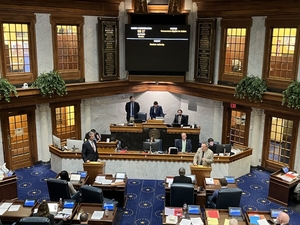
While campaigning happens out of public view, Carney and Shannon — both Democrats — are competing to win over legislators, who will meet on Dec. 2 to get sworn in and select these positions. Democrats now have larger majorities in both chambers after the Nov. 3 election.
The Maine Legislature selects the state’s constitutional officers every two years, the length of the legislative session. Attorney General Aaron Frey, a Democrat, terms out at the end of the year. Meanwhile, Secretary of State Shenna Bellows and State Treasurer Joe Perry have each said they will seek another term and do not currently have any known challengers.
The current term for State Auditor Matt Dunlap does not end until 2029. Dunlap unsuccessfully ran for Maine’s 2nd Congressional District seat this year.
Who will be the next attorney general?
Maine’s attorney general represents the state and its agencies in court and directs investigations into major crimes, among other responsibilities. The contenders competing to replace Frey would each bring vast legal experience to the position, but in different areas.
Carney, a Cape Elizabeth resident, has represented Cumberland County in the upper chamber since 2020, and served one term in Maine’s House of Representatives before that. Prior to her legislative service, Carney practiced employment, civil rights and municipal law at Norman, Hanson & DeTroy, LLC, for 17 years representing both plaintiffs and defendants. She was then an in-house volunteer attorney for Pine Tree Legal Assistance, providing free legal representation to low-income Mainers.
Shannon, who lives in Yarmouth and previously served on the town council, is a trial and appellate lawyer representing high-tech companies, inventors, and patentees in commercial litigation and patent disputes. He’s worked in private practice for 24 years. Shannon has run for attorney general before, during the crowded race in 2018 when Frey was first selected for the role.
“I have been watching the office closely for eight years,” Shannon said. “I think what ultimately nudged me back into running again is I am not satisfied with the state of the law, our state or our country with respect to some fundamental problems.”
Both Shannon and Carney said standing up to President Donald Trump would be a top priority. Frey has been part of a coalition of Democratic attorneys general who have consistently pushed back against the president, participating in lawsuits challenging federal funding freezes and attempts to exert more federal control over elections, among others.
Carney and Shannon would also both make consumer protection a priority. Carney pointed to the millions of dollars leaving the state every year because of financial scams foisted upon Mainers, often those with retirement savings. Shannon said there needs to be guardrails around Artificial Intelligence, comparing it to “lacing drugs with even worse drugs” when it comes to the impact on social media and addictive apps.
They have slightly different perspectives on how they’d tackle these shared concerns.
Most of the lawsuits Maine has waged in recent years have been multi-state litigation. Shannon said those are important, but he thinks the state needs to protect Maine-specific interests with Maine-specific suits.
“That’s a more robust undertaking for the office,” Shannon said. “It’s a bigger lift, but it’s potentially a much bigger reward.”
For example, he pointed to New Mexico’s attorney general who won a historic $25 billion civil penalty against Meta in October after choosing to sue separately rather than joining the multi-state lawsuit that Maine did. Maine received $56 million from that landmark settlement over the summer.
Carney has been responsible for overseeing the budget for the Attorney General’s Office in her capacity as chair of the Legislature’s Judiciary Committee. Having for the past six years been a part of the horseshoe where even small allocations are debated, she said she knows resources are limited.
If chosen, Carney said she would decide whether to join multi-state litigation or bring a case solely on behalf of the state based on “what is most efficient and effective.”
She would also work to improve communications to Maine people and Legislature about the status of cases and how settlement proceeds are being used.
Many of Maine’s constitutional officers have previously served as legislators. That was the case for Frey.
While Shannon pointed to his active practice of law as a plus, Carney sees her legislative service as a benefit, pointing to her work on the Judiciary Committee crafting three recently passed laws to counter Trump’s mass deportation agenda.
As part of the attorney general’s authority to investigate major crimes, Frey is currently investigating the fatal shooting of Biddeford resident Johan Sebastián Durán Guerrero by an immigration agent.
An issue on which both candidates differ from Frey is tribal sovereignty.
Frey bucked some fellow Democrats in his alignment with Gov. Janet Mills, also a Democrat, on not fully restoring sovereignty to the Wabanaki Nations, who are treated more akin to municipalities because of a land settlement agreement decades ago. But Gov.-elect Hannah Pingree plans to do so. Both Carney and Shannon said they support tribal sovereignty, with Carney pointing to her legislative work helping craft several proposals to recognize tribal rights in recent years.
Frey’s tenure also coincided with a constitutional crisis in Maine’s indigent defense system. Recent strides have been made, many of which Carney has spearheaded, including emergency funding in the spring. Still, another funding shortfall is expected.
Shannon said he believes “everyone’s been operating in good faith,” but added, “we need to fund it.”
Carney also pointed to a need for adequate funding, adding that, overall, “the public defense system is a lot more cost efficient for taxpayers than the system we’re transitioning from.”
The process
Revived efforts for Maine voters to elect constitutional officers founder
Under the Maine Constitution, the state Legislature has sole authority to select the attorney general, secretary of state and state treasurer, which were created when the original state constitution took effect in 1820. The attorney general was appointed by the governor until 1856. The Legislature also picks the state auditor, a role created later in 1907.
Back then, the attorney general largely advised lawmakers and the governor on issues that originated and ended in Maine, Shannon said.
“But the AG’s office today, of course, is faced with much bigger, broader, multi-state problems,” he said. “I think if the framers of the constitution had known what was coming, they would have opened up the process to a public vote. But we have the system we have, and the legislators are good people trying to do the right thing.”
While lawmakers on both sides of the aisle have attempted to change the process, they have failed to secure the two-thirds support required for a constitutional amendment, which would also then need to be approved by the majority of Maine voters.
Pointing to that bar, Carney said, “it’s not my decision one way or another,” noting that she’d still run regardless of the selection process. But she also said she sees some strengths in the current system, which relies on one-on-one conversations to win votes and is largely free from the Big Money trying to influence elections.
“I think that in this age of overspending on campaigns, we should evaluate the benefits of our current system before automatically jumping to a different system,” Carney said.
While each of Maine’s 186 members of the Legislature will get to weigh in when formal votes are cast on Dec. 2, it is the majority party that gets to pull the strings.
Democrats have even more power this upcoming 133rd Legislature than the last. Ahead of the formal votes, Democratic lawmakers meet behind closed doors to settle on their nominee.
Augusta, ME