SC colleges can apply to offer new Pell Grants aimed at in-demand trades. So far, none have.
Description
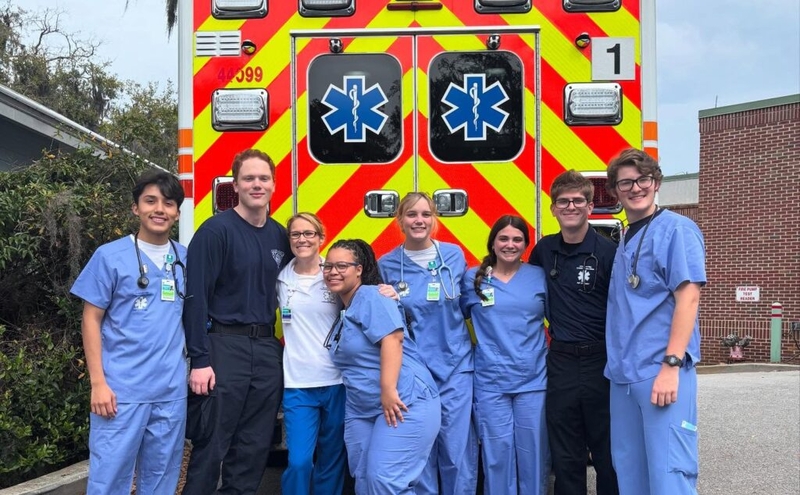
Emergency medical technician students at the Beaufort-Jasper Academy for Career Excellence on their first day of clinicals March 24, 2025. (Photo provided by Beaufort-Jasper Academy for Career Excellence)
COLUMBIA — Nursing and medical assistants, mechanics and commercial truck drivers, welders and construction equipment operators. These are among the South Carolina careers newly eligible for low-income, federal education grants.
But so far, colleges and trade schools in the Palmetto State have yet to seek approval for training programs under the recently expanded Pell Grant program.
The U.S. Department of Education has signed off on 21 programs in six states — Florida, Indiana, Iowa, Nebraska, North Carolina, Texas — since July, under new Workforce Pell grants.
While Pell Grants have existed for a long time, the Trump administration’s hallmark tax cut legislation — the “One, Big, Beautiful” law — opened up the financial aid to non-degree, certification programs as short as eight weeks long.
“Workforce Pell will help more South Carolinians gain the skills they need for good-paying, in-demand jobs without spending years in a traditional classroom,” Gov. Henry McMaster said in a statement in July. “This is a win for our state’s students, institutions of higher education, and employers that will benefit the economy and strengthen our state for years to come.”
Since passage of the bill in July 2025, states and federal education officials have been in a year-long sprint to rollout the effort.
The Congressional Budget Office estimates Congress will spend $1 billion on the program over the next decade and that by 2034, about 100,000 new recipients each year will receive grants of about $2,200 each.
“We have many citizens that don’t have the luxury of two years or four years to acquire the education that’s needed for certain occupations,” said Nina Staggers, executive director of workforce development at the state’s employment agency. “The Workforce Pell program is really targeting those short-term training programs that still lead to high-quality credentials.”
Home health workers, data scientists and cybersecurity projected to be SC’s fastest growing jobs
But colleges and training programs have yet to catch up with the fast-tracked implementation.
Final federal rules were not released until May 18. South Carolina’s employment agency opened up its first round of applications about a month and a half later.
“That gave states and colleges only a few weeks to understand the requirements and begin putting the program into place,” said Kelly Steinhilper, spokeswoman for the state technical college system.
So, the lack of applications at this stage is not unexpected, she added.
Whether that will change between now and Oct. 15, the deadline for the second round of applications, remains to be seen.
Colleges have a lot of hoops to jump through to qualify:
- Eligible programs must prepare participants for one of two dozen career fields, selected by the state Department of Employment and Workforce, considered high-skill, high-wage or high demand. To be high wage, they must have a median annual wage of $44,760.
- Programs must have existed for at least a year.
- Classes may run for only eight to 14 weeks with between 150 and 599 hours of instruction.
- They must also demonstrate past completion and job-placement rates of at least 70%.
- And the data must show that graduates earn more after completing the program. Their wages must increase over and above the cost of the program.
“This is a new program with significant requirements, and colleges are being deliberate about making sure they are ready before submitting programs for approval,” Steinhilper said.
In some cases, colleges may have to retool their certificate programs just to make them fit.
Many technical colleges offer certified nursing and medical assistant certifications, for example, but they don’t meet the Workforce Pell guidelines as designed in terms of length and classroom hours, said Lara Hewitt, a senior vice president focused on workforce for the South Carolina Hospital Association.
“So, they’re having to figure out how do we change our curriculum? Should we change our curriculum so that this program is Pell eligible? There is considerable work on the part of educational providers to try to get their programs where they’re going to meet the requirements,” Hewitt said.
“While I would love for it to jump and take off, I do know it’s going to take a little bit longer,” she added.
Here’s how many are graduating from SC colleges with in-demand degrees. It’s not enough.
Hewitt said many hospitals in the state have previously offered to foot the bill for employees who want to advance their careers with these certificates. Several commercial driving schools, on their websites, also boast about employer-funded training, as well as existing federal programs that pay the full cost of licensing.
While Staggers said it’s true options are already available, Workforce Pell is another tool in the toolbox.
“What we find in in this line of work is that there’s no one-size-fits-all solution, and that we need to have a variety of pathways and mechanisms that individuals can use to access the education and training that they need,” she said.
Columbia