Taylor aims to rein in private equity in healthcare, restore Medicaid funding and ACA subsidies
Sep 15, 2026 | 5:28 am ET
Description
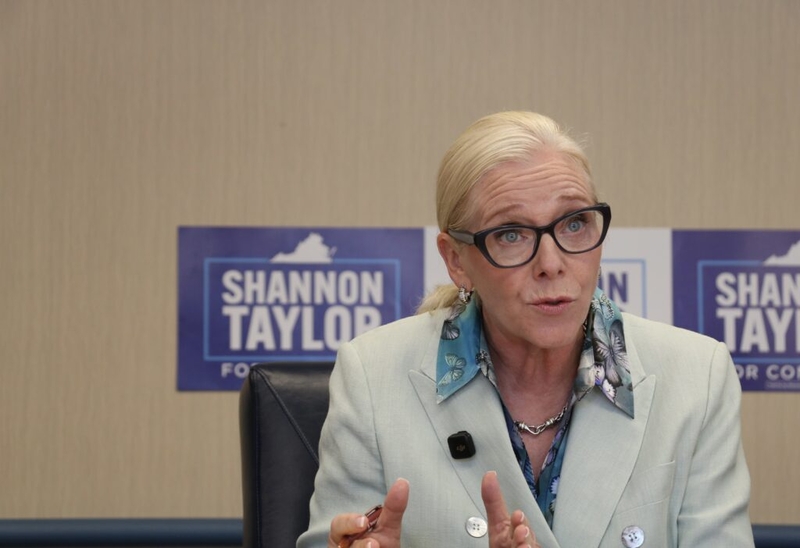
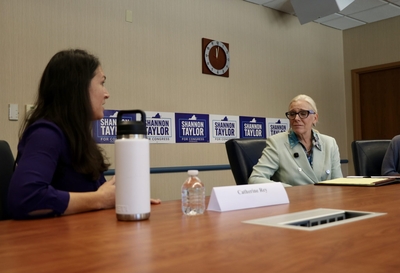
Democratic nominee for Virginia's 1st Congressional District Shannon Taylor speaks during a roundtable event in Henrico County on Sep. 14, 2026. (Photo by Charlotte Rene Woods/Virginia Mercury)
Shannon Taylor, the Democratic nominee for Virginia’s 1st Congressional District representative, wants to restore healthcare funding and resources slashed by the Republican-controlled Congress over the past year, she said at a roundtable alongside care workers and union leaders in Henrico Monday afternoon.
Taylor, who was first elected to her current role as Henrico County Commonwealth’s Attorney in 2011 and who is vying to unseat longtime Republican incumbent U.S. Rep. Rob Wittman, said she would also explore ways to more tightly regulate private equity in healthcare, if elected.
“No private equity should be profiting off of people’s healthcare and their health situation,” Taylor said. “It’s just morally wrong.”
The issue surfaced in Virginia earlier this year, when Valley Health trimmed services at one of its hospitals and changed staffing contracts, enabling a private equity firm to take over certain staffing decisions at all six of the health system’s hospitals in Virginia and West Virginia.
The move is meant to reduce Valley Health’s spending by over $80 million annually.
Valley Health joined a growing list of Virginian hospitals or clinics that recently reduced services, citing changes to Medicaid and hospital funding mechanisms that will strain their budgets in the months and years ahead due to H.R. 1, the federal spending bill passed last year.
Taylor cautioned against the hiring-and-firing tactics that can ensue once private equity firms enter healthcare spaces, and said facility staff may be replaced with different positions at lower salaries.
If Taylor defeats Wittman, who is seeking an eighth term in Congress and has supported the healthcare cuts levied by H.R.1, she will pursue legislation to “get private equity out of the healthcare equation,” she said.
“(We should) start from a premise that there should be no one getting rich off people getting sick — period. Then we’ll see what that looks like moving forward,” she added.
Taylor’s healthcare goals: Unraveling the ‘big beautiful bill’ and restoring ACA credits
Virginia and other states have already invested money into compliance with the forthcoming federal changes and strategized methods to prevent eligible people from losing their assistance.
Roughly 300,000 Virginians are at risk of losing coverage next year, while 5,800 lawful immigrants will no longer be eligible for Medicaid by October. Hospitals predict a $31 billion loss in Medicaid over the next decade, and 13 rural hospitals will be more vulnerable to closures or service cuts.
Congress also failed to extend expired Affordable Care Act subsidies that help low-income earners be able to purchase health insurance through state ACA marketplaces.
Wittman was one of few Republicans nationwide to join Democrats in support of extending the subsidies; the measure failed in the Senate. Prior to that aisle-crossing, Wittman had previously voted 60 times to repeal the ACA.
Wittman voted 60 times to undo the Affordable Care Act, then he backed extending its subsidies
At Monday’s event, Taylor criticized him for these moves and for voting to pass H.R. 1.
A key priority for Taylor if she takes Wittman’s seat will be “to make sure we are putting this funding back in place,” she said.
Several of Taylor’s would-be constituents shared their personal concerns about healthcare policy at the roundtable.
When Central Virginian Melissa Earley faced a cancer battle, her partner cared for her. Now, her partner can’t work due to a traumatic brain injury and Earley is her caregiver.
“She tells me everyday ‘I wish I could go back to work,’ but literally she can’t,” Earley said.
Medicaid coverage has helped the couple, but their finances have still been tight. At one point they had to appeal losing their waiver. The couple fears that additional Medicaid cuts could threaten their ability to maintain shelter.
“We almost lost our house. You can’t heal or you can’t stay healthy if you lose a home,” Earley said.
Gov. Abigail Spanberger’s administration predicts a $2 billion to $6 billion loss in revenue to the state each year starting in 2028 amid the federal Medicaid changes.
Catherine Rey had to become a permanent caregiver for her two sons that were born with ATR-X syndrome, which causes physical and intellectual disabilities. Rey’s children will need to live at home with specialized care for the rest of their lives.
“We’re 14 years in, which has felt like a long time, but it’s just a drop compared to a lifetime that we have ahead of us,” she said at the roundtable.
A specialized Medicaid waiver allows Rey to be reimbursed as a worker for the full-time care, but she called H.R. 1 a “big betrayal bill” due to the financial “pressures” it puts onto states.
“Every state is going to have to contend with ‘how are we going to make up for the loss of (Medicaid) funding?’” Rey explained.
Rey said she fears support for home care workers or community-based services to help her sons could become “optional” in future state budgets, which must now cover healthcare costs that used to be borne by the federal government.
Spanberger issued an executive order to help state and local social service agencies manage the increased workloads and foster collaboration with community-based organizations.
The state’s budget has also earmarked hundreds of millions in its state budget over the next two years to support H.R.1 compliance and a temporary state-level version of the expired ACA subsidies.
As Taylor traverses the district in the months leading up to Election Day, she said the rising cost of living is a top concern for voters in both Democratic- and Republican-leaning areas.
She connected spiking gas and fertilizer prices to healthcare costs, noting that none of the issues “exist in a silo.”
“The way I’ve always conducted myself and will continue to conduct myself, is to understand that things are very multifaceted,”Taylor said.
Voters will head to the polls Nov. 3 to elect Virginia’s next slate of congressional representatives. Early voting begins Friday.
Richmond, VA