With tax receipts flat, budget hurdles remain for WA leaders
Sep 25, 2026 | 6:52 pm ET

Description
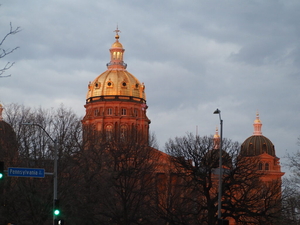
The Washington state Capitol on Jan. 12, 2026. (Photo by Bill Lucia/Washington State Standard)
The latest forecast of state tax collections released Friday did nothing to brighten Washington’s budget outlook.
But it does predict the state’s new income tax will gross hundreds of millions of dollars more than prior projections — if it survives challenges on the ballot and in court.
Friday’s forecast shows tax receipts up $22 million for the current budget that ends June 30, 2027, and $430 million higher in the next biennial spending cycle, compared to estimates the Economic and Revenue Forecast Council adopted in June.
That’s not enough to erase a several hundred-million-dollar-deficit in the 2028 fiscal year that begins next July or make a dent in the anticipated multibillion-dollar shortfall in the next budget.
The forecast “makes the budget picture slightly worse” next year and “a little bit better” for the one after that, K.D. Chapman-See, director of the Office of Financial Management, said after Friday’s council meeting.
“Creating a sustainable budget is the work we have ahead of us,” she said in a separate statement. “The cost to maintain current levels of essential services continues to increase, as does the demand on state resources.”
Sen. June Robinson, D-Everett, chair of the Senate Ways and Means Committee who will be the architect of the Senate budget, acknowledged revenues are up but far from enough.
“I think we need to find ways to reduce current spending so that we can balance in fiscal year 2028,” she said.
This sets up the third straight year lawmakers have returned to Olympia facing a budget shortfall.
If there is a financial silver lining in Chief Economist Dave Reich’s forecast, it would be his prediction of the revenue-generating power of Washington’s high-earner income tax. It is the source of the revenue bump in the next budget cycle.
Gov. Bob Ferguson signed legislation in March creating a new 9.9% tax on individual and household wage income above $1 million a year. It is slated to take effect Jan. 1, 2028, with payments due the following year.
Opponents sued, contending it is unconstitutional. And Let’s Go Washington qualified Initiative 645 on the November ballot. A yes vote on the initiative will repeal the tax.
In his June forecast, Reich assumed collections of $2.7 billion for the next budget and $6.9 billion for the 2029-31 fiscal cycle. Those amounts reflected figures assumed by lawmakers and the governor when the legislation was debated and passed.
Using findings of the June report, the state Department of Revenue carried out a new analysis that predicted the tax would bring in $3.1 billion for the next budget and roughly $8.3 billion in the 2029-31 biennium. Voters will see those sums in the fiscal impact statement for Initiative 645 that is online now and will be in voter pamphlets.
Reich projects even larger collections of $3.5 billion for the next budget and $9.4 billion for the 2029-31 period. Those numbers could go up, or down, in the next forecast in mid-November.
“Although a positive forecast is always welcome, it’s important to recognize that much of the predicted increase comes with an asterisk – because that’s tied to a tax that wouldn’t be collected until 2029, if it’s still on the books then,” said Sen. Chris Gildon, R-Puyallup, the lead budget writer for Senate Republicans. “I would be more encouraged by an increase that is based on anticipated growth in economic activity, but that’s not the case here.”
Anti-initiative forces contend the loss of the income tax revenue will open up a gaping hole in the state budget that can only be filled by slashing spending on vital services, and imposing other taxes.
Supporters of the ballot measure say the state’s economy is generating enough revenue but the Democratic majorities in the Legislature and the governor, also a Democrat, are overspending.
Washington operates on two-year budget cycles. In the upcoming 105-day legislative session that begins in January, the governor and legislators will hammer out a spending plan for the 2027-29 biennium.
Washington’s economy is now projected to generate $76.3 billion in revenue for the current budget and $82.6 billion for the 2027-29 biennium that begins July 1.
The November forecast will be the last before Ferguson releases his budget proposal in mid-December. Another forecast will come out early next year ahead of Democratic budget writers in the House and Senate putting out their spending blueprints.
Olympia, WA