Arkansas judge keeps block on laws giving governor firing power over prison officials
Sep 25, 2026 | 5:39 pm ET
Description
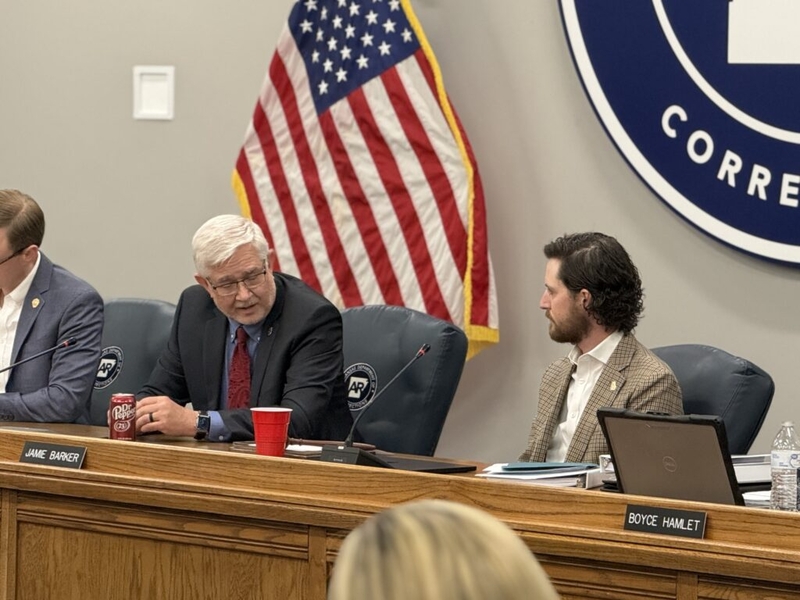
Arkansas Board of Corrections Chair Jamie Barker (right) and board member Lee Watson (left) during a special board meeting on Jan. 23, 2026. (Photo by Ainsley Platt/Arkansas Advocate)
A Pulaski County judge rejected a request Friday to allow Arkansas to enforce two laws giving the governor power to fire top prison officials, saying that a settlement agreement struck with the Board of Corrections was “in direct conflict with the Arkansas Constitution.”
Pulaski County Circuit Judge Patricia James’ decision to keep in place the ruling she issued last year blocking the laws comes after a July hearing on the state’s request to lift the injunction.
The board and Republican Gov. Sarah Huckabee Sanders said a settlement agreement the board voted to accept, and a later Supreme Court ruling, meant James had little say in whether or not to lift her earlier ruling.
Arkansas Board of Corrections endorses laws it’s been challenging under settlement
The Board of Corrections in March approved a settlement that called the laws constitutional, months after three new appointments gave Sanders a majority on the seven-member panel.
In an eight-page order, James called the settlement agreement “an unjustifiable attempt to usurp the power of the people, but also an attempt to undermine this court and authority of the judiciary.”
“This court summarily rejects the parties’ offer to take the first step down the slippery slope towards the degradation of our great democracy,” James wrote. Her refusal to lift the injunctions marks the latest twist in a long-running legal battle over who has ultimate control over the state prison system’s top leaders that began in 2023, after the board voted to suspend Joe Profiri, Sanders’ chosen corrections secretary.
Profiri said he answered to Sanders and pointed to the two laws passed by the Legislature earlier that year. The board, then led by Benny Magness, sued, arguing the laws violated Amendment 33 of the Arkansas Constitution, which safeguards the independence of the corrections board. James agreed, placing a permanent injunction on the laws last October.
After the board and the attorney general agreed to a settlement in March, the Supreme Court ordered James “to consider” lifting the injunction earlier this year. But justices declined to lift the injunction themselves despite a request from Sanders and the board to do so.
The March settlement effectively saw the board reverse the position it had taken under Magness’ chairmanship, endorsing the laws it had been challenging in court.
Lee Watson, a current member of the board who was appointed by Sanders’ predecessor, Republican Asa Hutchinson, and Magness asked James to allow them to intervene in the lawsuit after the board and Sanders asked to lift the injunction. James allowed them to so earlier this month.
Watson praised James’ ruling.
“Today’s order vindicates the actions of the Board, shows how the Attorney General has spent almost 3 years wasting the taxpayer’s time and resources, and is a huge victory for the people of Arkansas for the citizens’ initiative which resulted in Amendment 33 removing political power over the departments of corrections and higher education,” Watson said in a written statement.
In her order, James said the high court’s ruling didn’t take away her power to keep the injunction in place. If justices didn’t want her to have discretion, they would have ordered her to accept the settlement, she wrote.
The judge said there was “absolutely no precedent or justification” for her to grant the motion to lift the injunction.
“Granting this relief would result in preposterous and absurd consequences in which this court has enough foresight to prevent,” James wrote.
Board of Corrections Chair Jamie Barker, who Sanders appointed to the board, declined to comment on the ruling. A spokesperson for Republican Attorney General Tim Griffin, whose office represented Sanders in the lawsuit, said it was reviewing James’ order.
“The Board of Corrections has already reached a settlement on this case, and while this ruling unnecessarily delays the proper enforcement of Arkansas law, Governor Sanders is confident the court will ultimately recognize the agreement all relevant parties reached in this case,” said Sam Dubke, Sanders’ spokesperson, in a written statement.
It was not immediately clear if Sanders plans to appeal James’ decision. Dubke directed the question to the attorney general’s office.
Little Rock