Talking points from data center supporters don’t stand up to the facts in West Virginia
Sep 17, 2026 | 5:55 am ET
Description
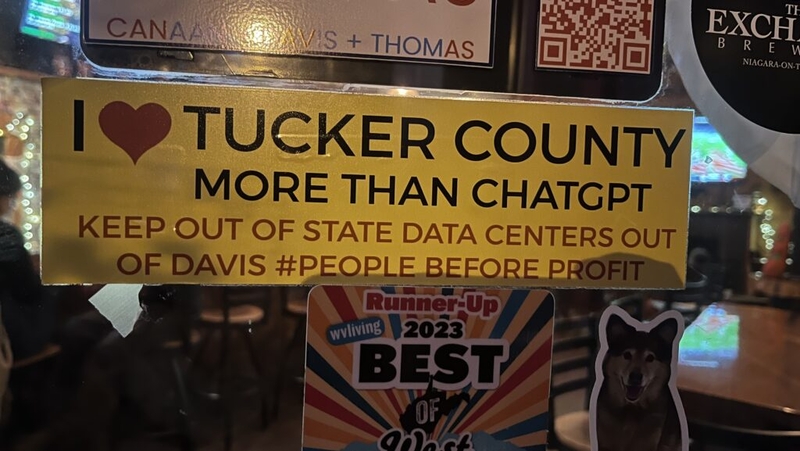
An anti-data center bumper sticker hangs on the door of the Stumptown Ales brewery in downtown Davis, West Virginia on Nov. 1, 2025. (Photo by Caity Coyne/West Virginia Watch)
There was a lot of talk this summer about data centers in artificial intelligence West Virginia. Let’s get to it. The governor outlined his Responsible Data Center Development Plan, which is full of a lot of “musts” but mostly empty promises. A data center developer in Mason County started buying out homes, then residents learned that they now have to deal with a second data center, after the governor announced a surprise approval at a conference in August. Zooming out, AI CEOs and employees are saying that we need guardrails and that this technology could lead to civilizational collapse by 2030. Sweet.
Typically in opinion pieces you want to use more words to flesh out your own arguments and give less airtime to your opponents’ points. But sometimes you’re just mad, just like the 70% of Americans who oppose data center construction in their communities, or the two-thirds of Americans who want AI guardrails.
So I want to use this space to look at just a few talking points from data center-loving Republicans in West Virginia and beyond.
“We should put data centers only in communities that want them”
This has been a common refrain across the country. Even the White House said as much in a statement to Politico this month. They said President Donald Trump “has been clear that he only wants data centers to be built in local communities that want them and “all of the significant benefits they bring.”
In some states in the country, maybe that’s true. Maybe other communities have the right to say no, they don’t want a certain development.
But not here in West Virginia.
Thanks to Gov. Patrick Morrisey and the West Virginia Legislature’s House Bill 2014, passed in April 2025, communities in West Virginia have almost zero input when it comes to large, dirty data centers. With HB 2014, the governor and Legislature concentrated the decision-making when it comes to big data centers to state bureaucrats. Ask the residents in Tucker, Mason, Putnam, Mingo, and Berkeley counties if they want the data centers that have been proposed for them.
(These localities still have the authority to say no to comparatively small data centers, but those don’t seem to be breaking down the door to come to West Virginia.)
“We’ve had data centers for a long time”
Data center lovers say this when they want to trivialize people’s worries about data centers, along with some version of “the people are using technology and data centers to complain about data centers.” Congratulations, you’ve revived the “yet you participate in society” meme.
Saying we’ve had data centers for a long time is akin to saying that Hitler was a rightfully appointed Chancellor. Both are true, but there’s a lot more to the story. Yes, we’ve had data centers for years, but what is being shoved down peoples’ throats now are hyperscale data centers intended to train and grow AI use. These data centers are being proposed with huge gas plants and dozens of diesel fuel generators connected to them. Loudoun County, Virginia, which is often invoked by data center supporters, did not see what is being proposed in West Virginia, which is onsite gas plants for several of the data centers under consideration. Gas plants and diesel generators emit toxic pollutants that can make people sick. Even data centers that are grid connected are going to lead to increased power production elsewhere.
“Only leftists, tree-huggers and people who want China to win are against data centers”
At the end of August, Trump said the following: “The only reason that communities throughout the U.S.A. should not want Data Centers is if they want to end up being backwards and poor… [if] we kill the Golden Goose, you will only have yourselves to blame.” He’s not the only Republican or corporate lobbyist making this kind of talk.
This one’s simple. It hurts to see the president say something like that to people I’ve gotten to know. I saw Fox News at the gym earlier this week and the guest was saying that raising the alarm about AI and data centers is just a leftist tactic to take power, which made my eyes roll as I thought about how culpable Fox has been in ginning up anger about immigrants and trans issues.
I encourage anyone who is unsure about sentiments on data centers to look at polling, or talk to a single person who lives next to, or even close to, a proposed data center.
Which takes me to the final point I’ll discuss today.
“I want one in my own neighborhood so it will lower my property taxes”
Spoiler, no. These people don’t actually want a data center next to them. No one wants to live next to noxious diesel and gas emissions, put their children at higher risk of asthma and other health conditions, or live in fear of some sort of disaster. If anything, maybe they’d move near one if it existed. But who wants to own a home and then learn “by the way, we’re going to build a mega-complex in your line of sight?”
It’s easy to pop off on social media about wanting data centers in your backyard when you’re wealthy and know that no one’s going to build a data center and a big natural gas plant in South Hills, Charleston or another rich neighborhood in West Virginia.
The same people who say this are ones who lobby on behalf of the wealthy families, polluting corporations, or other elite.
My friends and others I know who work on issues like this don’t represent those people. They talk to real people, who are affected by what happens in Charleston, Silicon Valley and Washington, D.C. They see people as people, not just numbers in a spreadsheet or as obstacles to remove.
They don’t look at people who own homes near proposed data centers and say “maybe you should accept a buyout and move?”
How wonderful it is to be a millennial, where you’re scolded for not owning homes or starting families, meanwhile people in power are making everything more expensive, polluting your air and water, and then saying, “OK, just move” if you do finally get a house and don’t want to have your property next to a data center or seized for a transmission line.
At the beginning I mentioned Morrisey’s Responsible Data Center Plan. He released that plan after reading the room, seeing that people are mad. That West Virginians don’t want corporations to trample on their communities without any right to push back. They don’t want a free pass to pollute water and air getting handed out. They don’t want their utility bills and other expenses to go up for reasons beyond their control.
But reading the room now is not the same as being in the room the whole time, talking to real West Virginians, as long as community and environmental advocates have been. We’ve been raising the alarm about concerns regarding data centers since HB 2014 was being debated.
What West Virginians need to do is seriously consider whether their state and local representatives truly have their best interests at heart. In other states, leaders seem to be listening to their residents’ concerns. But politicians are doubling down here in West Virginia in many cases. The 2026 election is going to be the first of many data center and AI referendums to come. West Virginia voters should choose the correct side.
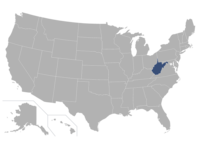
Charleston, WV