Struggling Delaware school districts could be taken over by DOE under draft plan
Sep 22, 2026 | 7:23 am ET

Description
Photo courtesy of Spotlight Delaware
Why Should Delaware Care?
For nearly a decade, Delaware schools have been struggling with poor test scores from students. Many critics have sought greater accountability measures for school districts that aren’t showing progress fast enough, and now the Department of Education has put forward such a draft plan.
As Delaware continues to grapple with concerningly low average test scores from students, the state Department of Education has drafted a plan that could see it take over low-performing districts or even hold back third-graders who are far behind grade-level reading and writing.
According to annual proficiency scores released by the state last month, less than half of Delaware’s third through eighth graders read and do math at a proficient level. And just 18% of 11th graders were proficient in math.
But Education Secretary Cindy Marten told state board of education members that Delaware must have a clearer, more-defined answer for what happens when a school, or its students, consistently do not show test score improvements.
“We can’t just say, ‘Well, they didn’t get it. Oh well, move on next year,’” she said during last week’s state board meeting.
To address those concerns, Marten unveiled a draft framework that consists of five tiers, ranging in support and accountability measures for districts and charter schools. The universal expectation is for schools to be in Tier 1, which has the lowest level of intervention.
While additional supports are introduced at Tiers 2 and 3, state intervention begins at Tier 4 and is carried into Tier 5.
Schools with little to no progress that are placed in Tier 4 would see “state-directed instructional and operational actions, leadership or staffing supports, and decisions need to be made when they’re needed,” Marten said.
Those schools would also be placed on monthly performance and implementation plans.
If none of the state-implemented supports work, the school would be placed in Tier 5 — resulting in receivership, where the Delaware Department of Education would take over operation of the district and appoint leadership, until conditions improved.
Marten told board members that the goal of Tier 5 is not to close schools. Instead, a state-approved “receiver” would address school conditions with a local school board and work on a “public recovery plan,” she said.
It would be the local school board’s responsibility to make improvements, and a return of authority to the local school board would be phased in after sustained progress.
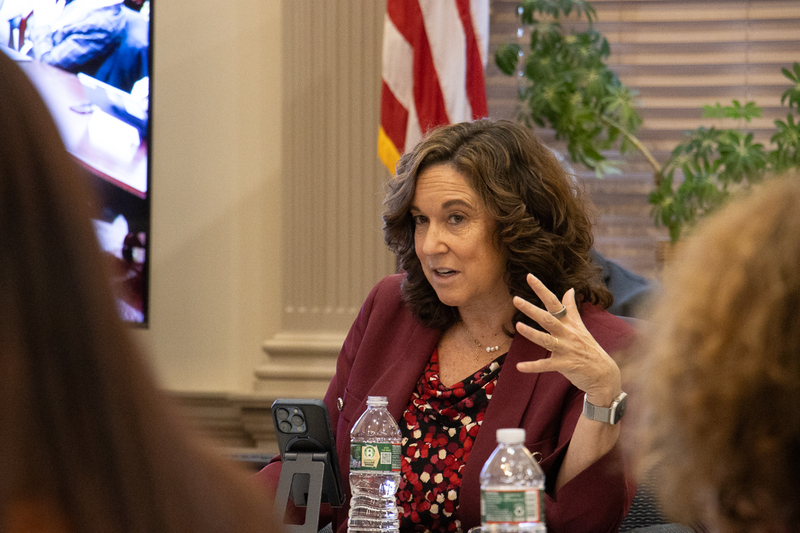
Marten also announced the possibility of holding third-graders back, a tactic that Mississippi has used to dramatically increase proficiency scores, but has also come under criticism from some as a manipulation of its test scores. Such a tactic would be a last-resort option, she said.
Delaware must first focus on early intervention screenings to address learning disabilities earlier and monitor students’ progress over time, Marten said. If students are not improving after receiving individualized support, then whether a student should begin fourth grade will be evaluated based on the student’s data.
“This is not a third-grade retention plan with a literacy plan wrapped around it,” she said during the meeting. “The whole point is prevention.”
The announcement came just one month after Marten told Spotlight Delaware that there will be “real action” taken if a school continues to underperform “for so many numbers of days, weeks, months, years.”
Marten did not specify what those actions may look like at the time.
Further determinations to be made
Marten reiterated throughout the meeting that the framework is only a draft, and more specifications still have to be made.
Marten said “some” of the framework would require legislative action before it is implemented, and plans to have legislation ready for the start of the new session in January.
The department will also have to determine how long a school can remain in a specific tier and establish criteria for where schools should be placed if the framework is implemented, among other details.
Marten also said the Delaware Department of Education will be holding more stakeholder engagement opportunities in the coming months.
Still, she noted that “nobody’s saying we don’t need this [framework,] everybody’s saying we do need this.”
In a statement to Spotlight Delaware, Lake Forest Superintendent Steven Lucas, who is also the president of the Delaware Chief School Officer’s Association, said his organization looks forward to working with Marten’s department to ensure the accountability framework “accurately assesses the needs and output of the Public School Districts, supports the work of our public school teachers, and helps to increase the college and career readiness of our graduates.”
Still, some education leaders have expressed concern with Marten’s draft framework.
Delaware State Education Association President Tameka Mays wrote in a statement to Spotlight Delaware that the state’s educators’ union is committed to having conversations with Marten, Gov. Matt Meyer, and legislators about plans for improving student academic performance.
But in her statement, Mays said she and her organization have mixed feelings about Marten’s plan.
“There are aspects we favor, such as additional instructional support for struggling students, and aspects that raise serious concern for our members and our communities, including the process leading up to a possible state takeover of our local schools and the potential for 8- and 9-year-olds to be held back a grade,” Mays said in her statement.
She said the union will also be gathering feedback from its members throughout the state in the coming weeks.
Dover