State revenues get modest bump despite ‘mixed’ economic indicators
Sep 25, 2026 | 3:21 am ET
Description
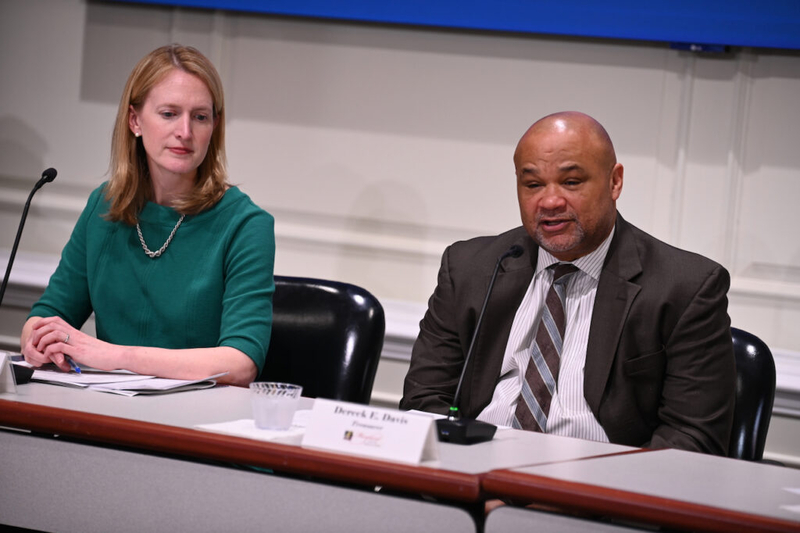
Comptroller Brooke Lierman, left, and Treasurer Dereck Davis, members of the Maryland Board of Revenue Estimates, in a file photo. The panel adopted a new forecast that ads $320 million to the state's revenue projections, but also raises some concerns. (File photo Bryan P. Sears/Maryland Matters)
Maryland’s revenue forecast for the current year has improved and a first look at the coming fiscal year shows some modest improvement despite a “mixed picture” of economic indicators.
Those projections, released Thursday by the Board of Revenue Estimates, added $320 million to the board’s revenue forecast from March. But it also highlighted concerns about growing inflation and a projection that tax withholdings in the first half of the year would grow at half the rate of the same period a year ago.
“Overall, this forecast does reflect continued resilience despite real economic uncertainty and real challenges on a day-to-day basis for Marylanders, Maryland families, and small businesses,” said Comptroller Brooke Lierman (D).
“Taken together, these numbers show a mixed picture,” Lierman said. “Our revenues are stronger than expected, but paycheck-related growth is slowing while prices continue to rise, and we certainly cannot examine these numbers in a vacuum.”
Despite the upward revision, to more than $27.4 billion, the new outlook represents a decline of a little less than 1% “on an ongoing basis” compared to fiscal 2026, according to board Director Robert Rehrmann.
“It’s important to note that’s not because we’re forecasting a recession that’s pushing our major revenues down, but it’s a collection of unusual events,” Rehrmann said.
Budget officials ask agencies to tighten belts, including a 10% cut scenario
Last fiscal year, the state benefited from much larger than expected estate taxes, including one payment of $260 million. The unexpected increase is not likely to be repeated in the coming year.
Also not to be counted on is the increase in capital gains taxes in fiscal 2026 that allowed the state to end the year $550 million over the board’s estimate. The tax is considered one of the “most volatile and difficult to predict” revenue sources, Rehrmann said.
The board also revised revenue estimates from an IT and Data tax down. That tax, passed in 2025, has woefully underperformed the $500 million in revenues projected by legislative analysts. In March, the state collected just $35 million in the first half of fiscal 2026. After a full year, the state had collected $100 million.
“In addition to decreasing the board year estimates, we’re also decreasing the out-year estimates as well, and waiting for additional data in this fiscal year on that tax,” Rehrmann said.
The reason for the less-than-expected revenue from the digital tax remains unclear. Opponents of the tax claim the result is proof that businesses shifted operations outside the state. Supporters say businesses may not be fully aware of how the tax applies and others may simply be avoiding payments.
Additionally, the state will have to refund $280 million to Potomac Edison. In July, the Supreme Court of Maryland ruled the state overcharged the company on production of electricity. Ongoing, the decision reduces state revenues by about $15 million per year.
“That, combined with some modest growth rates, is what ultimately ends up in a slight decline” compared to the previous year, Rehrmann said.
The board estimates released Thursday also provided a first look at expectations for fiscal 2028.
There, the board projected general fund revenues of nearly $28.4 billion. The estimated 3.3% growth year over year is still under the state’s trend growth rate of 4%.
Overall, the report is a mixed bag for state fiscal leaders, said Budget Secretary Yaakov “Jake” Weissmann.
The fiscal 2028 budget that will be introduced in January will have to address a projected structural budget gap of $3 billion. Those projected gaps grow in out years.
“Maryland’s economy continues to weather the instability at the federal level,” Weissmann said. “At the same time, I also want to be clear that today’s news is not so good that it changes the difficult decisions that we have ahead.”
State agencies are already being asked to find cuts of roughly 3%. Those cuts will not fully close the gaps.
One group is renewing its call for the passage of a tax package known as the Fair Share Act. The 2024 proposal included changes to corporate income tax reporting, increased taxes on the wealthiest residents, more auditors and increased capital gains surcharges. Supporters claimed it would raise $1.6 billion when fully implemented.
“Lawmakers must close corporate tax loopholes and make sure those earning over $1 million a year pay what they owe to meet the needs of Maryland communities,” said a statement from Fair Share Maryland, a coalition of 75 organizations.
“When Maryland’s wealthiest residents and wealthy corporations pay what they owe, our state will be able to fully fund our public schools, invest in essential state services, and protect Marylanders from federal health care cuts,” it said.
Annapolis, MD