Clean Elections fraud fight goes to court as Green Party candidates seek to block repayment
Sep 25, 2026 | 12:11 am ET
Description
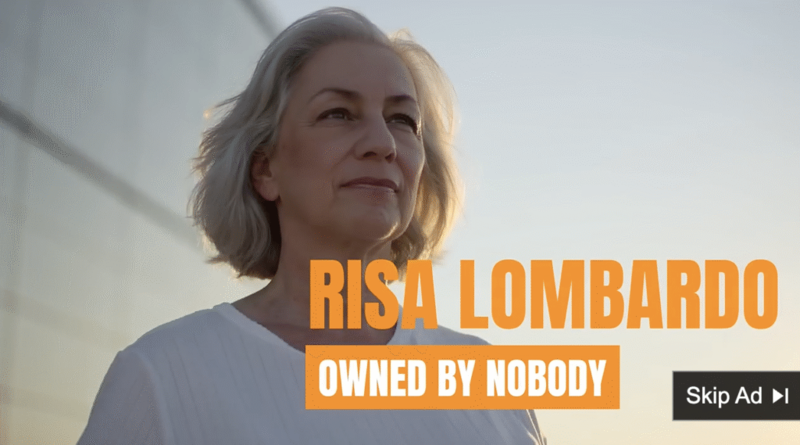
Risa Lombardo, a Green Party candidate for governor, is being accused of fraudulently qualifying for public campaign financing. On Aug. 27, 2026, the Arizona Citizens Clean Elections Commission is expected to consider asking her to repay the $2.8 million her campaign was given. (Screenshot via Google Ads Transparency Center)
The attorney for two Green Party candidates accused of fraudulently obtaining public campaign funding and lawyers for the commission that regulates that funding sparred in Maricopa County Superior Court Thursday over whether the commission has the power to make candidates repay ill-gotten funding.
Tim La Sota, the attorney for Risa Lombardo and Duwayne Collier, the Green Party nominees for governor and secretary of state, argued that the Citizens Clean Elections Commission had overstepped its legal authority for political reasons, in an attempt to derail their campaigns. Although he said his clients had done nothing wrong and were being unfairly targeted, La Sotat later admitted that the candidates had violated Clean Elections regulations that they agreed to in exchange for the public campaign funding.
If Maricopa County Superior Court Judge Melissa Iyer Julian fails to block the Clean Elections Commission from attempting to claw back the funding, La Sota said that their campaigns would remain frozen through the general election.
“The Commission has made them afraid, which is the Commission’s purpose,” he said. “It’s Tom Collins’ purpose to intimidate these candidates into silence.”
La Sota said that both candidates had stopped spending their public campaign funds last month, after Collins, the commission’s executive director, sent them letters informing them of an investigation into their campaigns. In the letter, Collins “strongly encouraged” Lombardo to stop spending public campaign funds and to seek legal representation, but made clear that the commission hadn’t made any final decisions and was still in the midst of its investigation.
Attorneys Craig Morgan and Bill Richards, representing Collins and the five-person bipartisan commission, respectively, said there was no evidence that their clients had any political axe to grind against the candidates — but there was evidence suggesting the candidates may have committed fraud.
Lombardo, Collier and Republican Scott Neely, who lost his primary for governor to Andy Biggs, are all being investigated by the Clean Elections Commission and the Arizona attorney general for allegations that they falsified documentation for enough $5 contributions from voters to qualify for a collective $4.7 million in public campaign funds.
Like other Clean Elections candidates, Lombardo, Collier and Neely agreed to forgo large contributions and money from PACs in exchange for a fixed amount of public funding, based on the office they seek.
Last month, the Arizona Mirror exclusively reported that six people who were listed in campaign finance records as having made $5 contributions to all three candidates were adamant they didn’t give any money to the candidates.
“I can tell you right now, with 1,000% certainty, that I did not make a single contribution, let alone three of them,” Christopher Scott of Peoria told the Mirror when asked about forms filed by the candidates showing he had donated $5 to each in order to help them qualify for Arizona’s public campaign finance program.
La Sota mentioned the article numerous times during Thursday’s hearing, and dismissed what voters told the Mirror, suggesting instead to the judge that they forgot they made the contributions.
While La Sota said that the Clean Elections Commission’s investigation is “largely based” on the Mirror’s reporting, Collins told the commission during its Aug. 27 meeting that he had already been conducting his own investigation. The Mirror’s reporting, he said, confirmed what he’d already found.
Both the Mirror and Collins separately found that thousands of donors were listed as contributing $5 to all three campaigns on the same days. Many of them had never made a contribution to any other candidate, according to campaign finance reports.
Voters rarely donate qualifying contributions to more than one Clean Elections candidate, but the Mirror’s analysis found that the three long-shot candidates reported collecting contributions from nearly 4,000 of the same voters — including more than 2,600 who were listed as giving to all three
La Sota tried to convince Julian that, because the Maricopa County recorder and the Arizona secretary of state approved the Green Party candidates for public funding after determining that the candidates’ qualifying contributions came from registered voters and contained what looked like those voters’ signatures, the Commission couldn’t take back that funding months later.
He argued that only the secretary of state had the power to approve or deny that funding.
La Sota failed to note that all six of the people who spoke with the Mirror said they had signed unrelated petitions in grocery store or marijuana dispensary parking lots within the past year, and believed their information and signatures had been taken without their knowledge from the petitions to be used instead to qualify the candidates for public funding.
The attorneys for Collins and the commission countered that the Clean Elections Act not only gave the commission the power to investigate possible fraud, but required it to do so.
Morgan argued that the court couldn’t block the Commission from taking action, because whatever action it might take hasn’t been determined. The investigation is still underway with an Oct. 29 deadline for completion. After that, he said, the candidates could contest the commission’s decision.
La Sota said that at that point, days before the Nov. 3 election, the candidates’ campaigns would be effectively over, even if the investigation found no wrongdoing.
“They haven’t actually issued an order, and they never will, because once Nov. 3 comes along, they don’t have to issue an order,” La Sota said. “It’s done with and they don’t have to do anything.”
Morgan reminded the judge that the Clean Elections program is voluntary and that the commission hadn’t ordered Lombardo or Collier to stop spending campaign money. The decision to do so, he noted, was a choice they voluntarily made after Collins sent them the letters informing them of his preliminary findings, advising them that a formal investigation was likely and warning them that they could be on the hook to repay the money.
“Nobody has told them they can’t do anything,” he said. “They’re making a choice. And maybe it’s because they’re being cautious, maybe it’s because they’re guilty as hell and they know it, I don’t know.”
But La Sota said that Collins and the Commission had violated the candidates’ First Amendment rights by telling them how they could spend their public campaign funds and attempting to bully them into halting their campaigns.
Morgan called La Sota’s allegations of First Amendment violations “absurd.”
La Sota said that because Collins mentioned in his letter to Collier and Lombardo that the Green Party had disavowed them and called them “sham” candidates, it was proof that the investigation was political.
“Collins admitted in his letter he doesn’t like these candidates, that the Green Party called them a sham, and he put that right in his letter,” he said. “There’s a political element here… There’s obviously a political axe to grind because he said it himself in his letter.
In the letters, Collins questioned how the candidates had the infrastructure to collect thousands of $5 contributions, without spending any money, and without the support of their party.
The Arizona Green Party accused Collier and Lombardo of being Republicans in disguise, aimed at pulling progressive votes from Democratic Gov. Katie Hobbs to help Republican candidates Andy Biggs and Alex Kolodin.
Lombardo was a local Republican Party official until days before she filed her intent to run for office last year and has extensive ties to the Republican Party. Both candidates hired multiple businesses and people closely tied to the AZGOP to work for their campaigns.
While La Sota correctly argued that candidates aren’t allowed to pay people to collect $5 contributions, Collins told the Commission on Aug. 27 that it didn’t make sense that the candidates reported spending nothing on coordination of those volunteers or supplies for them.
La Sota dismissed as minor other campaign finance violations that the commission was investigating, saying that the candidates had no knowledge of any wrongdoing.
“I mean, you collect 4,300 signatures, candidates can’t know every single person who gives them a $5 contribution when they run for governor,” he said.
Lombardo signed each $5 contribution slip, attesting under penalty of perjury that she had personally received the $5 contribution from the voter who signed the form. La Sota admitted during an Aug. 27 Clean Elections meeting that Lombardo had not collected all of the $5 donations herself but signed all of the forms anyway because she was confused about the rules.
And he downplayed additional concerns highlighted in Collins’ letter that the candidates failed to disclose subcontractors they hired to do work for their campaigns, as is required by state law and Clean Elections rules. Lombardo and Collier both made large lump sum payments to Bootstrap Campaigns, a shadowy Nevada business created by California GOP political operatives weeks before Lombardo made her first payment to it.
Neither candidate disclosed payments to Uncle Sam Petitions or O’Neil Printing on their campaign finance reports, despite evidence that both businesses did work for their campaigns. La Sota said that didn’t matter, because Collins figured out who their subcontractors were on his own.
“He’s basically sort of filling in the gaps about how, precisely, the money was spent, in the same letter where he’s saying, ‘You’re going to have to repay misspent monies,’” La Sota said of Collins. “It doesn’t make any sense.”
Lombardo and Collier paid more than $1 million in public campaign funds to Bootstrap for a wide variety of services that even major, established firms would typically delegate to subcontractors. That makes it likely that the campaigns used other subcontractors that weren’t disclosed.
Richards asked Julian to imagine that the candidates did receive the public campaign funds fraudulently, and what it would mean if she ruled that the commission had no authority to claw back those funds.
“It may well be that that fraud was so good that it fooled the Secretary of State’s Office,” he said. “But Mr. La Sota is saying, ‘Great, that’s a win to the candidate who’s committed the fraud. If they pull the wool over the eyes of the secretary of state, that’s it. The Clean Elections Commission can do nothing about it. The money can be spent. The public dollars could be expended, even though they were not lawfully obtained.’”
Julian said she would take the arguments under advisement and hoped to issue a decision early next week.
Phoenix, AZ