State Museum debuts exhibit highlighting SC’s role in Revolutionary War
Jun 26, 2026 | 9:38 am ET
Description
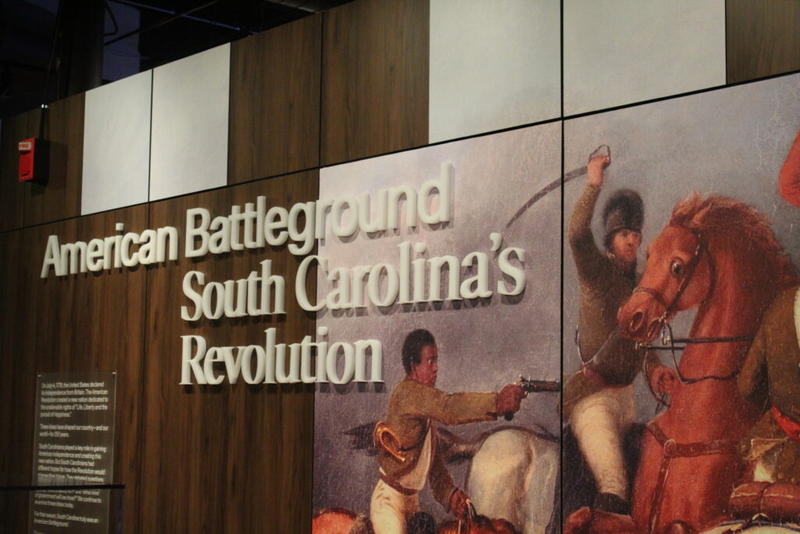
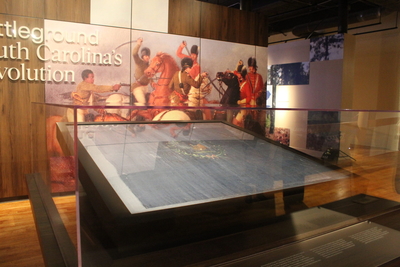
A sign welcomes visitors to the State Museum's new exhibit about the Revolutionary War in Columbia, S.C., on Thursday, June 25, 2026. (Photo by Skylar Laird/SC Daily Gazette)
COLUMBIA — Soon after Patriots defended Charles Town at Fort Moultrie in 1776, the regiment received a flag embroidered with acorns, a battle drum and an early version of the crescent that would eventually adorn the state flag.
Almost exactly 250 years later, the same flag will be on display at the State Museum starting Saturday, alongside the opening of a $2.8 million state-funded exhibit focused on South Carolina’s role in the Revolutionary War.
The opening comes a day before Carolina Day, which commemorates when Patriots repelled the British from Sullivan’s Island on June 28, 1776. The annual recognition of Americans’ first major victory over the Royal Navy takes on new significance on the 250th anniversary.
This is the first new exhibit to open as part of a $75 million overhaul meant to modernize decades-old exhibits. Museum officials decided to speed up the timeline to open as part of the country’s 250th birthday celebration, said Amy Bartow-Melia, the museum’s executive director.
In celebration of the exhibit’s opening, the museum will waive admission Saturday.
Anyone who can’t make it that day will have plenty of time to come back, since the exhibit is expected to remain open for at least eight years.
The Second South Carolina Regiment battle flag, however, will remain for just five, before it returns to the Smithsonian in Washington, D.C., for its regular cycle of rest and repairs.
Artifacts from the Revolutionary War will also be on temporary display in Charleston in commemoration of Carolina Day. The original 1776 state constitution will be on display at the South Carolina Historical Society on Saturday.
The Charleston Museum will also display the original state seal, an account of the war from Capt. Jacob Milligan, one of the first captains of the state Navy, and a speech given in 1776 by South Carolina’s first non-colonial governor, John Rutledge, on Saturday.
And on Sullivan’s Island, the National Park Service is holding fee-free events all weekend. A ceremony Sunday at the national historical park will commemorate the battle itself.
The flag
Inside the State Museum, the blue battle flag welcomes visitors to the rest of the exhibit.
The silk is shattered, especially around the embroidery in the center. A portion of the right side has frayed and disintegrated over time. A mesh netting keeps the fabric in place inside a pressurized frame, which is meant to keep the silk as still as possible.
For the most part, though, the flag remains intact.
“It’s in really good shape for everything that it’s been through,” said Robyn Thiesbrummel, director of collections management for the museum.
Susannah Elliott, the wife of Maj. Barnard Elliott, presented the flag to the Second Regiment on July 1, 1776, alongside another one made out of red silk. The regiment had just come off the decisive Battle of Sullivan’s Island, which boosted morale a few days before the Second Continental Congress adopted the Declaration of Independence in Philadelphia.
Then-named Fort Sullivan, which was later renamed Fort Moultrie for the commanding officer, withstood a British bombardment because it was made of palmetto logs and sand. British cannonballs embedded in the walls or reportedly bounced off them.
Outnumbered troops led by Col. William Moultrie fended off an attack that continued for 10 hours.
During the fighting, Sgt. William Jasper threw himself in harm’s way to rescue the fort’s fallen flag.
That flag, created by Moultrie to match his troops’ uniform, featured a crescent in its upper lefthand corner, a precursor to the existing state flag. Jasper retrieved the fallen flag from the beach and replanted it as the bombardment continued.
Elliott’s flag accompanied the regiment three years later at the Battle of Savannah, where British troops captured it and killed the color guard carrying it, including Jasper.
The troops took the flag back to England, where the family of Col. Augustine Prévost kept it for more than 200 years.
“It’s an incredibly rare artifact to have 200 or something years later,” Thiesbrummel said. “I want people to just really be able to see what having tangible parts of our history can move them to.”
The Rifleman’s Museum in Winchester, England, displayed the flag for about half that time, though the Prévost family still owned it. It wasn’t until 1989, 210 years after the battle, that the Prévost family sold the flag back to the State Museum and the Smithsonian Institution in Washington, D.C., said Christopher Graham, the exhibit’s curator.
Since then, the two have switched off the flag, with the State Museum displaying it and the Smithsonian performing maintenance and allowing the flag to rest, which helps prevent further damage, Thiesbrummel said.
Typically, the flag rotates on a five-year schedule, but because of extended preservation work, this is the first time the flag will be on view in over a decade, she said.
The flag remains one of the museum’s most requested items, and people still call regularly to ask when it will return, Thiesbrummel said.
“Many people have been excited to see this, and I do think for a lot of people in South Carolina, just because it’s been gone so long, they wouldn’t have seen this flag, so it will feel like a new artifact to them,” she said.
Bringing the exhibit together
Past the flag, a projection lights up one wall, walking visitors through an interactive history of the Revolution. A touchscreen just beneath allows people to select different paths and learn about different aspects of the war, such as different people who fought.
Nearby, an interactive map shows every one of the more than 400 battles and skirmishes fought in the state. Clicking on a county will show all the battlefields there, including which are publicly accessible.
The technology is the biggest advancement the museum made in the new exhibit, Bartow-Melia said.
“It’s very interactive, very different from anything the museum has done before,” she said.
Most people walk into a museum expecting to simply look at displays, but during rounds of feedback several years ago, museum officials kept hearing that people wanted more exhibits that responded to their actions, Bartow-Melia said.
Officials also kept hearing that people wanted to see their communities and themselves represented, and they wanted to be able to connect the stories back to their own lives, she said.
That’s why much of the exhibit focuses on the enslaved people, Native Americans and women who contributed to the war.
Among the people highlighted are Antigua, an enslaved man who acted as a spy during the war; Peter Harris, a Catawba who fought alongside the Patriots; and Rebecca Brewton Motte, who set fire to her own house to thwart British soldiers.
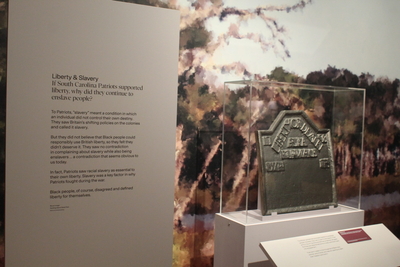
While the exhibit is meant to celebrate the country’s founding, it also asks visitors to contemplate difficult questions, said Graham, the curator.
For instance: What did it mean for Patriots to say the British enslaved them when many owned slaves themselves? Why did so much violence take place in South Carolina? And what did the ideas of liberty and freedom look like for different people?
“We hope to open up some of those things to offer a greater understanding of what the war was about,” Graham said.
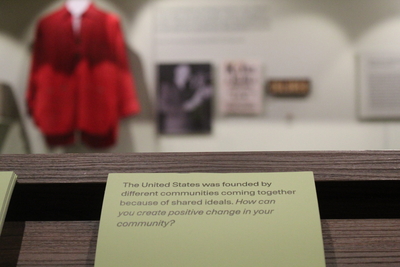
Visitors are asked to answer some of those questions literally in the exhibit’s final room, where text on one wall asks, “What ‘revolutionary ideal’ matters most to you? Why?” Answers will fill the designated pockets, allowing visitors to contribute their own stories, said Jeffrey Brodie, the museum’s chief content officer.
“We really want people to say this is their place,” he said. “This is where they see themselves as a South Carolinian.”
The bicentennial
Tucked in an alcove off to the side of the main exhibit are much more recent artifacts, from the state’s bicentennial celebration in 1976.
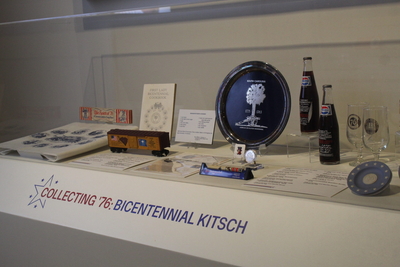
The space will become a rotating exhibit, with local museums and other groups from throughout the state creating annual displays about local stories, Brodie said.
To mirror the sestercentennial celebration, the museum started by showing how the state commemorated the bicentennial, which some visitors may remember.
Brodie does, he said. On one wall is a photograph of the American Freedom Train, a 26-car train that traveled the country. The photo shows its stop in Columbia, but Brodie remembers seeing it in San Jose, California, when he was 6 years old.
That’s the sort of connection he hopes people will be able to make, he said.
“To see that image up there, I’m like, ‘Yeah, that could have been me,’” he said.
Columbia