State lawmaker questions whether LVCVA should be all-in with Vegas Loop, Boring Co.
Jan 22, 2026 | 8:07 am ET
Description
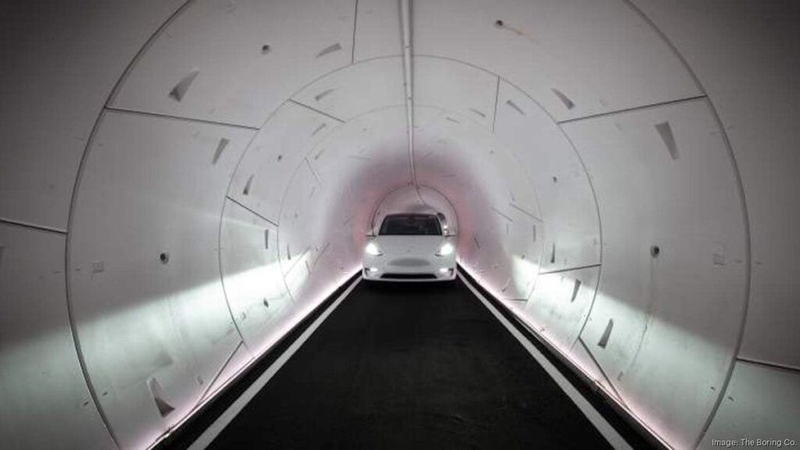
Some of Boring’s original plans for stations have already fallen through.(LVCVA Vegas Loop photo)
If you find yourself in a hole, stop digging.
That is the attitude some state lawmakers have about the Vegas Loop, Elon Musk’s Boring Company project, a 4-mile underground tunnel system beneath the Las Vegas Convention Center that critics fear is expanding faster than its oversight.
Nevada State Sen. Fabian Doñate, a Democrat whose district includes the convention center, during an interim legislative meeting Wednesday questioned the Las Vegas Convention and Visitors Authority (LVCVA)about its persistent enthusiastic support for Boring Co.
“What we’ve seen over the last several years is that there are continuous concerns — environmental concerns, labor concerns,” he said. “And so I guess the question becomes: To what extent are we sacrificing our workers and our communities at the expense of our taxpayers to subsidize or support a company without essential oversight.”
Doñate referenced numerous high-profile incidents at Boring’s construction sites, which have included a “crushing injury,” workers and firefighters enduring chemical burns, and digging errors that exposed the foundation of two Las Vegas Monorail columns.
Overall, Nevada state regulators have accused the company of nearly 800 environmental violations, according to reporting from ProPublica and City Cast Las Vegas. Boring Co. has also been cited by the Nevada Occupational Safety and Health Administration. Some of those citations were rescinded after Boring Co. president Steve Davis called Gov. Joe Lombardo’s office, raising concerns of backdoor deals and a deep-pocked company’s ability to skirt regulatory oversight, according to reporting by Fortune.
The governor’s office has disputed that report. Democratic Assemblymembers Cinthia Moore and Venise Karris, both Democrats from Las Vegas, have publicly called on the Clark County District Attorney’s Office to investigate the accusation.
An LVCVA official during Wednesday’s meeting acknowledged the publicly reported safety issues at Vegas Loop construction sites.
“There have been events, and we should have been better,” said Ed Finger, the authority’s chief strategy officer. “The Boring Company should have been better than they were. It is The Boring Company’s goal to be better.”
But Finger also seemed to suggest the incidents might not be out of the realm of normalcy. He also told lawmakers that, on the rider experience side, the Vegas Loop has had a “near flawless” operational safety experience.
“I’ll suggest to you that reasonable people can have a difference of opinion about how much of that was built safely and done well, versus those events, and what happens across multiple-year total construction projects and transportation projects in general,” he said, addressing Doñate.
Finger said the LVCVA has “attempted to improve our awareness, and our coordination and understanding” of safety concerns on the construction sites.
He emphasized the LVCVA has no technical or contractual responsibilities with regulatory agencies like OSHA but is choosing to be proactive, including sending their own ex-OSHA employee into the field “on a periodic basis.”
Finger said the mission of LVCVA is “to maximize the biggest economic engine in the State of Nevada,” meaning the Las Vegas Strip.
“We believe it’s within our purview to attempt to work with our Southern Nevada partners to also try to facilitate improvements in the Strip resort corridor, specifically transportation,” he added.
That mission drove the acquisition of the Las Vegas Monorail after its second bankruptcy, he said, and it drives the facilitation of the Vegas Loop.
“We have a sincere, vested interest in the success of this destination,” said Finger. “We believe that The Boring Company system will be transformative to Strip corridor transportation and will be a unique asset that further separates Las Vegas as the greatest tourism destination in the United States of America and competitive in the world.”
Vegas Loop presentation materials state there are currently eight operational stations at the convention center, Encore, Resorts World, and Westgate. An additional 15 are expected to become operational in the next few months.
“We’re at a current pace of better than a million passengers per year,” Finger told lawmakers. That’s “about a quarter” of the ridership volume of the monorail.
But Boring has been approved for 68 miles of tunnels and 104 stations.
If those ambitious goals actually come to fruition, it would be the second largest tunnel transportation system in the country, behind only the New York City subway system, according to Vegas Loop materials.
The annual ridership of the New York City subway system was 1.2 billion in 2024.
Some of Boring’s original plans for stations have already fallen through. UNLV denied the company’s offer to build a station on campus for free, according to the Las Vegas Weekly. The university cited parking enforcement as the primary reason.
Meanwhile, Nevada’s entanglement with Boring Co. could grow beyond Las Vegas. According to reporting from Fortune, the Economic Development Authority of Western Nevada (EDWAN) is conducting a feasibility report for a potential tunnel project leading to Tahoe-Reno Industrial Center (TRIC), where Musk’s Tesla Gigafactory is located.
Environmental groups like the Sierra Club Toiyabe Chapter have already publicly vowed to fight any proposals by the company.
“My responsibility is to protect Nevada’s land, water, and communities from harm, and that responsibility requires me to oppose this project outright, and forcefully, given the Boring Company’s egregious record of environmental violations already in Nevada,” said Executive Director Olivia Tanager in a statement Sunday.
A monorail? A taxi? A limousine, kinda?
The ultimate vision is for the entirety of Vegas Loop travel to happen within the tunnels, Finger told lawmakers on the interim legislative committee on revenue, but before that vision is fully realized there exists “an interim opportunity” for above-ground transportation connecting passengers from existing stops in the tunnel system to future ones, most prominently Harry Reid International Airport.
Last year, a Boring subsidiary called Paradise Transportation received approval from state regulators to transport people above-ground, so long as the trips include the underground system.
State Sen. Dina Neal, a Democrat from North Las Vegas, said the question for the interim revenue committee is: What changes when the Vegas Loop Teslas emerge from the tunnels and begin operating on surface streets?
The Vegas Loop tunnels are statutorily considered a monorail system, she said. Boring owns the tunnels and operates the Vegas Loop under a franchise agreement with Clark County and City of Las Vegas. But, with the expansion to above-ground transportation using public roadways, they appear to many to be operating more like a transportation network company like Uber or Lyft.
Neal said it raises questions about whether that new hybrid service is being properly taxed by the state: “Do we need to have statutory changes that reflect that new behavior and activities…?”
TNCs, colloquially referred to as rideshare, and taxis are both subject to a 3% excise tax. Taxi and limousine companies have said Boring’s above-ground plans will decimate their industry.
Nevada Transportation Authority Chair Vaughn Hartung told lawmakers the Vegas Loop vehicles cannot be classified as TNCs because passengers are not connected to their rides through a digital network, which is part of the state’s definition of a TNC. It also cannot be classified as a taxi because they don’t use meters.
“So, it is classified for us the same as we would classify a limousine,” he said.
State lawmakers wanted to further question Hartung and his staff about the classification of the above-ground operations of the Vegas Loop, but the agency’s administrative attorney Yoneet Wilburn intervened to advise they could not answer such questions because of pending litigation.
The Livery Operator’s Association of Las Vegas in November filed a petition for judicial review, asking a district court to review the Nevada Transportation Authority’s decision to give Vegas Loop the greenlight to provide above-ground transportation.
“We need to fully adjudicate that court process,” said Wilburn. “These questions are getting into the application process and the hearing and how we decided.”
Wilburn told lawmakers a hearing is expected in the next few weeks.
Las Vegas, NV