‘Spreading like wildfire’: How one KY county is grappling with a national tick-borne scourge
Sep 29, 2026 | 5:30 am ET

Description
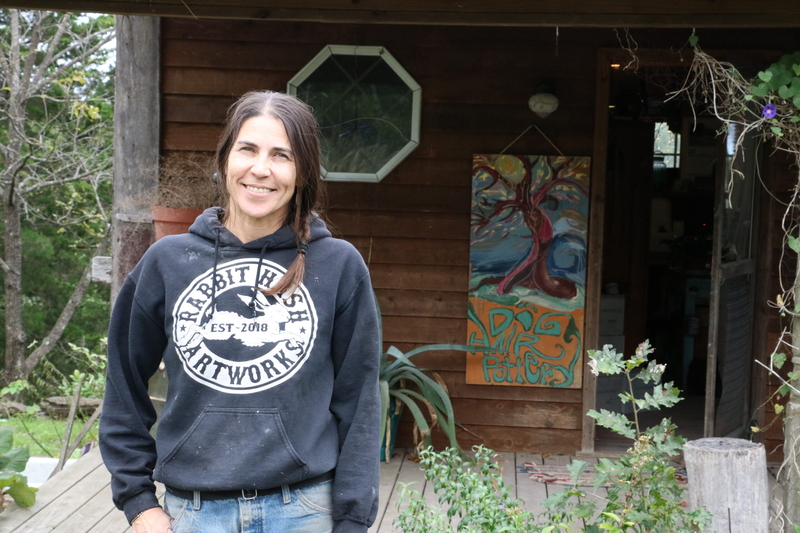
Eliza Petzinger puts together pieces of clay soap dishes at her studio in Owen County, Kentucky. She and numerous members of her family have been diagnosed with alpha-gal.(Kentucky Lantern photo by Liam Niemeyer)
OWEN COUNTY, Ky. — She usually had a “stomach of steel.” Most food wouldn’t really bother her. But when Eliza Petzinger had a helping of country ham during her family’s Christmas dinner last year, the strong reaction — stomach discomfort and nausea — came just hours later.
“I was so sick, and so I knew. I just knew,” Petzinger told the Lantern earlier this month.
Just days later in January, she had her doctor test her blood for alpha-gal syndrome, an allergic reaction by the body to a sugar molecule found in most mammals but not in humans. A bite from a tick, primarily the lone star tick found throughout Kentucky, can expose a person to the alpha-gal molecule and trigger an immune response.
The test came back positive. And unlike Lyme disease, a rarely fatal but chronic tick-borne disease she contracted years ago, the potential lethality of alpha-gal scares her.
The syndrome can trigger a life-threatening allergic reaction to animal products, including eating red meat, but it can also include products such as gel capsules that have gelatin sourced from red meat. For some people, even the fumes of cooking red meat can trigger a reaction. Less severe reactions can mean stomach distress, rashes, hives, shortness of breath and swelling of the lips and throat.
Each person’s reaction is different, and some people can test positive and have no reaction at all. Petzinger said her reaction is often delayed by hours.
“You got to think about how late at night you can eat…because you don’t want to wake up in the middle of the night and be having some reaction. And that’s how a lot of people have had serious, even life-threatening reactions,” Petzinger said. “I’m literally scared to eat certain things.’
It’s yet another illness connected to ticks that’s continuing to emerge in Kentucky, yet Petzinger was already well aware of it when she was diagnosed. Her 13-year-old daughter, Iris, was the first of her family to test positive for alpha-gal about two years ago. So has a brother and a 10-year-old niece, though she says her brother attests he doesn’t have symptoms.
She said her father tested positive after breaking out in hives a couple of times in the middle of the night. Her mother hasn’t gotten tested yet, but she broke out in hives recently at her granddaughter’s ball game after eating some ham.

Much of her immediate family lives on rolling, green farmland next to each other, and her kids sometimes run in between her house and her parents’ cabin. She estimates about five of 10 immediate family members, including herself, have alpha-gal. A neighbor who raises beef cattle also has it; he’s unable to eat the beef he raises.
Similarly do a growing number of people in Owen County, one of a number of rural communities throughout Kentucky and the nation grappling with a rising number of ticks and the cases of the illnesses they bring, including alpha-gal.
Petzinger said the ticks on her family’s land, where she has a pottery studio and farm animals, have been relentless, even with the use of the chemical permethrin on clothes to kill them. That includes the lone star tick, a relatively newer tick that’s come to Kentucky and is suspected by health experts to be the main culprit behind alpha-gal transmission in the United States.
“I grew up on this big farm, and so I take my kids to the creek. We do all these things, and now the first thought is, ‘Oh gosh, I’m gonna get covered in ticks,’” Petzinger said. “I have to adapt to it and just learn to live with it.”
Local doctors track the rise
It wasn’t until two or three years ago that most people in Owen County had ever heard of alpha-gal syndrome, according to one local family doctor. Cases of other tick-borne illnesses such as Lyme disease, Rocky Mountain spotted fever and ehrlichiosis would sporadically pop up in Larry Johnson’s health clinic.
But then came the alpha-gal cases. From him diagnosing zero alpha-gal cases in a month has eventually become one to two cases diagnosed a week during some months this spring and summer, a “huge increase” for his health clinic in a county of a little over 11,000 people.

“It just seemed like all of a sudden it was just spreading like wildfire,” said Johnson, who’s worked as a doctor in Owen County since 2001. Johnson said the cases have shown up in people of all ages who work or spend time outdoors “in the brush,” whether that’s farmers or tree trimmers.
Kentucky joined a minority of states last year to require cases of alpha-gal syndrome to be reported to public health officials. Three Rivers District Health Department, which serves Carroll, Gallatin, Owen and Pendleton counties, has seen an increase in the rate of all tick-borne illness across the four counties since 2021.
But with alpha-gal cases now being reported, the rate of cases of tick-borne illnesses per 100,000 people across the four counties has skyrocketed — from 83 cases per 100,000 people in 2024 to over 300 cases per 100,000 people in 2025 and 2026.
It’s not clear to Johnson and other medical practitioners whether they’re finding more local alpha-gal cases because there’s more awareness of the condition and doctors are testing for it more, or if there are other factors increasing the number of cases.

Owen County residents are taking notice. Owen County Judge-Executive Todd Woodyard said he knows people who deal with alpha-gal. The city’s volunteer fire department chief Greg Estes said he had alpha-gal and avoided red meat for months, though he never got tested for it.
Family Billiards, a diner next to the county courthouse that offers burgers and pool tables, has had a few regulars come in and start mentioning alpha-gal; one of the regulars told co-owner Brandi Neal he stopped eating bacon.
“He said he got bit by a tick. I guess that caused it,” Neal said. “We work around the issues and do our own thing for them. Whatever gets them to eat here safely without getting sick.”
The unknowns of alpha-gal
The surge of alpha-gal cases hasn’t just been isolated to Owen County, though. A 2023 report by the Centers for Disease Control and Prevention found Kentucky to be among several states with a high incidence of suspected alpha-gal cases, with Muhlenberg County in Western Kentucky cited as having among the highest county rates of cases.
The rates of other tick-borne illnesses have also significantly increased in recent years, with Kentucky Department for Public Health data showing cases of Lyme disease in the state increasing by 275% between 2020 and 2023.
On the national front, data from the Centers for Disease Control and Prevention show tick-borne illnesses have more than doubled since 2004.
Kentucky state epidemiologist Kathleen Winter said other nearby states have seen a similar rise in tick-borne illnesses, likely because both disease surveillance and reporting efforts have increased and more people are being exposed to ticks.
Winter, a University of Kentucky associate professor, also said the ranges of various ticks are expanding both from the north and south into the state.
“We live in a region of the country where we have a lot of ticks that like to call this their home,” Winter said. “We think the tick population is increasing, and there are seemingly to be more and more exposures to ticks. So, whether that’s just people spending time outdoors or having them more in urban areas.”
Johnson and Winter point to the prevalence of the lone star tick as a key factor behind the rise of alpha-gal.
Jonathan Larson, an extension entomologist at the University of Kentucky College of Agriculture, Food and the Environment, told the Lantern the lone star tick — now the most common tick in Kentucky based on survey data, he said — is seen as the primary tick but not the only tick behind alpha-gal transmission.
Larson said the state is also seeing more ticks in general because of an abundant amount of wildlife hosts in deer and mice, warmer winters allowing for tick populations to rebound and weedy, invasive plants creating an environment for ticks.
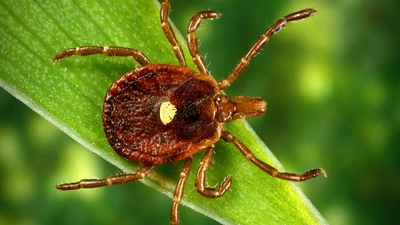
Owen County is among Kentucky counties that have plenty of deer, with Kentucky wildlife management officials allowing no limit on the number of antler-less deer that can be taken.
“All of that adds together to create this kind of perfect storm that we’re seeing. The lone star tick has taken full advantage of it,” Larson said.
But for Johnson and the other doctors he works with, there’s plenty still unknown about alpha-gal. For example, Johnson said there’s no “rhyme or reason” to how strong an allergic reaction someone might have; a person can have a positive test result, showing an alpha-gal immune response, but have no symptoms after eating red meat.
Hans Otto, a Boone County allergist who previously served as the president of the Cincinnati Allergy and Asthma Society, told the Kentucky Lantern that alpha-gal has probably been around for decades but only widely recognized by medical professionals in recent years.
Otto said treating alpha-gal is tricky because, like all medicine, “everybody presents differently.”
“The tough thing is that avid hunter, outdoorsman who lives off the land, raises cattle, and goes hunting for deer — and if I tell them not to eat mammal meat, they blow a fuse,” Otto said.
Accepting ‘what your cards are dealt’
Greg Cole and his wife are among the Owen County people who’ve been told not to eat mammal meat after being diagnosed with alpha-gal.
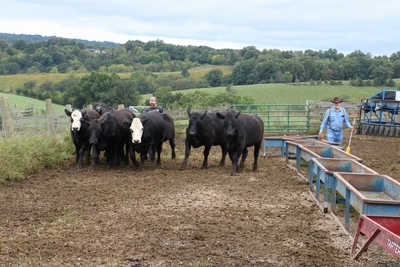
That reality is especially stark given his occupation as a beef cattle farmer, or “playing cowboy for a living” as he calls it. He’s the manager of the Eden Shale Farm, a demonstration farm that raises 100 beef cattle to help educate other cattle farmers on best practices. The farm is overseen by the Kentucky Beef Network, a part of the industry group Kentucky Cattlemen’s Association.
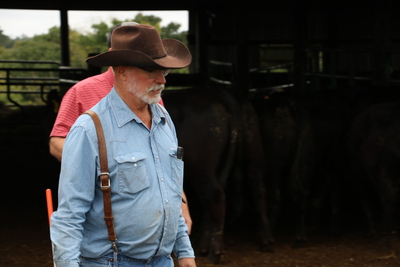
“You can accept what your cards are dealt, or you can be mad about it,” Cole said. “This is what I’ve done all my life, and I’m not going to change that.”
On a cloudy September day, his lifelong work meant corralling cattle on the Owen County farm as a part of the weaning process, a chorus of bellows heard from the cows in the pens. He tested positive for alpha-gal two years ago, while his wife tested positive about a year later.
He’s been able to pivot, learning to appreciate other foods including seafood, chicken, turkey — “I make a mean turkey burger” — even if he occasionally misses beef. He said he and his wife drive about 40 miles north to a Kroger grocery store that’s well-stocked with options including vegan products. He mentioned how some people are raising ostriches as an alpha-gal safe alternative. They’ve also grown accustomed to bringing their own food to local Cattlemen’s Association events as well.
“So far we haven’t found a treatment. It’s just dealing with it,” Cole said. “I don’t know if we’ll ever see a treatment or cure or not.”
Winter, the state epidemiologist, said research is still active and ongoing around potential treatments, including ways to mitigate or reduce symptoms, though the current guidance is to avoid exposure to food and other products that could trigger a reaction. Some people have sought out a specific form of acupuncture that some people say helps with symptoms, though Winter said there is “no clear recommended treatment at this time.”
Adapting to alpha-gal, though, has been a harder challenge to grapple with for some of Petzinger’s younger family who live just down the road from the Eden Shale Farm.
Petzinger, who was assembling the dark, clay pieces of soap dishes to be put in her kiln, told the Lantern that her 10-year-old niece has had to go to birthday parties where “you can’t have any of the cake or ice cream.”
Petzinger’s mother will bake “alpha-gal safe cupcakes for her to take to the party.”
Her own 13-year-old daughter has struggled at times with managing an alpha-gal-safe diet, too.
“It’s just so hard. They have enough going to deal with as a teenager,” Petzinger said.
Frankfort