Southern Nevada activists organize ICE response network
Feb 06, 2026 | 8:00 am ET
Description
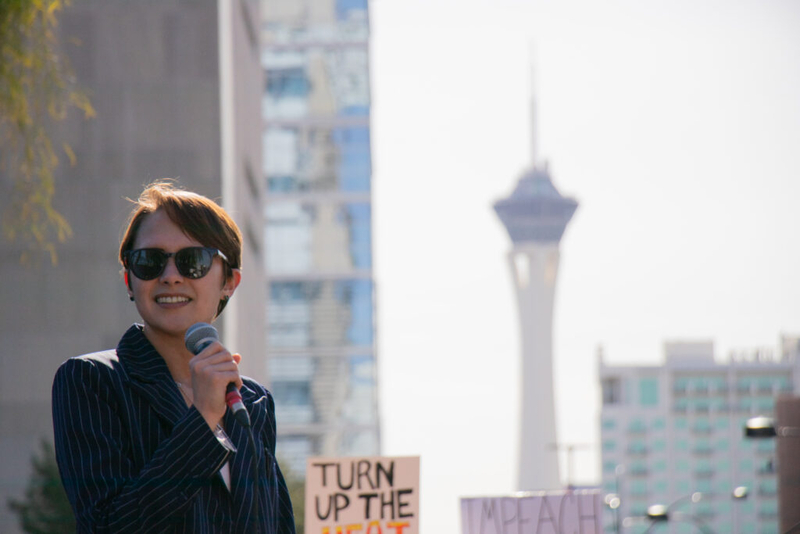
“We’ve had hundreds of new sign ups to the point where we have to expand our training,” said Lauren Doctor, an organizer with LV Defensa. “People aren’t afraid to say that ‘this is wrong’ and that I need to fight back.” (Photo: Matthew Mondschein/Nevada Current)
The Trump administration’s violent immigration raids in Minneapolis have stirred locals in Southern Nevada to organize their own resistance networks to protect their communities from federal immigration enforcement agents that already operate in the state and any future escalation.
LV Defensa is a grassroots rapid response network in Southern Nevada that formed in October 2025. The group surged in membership by hundreds after federal agents killed two American citizens, Alex Pretti and Renee Good, in Minneapolis last month.
“We’ve had hundreds of new sign ups to the point where we have to expand our training,” said Lauren Doctor, an organizer with LV Defensa. “People aren’t afraid to say that ‘this is wrong’ and that ‘I need to fight back.’”
The organization modeled itself after VC Defensa, which Californians launched as a response to Immigration and Customs Enforcement (ICE) raids in Ventura County last summer. Through mutual contacts, organizers in Las Vegas directly learned effective tactics and structure from VC Defensa.
”As a rapid response network, we respond to ICE detainments,” Doctor said. “We neighborhood watch, act as legal observers and try to warn locals of activity and help them if they are taken.”
At a protest in downtown Las Vegas on Jan. 30, LV Defensa volunteers distributed small resealable plastic bags with American Civil Liberties Union “Know Your Rights” booklets and whistles on lanyards — a tool used by ICE resistance in Minneapolis. Whistles are simple, loud tools used to alert an immediate area of ICE activity and call for community backup. With the whistle came instructions in both English and Spanish for when ICE is detaining someone: blow in a steady rhythm, form a crowd, stay nonviolent and loud.
LV Defensa also trains volunteers on how to respond when locals call their hotline with ICE sightings—video documenting the scene and informing anyone being detained of their rights.
Doctor recalled her own experience responding to a reported ICE sighting.
“As soon as I saw the text that there’s an ICE spotting two blocks away from me, I immediately went to the scene,” Doctor said.
The area was cordoned off by the time she arrived, but she managed to see identification of the officers on scene by zooming in on her phone’s camera. They were members of the Las Vegas Metropolitan Police Department gang unit, which wear uniforms similar to Department of Homeland Security (DHS) agents.
Due to lack of education on how to identify ICE, Doctor said, the group gets many false alarm sightings, but doing the work to confirm those false alarms is important for the community.
On Jan. 29, the Nevada Immigrant Coalition (NIC), a statewide response network, heard rumors that ICE would be conducting traffic stops with Nevada Highway Patrol in the Reno-Sparks area. NIC verified that the report was false and recommended Nevadans not post unconfirmed ICE activity on social media in order to “prevent spreading fear and misinformation in the community.”
LV Defensa coordinates efforts with NIC and other grassroots organizations, Doctor said, as it streamlines sharing information and volunteers, as well as fundraising efforts for those directly impacted by ICE.
Those coordinated efforts have helped people like Emine Sahin, who was held in the Henderson Detention Center for 122 days while pregnant. She and her husband, Batuhan, told KLAS that she was not given adequate medical care while detained. Emine was released last week, but during those 122 days, the couple lost their home, one of their cars was repossessed while their only other is at risk of being taken as well. There are nights, the couple said, that they are forced to sleep in their car.
LV Defensa, as well as other local organizations like Fifth Sun Project, have helped fundraise for the couple’s GoFundMe to secure funds for temporary housing, prenatal medical care for Emine and other expenses. So far, $10,000 has been donated.
Fifth Sun operates an “Undocu-Relief Fund” which sources donations from the community to support migrant families with urgent financial needs: legal, medical or basic expenses. On social media, the group posts how funds were used for accountability purposes.
Emine’s story also demonstrates how ICE usually operates in Nevada. She was arrested in September 2025 for a domestic dispute, with all charges being dropped on Sept. 25. But she was not free to go. She instead was transferred to ICE custody.
Most immigration enforcement in the state, Doctor noted, is through LVMPD’s 287(g) agreement with ICE—which allows Metro to execute civil immigration warrants and detain individuals past their scheduled release so that federal agents can take them into custody.
The ACLU of Nevada alleged in a lawsuit filed on Oct. 13, 2025 that the agreement between Metro and ICE violates state law.
Doctor sees future ICE escalation in Nevada, as seen in other cities, as probable.
“Minnesota is the testing ground,” she said.
She disagrees with the argument that the casino industry, or Republican Gov. Joe Lombardo, are staving off ICE raids in Nevada. If the Trump administration’s mission in Minneapolis is without consequence, then the entire country, including Las Vegas, can be targeted, she added.
That belief is driving much of the interest in LV Defensa.
Minneapolis’ rapid response network also involved small business outreach, with volunteers standing outside businesses owned by immigrants, or businesses with signs in windows stating a refusal to cooperate with ICE without judicial warrants. This level of outreach is what LV Defensa is attempting to replicate.
“We’re hitting everywhere we can: gas stations, grocery stores, bars where people hang out so we can get to know each other,” Doctor said. Some volunteers are organizing door-to-door within their neighborhoods.
“Vegas is a large city, so getting people united, especially down to neighborhoods, is a lot of work but that’s what we’re focusing on,” she added.
The Jan. 30 protest was a part of a national call of action for no work, no school and no shopping. Organizers were able to get a few small businesses in downtown Vegas to close their doors in solidarity: Tofu Tees, LV Plant Collective and Fresa’s Skate Shop, all located in Ferguson’s Downtown. Yukon Pizza also closed its doors in solidarity with the people of Minnesota and all those brutalized by ICE, according to a social media post.
Nevada lawmakers are under voters’ microscope
In addition to grassroots organizing at the neighborhood level, more Nevadans are feeling more compelled to demand more from their elected officials in Washington.
U.S. Sens. Jacky Rosen and Catherine Cortez Masto, both Democrats, voted against a DHS funding bill, citing the need for ICE enforcement reforms.
Nevada’s three Democrats in the U.S. House voted against the funding as well.
U.S. Rep. Mark Amodei, the sole Republican Nevada representative, voted to fund DHS. The short-term funding measure was passed and signed by Trump, giving Congress and the White House a few more days to negotiate enforcement reforms.
U.S. Rep. Susie Lee listed some of these “guardrails” as requiring ICE to obtain warrants, mandating officers wear body cameras and proper identification, enforcing use of force standards and prohibiting arresting U.S. citizens, according to a statement.
A plurality of Americans support abolishing ICE entirely, according to a YouGov poll taken after the killing of Pretti. The sentiment echoed at a protest held at the federal courthouse in downtown Las Vegas on Jan. 30.
“We want ICE abolished and we won’t stand for anything else but that,” said Jasmin Lazaro, a registered nurse at the protest. Lawmakers seeking to reform ICE made Lazaro feel disappointed and angry “because it makes me think that they’re either not paying attention to the voices of their constituents or they’re complicit.”
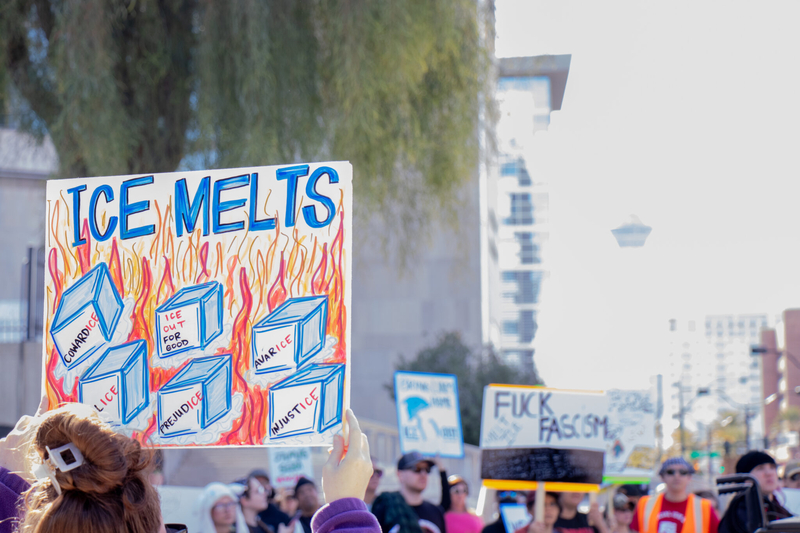
Lazaro and her wife, Tomi Love, also a registered nurse, attended the protest together as street medics, equipped with medical kits, N95 masks, and milk of magnesia to counter any chemical agents like tear gas that police deploy.
“As nurses we just want to be there to protect each other and protect our community while we exercise our right to peacefully protest,” Lazaro said.
The couple was also joined by Thomas Ramey, Love’s 92 year-old father and Korean War veteran, in his wheelchair. The protest against ICE was the first he’d attended in his life, and he carried a sign that read: “I skipped a nap for this. Angry veteran.”
Love was shocked at top Trump administration officials casting Pretti, who was an intensive care nurse at a VA hospital, as a “domestic terrorist” and “would-be assassin.”
“In nursing, we hold people accountable,” she said. “I don’t understand why they can’t be held accountable for the death and false representation of another human being.”
The protest ended with Doctor giving final remarks as community members lined up en masse to volunteer for LV Defensa and receive rapid response training.
“This doesn’t stop at voting. We need to come together as neighbors to protect our people to let them know that we are here and will stop them as they come.”
Las Vegas, NV