Snowstorm response heats up Providence mayoral race
Feb 02, 2026 | 6:41 pm ET
Description
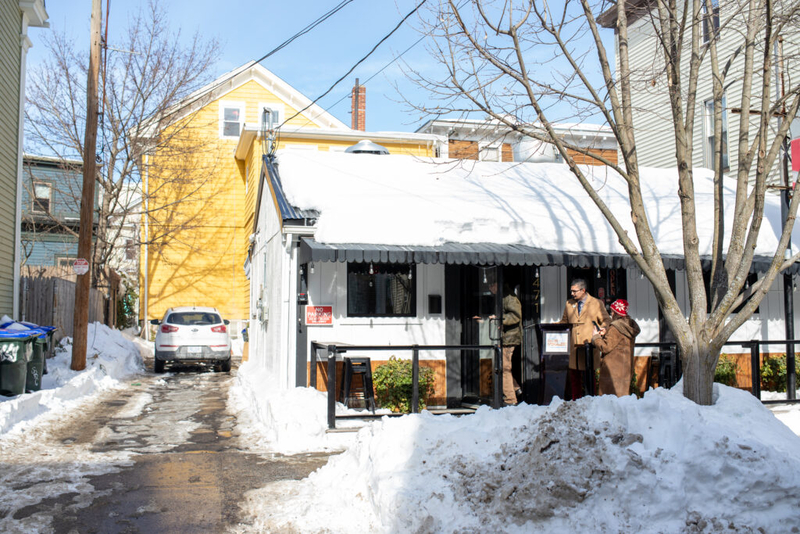
Mayoral candidate and Democratic state Rep. David Morales, center, enters There, There on West Fountain Street in Providence on Monday, Feb. 2, 2026, after a press conference criticizing the Smiley administration’s response to a late January snowstorm. (Photo by Alexander Castro/Rhode Island Current)
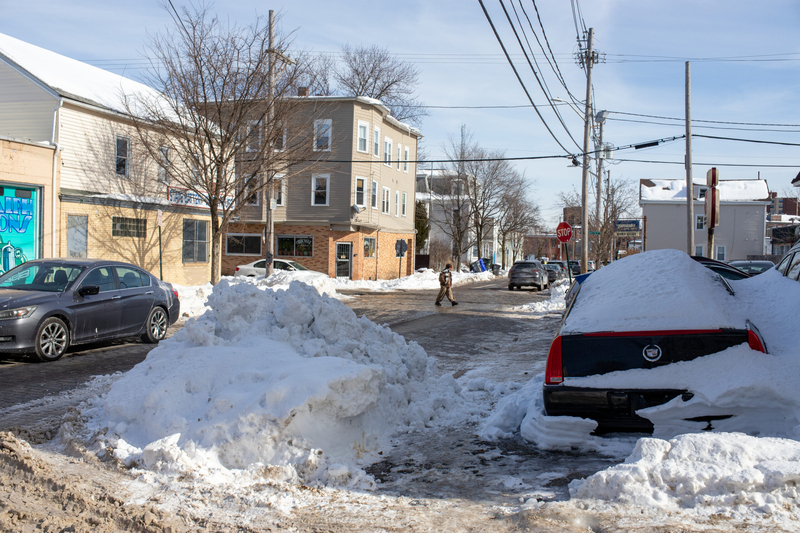
Providence mayoral candidate and Democratic state Rep. David Morales on Monday blasted Mayor Brett Smiley’s handling of city snow removal since the winter’s first big storm dropped approximately 16 inches of snow on the capital city last week.
“We heard the same trend and story over and over from our neighbors and from small businesses alike,” Morales said at a campaign appearance outside a West End burger joint. “Side streets that went left untouched, bus stops that were buried, driveways that were blocked.”
“This was not a failure when it comes to our front line workers between the Department of Public Works or the parks department, because they have worked long hours,” Morales added. “They’ve worked long hours in difficult conditions. More so, this is a reflection of a lack of coordination, a lack of planning and the lack of leadership.”
Morales set up a podium outside West Fountain Street’s There, There to announce how, if he were to become mayor, he would handle the city’s uncooperative winters.
Central to Morales’ plan is a public-facing plow tracker that would map out snowplow locations and allow residents to see when and where both city- and contractor-operated trucks are working to combat the piling snow and slush. A similar model has been used in places like Rochester, New York, Morales said.
Morales criticized Smiley for acting too hasty in lifting parking bans on Jan. 27 at 6 a.m. — just under two days after it had been enacted, and less than a day after there was more significant snowfall. Plow drivers were not given enough time to finish clearing some side streets which ended up “unfairly neglected,” Morales argued.
“I think that’s going to require a strategy on how we communicate with our neighbors about having phased out parking bans, as opposed to just simply having an umbrella announcement that a parking ban has been lifted.”
Josh Estrella, a spokesperson for Smiley, defended the administration in a statement over email Monday, saying that the mayor “implemented a coordinated, multi-department approach to addressing severe weather events.”
According to Estrella, the city used over 80 municipal personnel and “over 30 contractors to clear snow in every neighborhood.” Estrella said the city has kept its vendor bidding process open and offers drivers one of the highest hourly rates in the state in hopes of incentivizing more contractors to sign up for cleaning the city’s streets.
“Last week’s snow storm was one of the most severe in years, complicated further by additional snowfall on Monday,” Estrella said. “Mayor Smiley expressed from the beginning that this clean-up process would take longer than usual and has assured residents that our crews are still clearing streets.”
But at least some damage has been done, according to speakers Morales highlighted at his event — including Brandon Teachout, the chef and owner of There, There. The restaurateur said a dip in business during a major storm was to be expected.
“But we were cut by 70% because of lack of street parking and just the street conditions,” Teachout said. “People haven’t even turned on our street…And I know we weren’t even the worst street.”
Andy Nosal, a West End resident and transit advocate who Morales invited to speak at the press conference, said he frequently walks to Providence’s many eateries and businesses. He said he prefers errands on foot, and that he’s “not afraid of cold weather.”
“There’s no question that the city’s got to spend money to make it possible for me to get in my car and drive,” Nosal said. “And sometimes they spend a lot, and sometimes they do a good job, and sometimes not, but it spends zero to make it possible for me to safely walk or access the bus.”
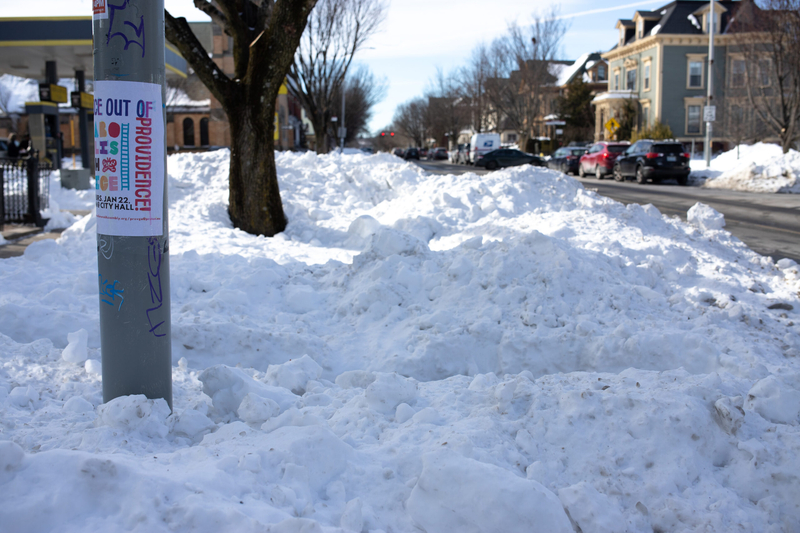
Both drivers and pedestrians have had to learn a little choreography on the streets of Providence in the past week. Plowed and piled snow decorates and frames sidewalks, and pedestrians have to find the footholds left by previous walkers to cross the street. Mounds of frozen white have crowded out bus stops, and the city’s narrower routes with on-street parking have become exercises in automotive patience, with two-way streets effectively reduced to one-ways in some areas.
Morales said he would tighten requirements for snow-removal vendors hired by the city, onboard contractors earlier in the year, and tailor contracts so that “additional plows and operators are automatically activated when snowfall reaches certain thresholds.”
As for sidewalks, the city technically leaves that responsibility to property owners, who are required to remove snow from the areas outside their properties. But Morales argued the city’s enforcement is inconsistent and often lands on tenants, seniors, or smaller landlords who may not have the capacity to deal with more than a foot of snow to remove.
Morales said the city could consider investing in sidewalk plows and other new and shiny winter infrastructure used in parts of the Midwest and Canada. The idea, he said, is to move away from punishing violations to being proactive and keeping routes passable — a major issue still in the city as of Monday, with pedestrians forced to move in nonlinear paths across streets and along sidewalks blocked by snow or ice.
“We want to make sure our students are able to get to school without the need of having to walk on the road,” Morales said.
Winter of discontent?
Morales — who was first elected in the Rhode Island House of Representatives in 2020 — has been building a base among the city’s younger, more firmly left-leaning voters as the preferred option in September’s upcoming Democratic primary.
The incumbent Smiley has a monetary advantage over Morales. As of 2025’s Q4 campaign filings, which were due Monday, Morales had an ending balance of $89,088.64 in his campaign account.
Smiley’s Q4 filing was not available as of press time, but Q3 filing from Oct. 31, 2025, showed an ending balance of $1,080,088.
Still, snow can weigh down a candidate if not handled properly, said Wendy Schiller, the Alison S. Ressler Professor of Political Science at Brown University, in a phone interview Monday. Schiller gave the example of when, in 1979, Chicago Mayor Michael Bilandic lost his chances at reelection to a primary challenger, in large part due to how his administration handled a snowstorm.
Smiley’s handling of the snowstorm is all the more curious, Schiller offered, when juxtaposed his first mayoral campaign’s emphasis on efficiency in public works.
“It just seems as though his administration should have been far better prepared for this kind of snowstorm,” Schiller said.
That Smiley’s team came off as “caught off guard or just unprepared” for the snowfall is not totally insignificant in an election year, Schiller said, especially since “there seems to be a groundswell among the average voter of dissatisfaction with the government.”
“It can be the Trump administration, it can be the McKee administration,” Schiller said. “It doesn’t seem to matter as much this year. What party you’re in, you’re seeing Republicans challenging lots of incumbent Republicans, and you’re seeing Democrats all over the place challenging well-established Democrats.”
Smiley’s leadership was “excellent” after the Brown University mass shooting and manhunt in December, in Schiller’s assessment. Still, she spied another awkward juxtaposition between that recent public goodwill and Smiley’s being out of state during the snowstorm’s aftermath last week. He was attending the 94th Winter Meeting of the U.S. Conference of Mayors in Washington, D.C.
“I do think the mayor is going to have some work to do to regain the confidence of people in the city to be able to handle basic functions like snow removal,” she added.
Providence, RI