Slotkin, bipartisan group of lawmakers introduce bill to improve ovarian cancer prevention and care
Sep 30, 2026 | 5:57 pm ET

Description
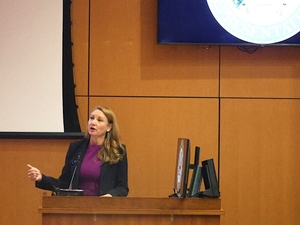
U.S. Sen. Elissa Slotkin speaks during the Michigan Democratic Party Legacy Dinner in Detroit, Mich., on April 18, 2026. (Photo by Andrew Roth/Michigan Advance)
U.S. Sen. Elissa Slotkin introduced legislation in Congress to expand access to ovarian cancer prevention and care, including expanding access to genetic counseling and testing, improving hereditary cancer risk assessment, strengthening cancer education, and helping patients connect with specialized gynecologic oncology care.
The bill, cosponsored by Republican Sen. Katie Britt of Alabama, was introduced on Sept. 24 and referred to the Senate Committee on Health, Education, Labor, and Pensions. A counterpart bill in the House was introduced by Connecticut Democratic Rep. Rosa DeLauro and Nebraska Republican Rep. Don Bacon.
“No family should have to fight both a cancer diagnosis and their insurance company at the same time,” Slotkin said in a press release. “Women, especially in rural communities like Michigan, should be able to get the genetic testing and specialty care they need to catch this disease early or prevent it altogether. Our bill tackles this issue from every angle — awareness, outreach and access to care and testing — and I thank my colleagues from across the aisle as we all work to save lives.”
The bill, known as the “Ovarian Cancer Improving and Modernizing Prevention, Access, Care, and Testing Act,” would expand access to gynecologic oncology specialists in rural and medically underserved communities, including through telehealth, as well as prioritizing grants focused on rural, underserved and high-risk communities.
Slotkin also noted her own personal connection to the legislation, having lost her mother to ovarian cancer at 64 and her grandmother to the disease at just 39
A press release from Slotkin’s office notes that ovarian cancer is the fifth-leading cause of cancer deaths among women in the United States. When caught early, the five-year survival rate for the disease is over 90%, but most cases are only detected after the disease has reached an advanced stage.
“We have an evidence-based strategy to reduce ovarian cancer risk and save lives with salpingectomy but need solutions to remove barriers to this care,” said Dr. Sandra E. Brooks, CEO of the American College of Obstetricians & Gynecologists, referring to the procedure which removes the fallopian tubes. “ACOG is proud to endorse the Ovarian Cancer IMPACT Act, which would expand awareness of and access to evidence-based prevention strategies, helping spare more patients and families from the devastating burden of ovarian cancer.”
Lansing, MI