Senators advance nicotine, vape tax to fund pediatric cancer research
Apr 14, 2026 | 6:27 pm ET
Description
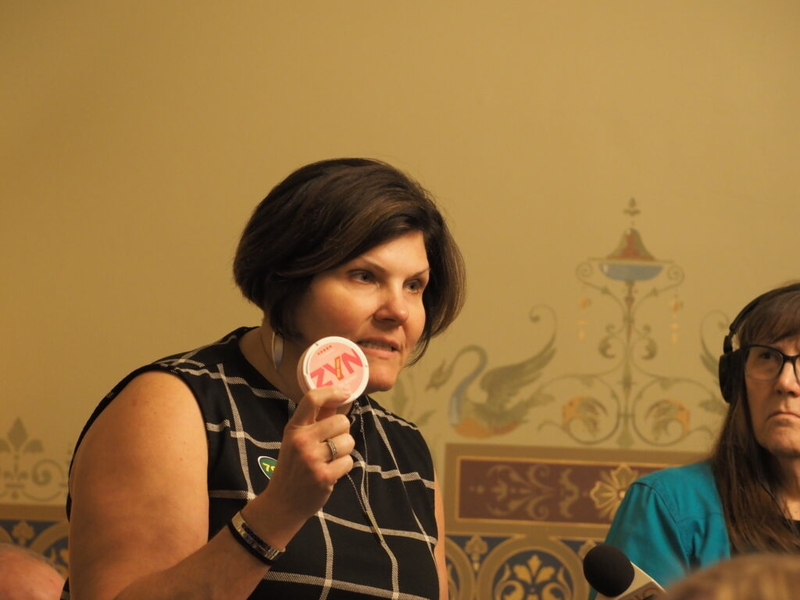
Threase Harms, representing the CAFE (Clean Air for Everyone) Iowa Citizen's Action Network, held up a nicotine pouch container labeled "Zyn" at a subcommittee meeting April 14, 2026 discussing a potential tax on alternative nicotine products and vapes. (Photo by Robin Opsahl/Iowa Capital Dispatch)
As Iowa lawmakers aim to find ways to address the state’s high cancer rates, a Senate subcommittee and committee advanced a bill Tuesday that would put a 5-cent tax on vapes and nicotine pouches — which anti-smoking advocates said would not significantly curb use of these products.
Senate File 2480 proposes a 5-cent tax on “alternative nicotine products” and vapor products. This tax would be applied on a per-unit basis — a container of nicotine pouches containing up to 20 pouches would be taxed 5 cents, and a proportionate tax would be applied for each unit above 20 within a container. For vape products, the five 5-cent tax would be applied per milliliter of nicotine in a solution.
The tax would apply to both disposable vapes and cartridges used in other vapor products — but would not apply to components, parts or accessories used in the device “when not sold in combination with any substance containing nicotine,” tobacco or nicotine analogs.
The money from this tax would go toward the state’s health care trust fund — a Medicaid appropriation program. Beginning in fiscal year 2028, up to $3 million of the revenue generated from the new tax would go to the Iowa Board of Regents specifically to conduct pediatric cancer research, clinical therapy trials and provide physician-scientist leadership at the University of Iowa Stead Family Children’s Hospital.
Multiple parents of children who were diagnosed with cancer spoke in support of the measure during the subcommittee meeting. Scott Kaas told lawmakers his daughter, Devyn Kaas, was diagnosed with acute myeloid leukemia, a type of bone marrow cancer, in 2023 when she was 7 months old. He said in the past three years, he has advocated for the Iowa Legislature to fund pediatric cancer research — and following lengthy discussions with lawmakers, this bill alongside a measure in the House have provided potential solutions to fund this research in Iowa.
“On behalf of my daughter and all the children in Iowa that suffer from from cancer, this bill is important,” Kaas said. “We just urge you to pass it.”
But several advocates representing health organizations said the measure did not go far enough. Threase Harms, speaking on behalf of the CAFE (Clean Air for Everyone) Iowa Citizen’s Action Network, called for lawmakers to instead pursue a “more consistent, fiscally responsible approach to nicotine and tobacco taxation” than the “nickel tax” being proposed.
Harms brought a container of nicotine pouches labeled “Zyn” to show the small impact of the tax based on how much nicotine was being sold. While advocates representing the industry said they estimated the tax would have generated $14.8 million for the state if applied in 2025, Harms said that number was likely inaccurate, as it assumes the 10% to 15% of the Iowa population using these products are purchasing at the same rate that people purchase cigarettes and other tobacco products.
She said this was not correct, as products like the container she showed have “the same amount of nicotine as anywhere from three to 22 packs of cigarettes.” A lobbyist representing Philip Morris International said was an illegal product not sold by their company, as it contained more pouches than allowed in distribution.
Harms also brought a Geek Bar — a disposable vape — which she said would be taxed at roughly 80 cents under the proposal, but which contains the equivalent to “22 packs of cigarettes.”
Harms said she believed the bill “encourages and incentivize(s) more products to be purchased to increase revenue.”
“I would actually ask, what’s the intent of the bill?” Harm said. “Is it to address the tax, and kick this issue down the road for another 20 years — because that’s how long it’s been since we’ve addressed tobacco tax? Is it to raise a little bit of revenue so that we can then addict the next generation of youth to use these products? And so I would tell you that the goal of the tobacco control community is to reduce the death and disease caused by these products, by curbing youth initiation. This bill doesn’t get it done. It’s not going to do anything.”
Jackie Cale, representing the American Cancer Society Cancer Action Network, said while their organization was supportive of funding cancer research, it was “unfortunate to see that a really good bill has been attached to a rather disappointing tax policy.” She said advocates prefer House File 2758 — the proposal that would provide pediatric cancer funding through a standing appropriation — while saying the 5-cent tax proposal would have a “negligible” impact on preventing people from purchasing nicotine products.
She also spoke in support of another House proposal — House File 2406, a measure introduced by Rep. Brett Barker, R-Nevada, that would raise on cigarettes by $1.50 alongside other nicotine and vape products — as a better solution to decreasing nicotine use in Iowa.
Some advocates representing businesses that sell nicotine products, like vape stores, grocers and convenience stores, said the tax could have a negative impact on Iowa businesses, as it would drive consumers not to quit smoking, but to go to other areas where these products are sold for a lower price.
Rep. Janet Petersen, D-Des Moines, opposed the bill. She said the measure was an “industry bill” — and a measure that may not result in the state providing $3 million in funding for pediatric cancer research. The bill states that beginning July 1, 2027, “an amount not to exceed” $3 million from the revenue collected through this tax would go toward UI pediatric cancer research, but Petersen said the measure does not include a minimum allocation for this fund.
She said this was concerning, as the tax stream could be diverted to address expected funding shortfalls for Iowa’s Medicaid program in the future.
“That means it could be $1 — and so, this is not a guaranteed $3 million dollars,” Petersen said. “… And if you look at the current Medicaid situation and the amount of shortfall we’re going to see in the upcoming years, they could completely scoop that money from pediatric cancer to try and just fill the hole we know we’re facing.”
Republicans on the subcommittee said they would be open to making changes to the bill if Petersen’s interpretation of the language was correct. Sen. Carrie Koelker, R-Dyersville, said she supported moving the bill forward to keep the conversation going.
“I don’t know if this bill is in its final perfect form,” Koelker said. “I would agree it’s probably not. But I think that it starts with a conversation, and we can adapt it and adjust or grow it.”
Petersen reiterated her concerns during the Senate Ways and Means committee meeting Tuesday afternoon, saying she was “sorry” to see pediatric cancer research funding and this tax in the same bill. However, she was a yes vote on the legislation in the hopes of introducing an amendment when it gets introduced on the Senate floor.
Sen. Dawn Driscoll, R-Williamsburg, called the bill a “great start” in providing dedicated funding for pediatric cancer research, which currently isn’t funded at all. The legislation passed in the committee and will move to the Senate floor for potential debate.
— Brooklyn Draisey contributed to this report.

Des Moines, IA