Secretary of State responds to legislative subpoena, with pushback
Sep 14, 2026 | 7:30 pm ET
Description
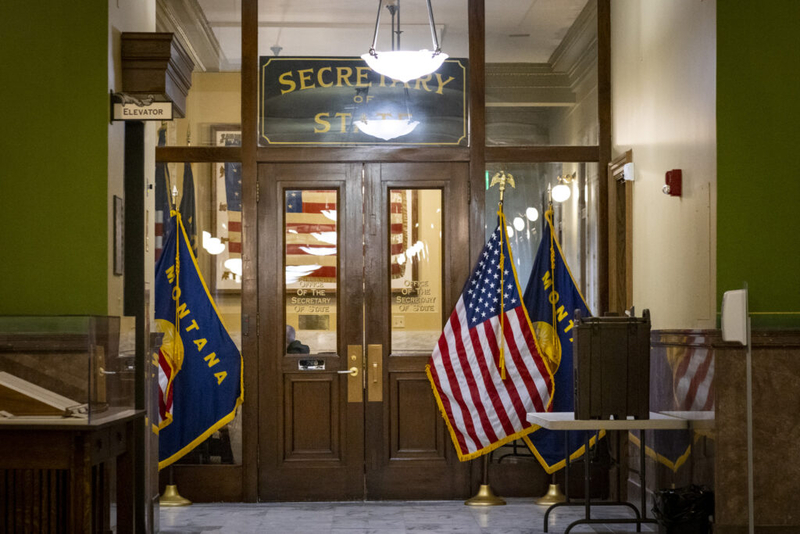
The Secretary of State’s office in the Montana State Capitol in Helena on Wednesday, April 26, 2023. (Photo by Mike Clark for the Daily Montanan)
Montana Secretary of State Christi Jacobsen responded to a legislative subpoena to disclose voter roll information her office provided to the federal government, but also objected to the demand and described it as “political theater.”
For months, members of the State Administration and Veterans’ Affairs Interim Committee have been trying to find out exactly what information Jacobsen, a Republican, provided to the federal government in response to the U.S. Department of Justice’s demand for voter records.
Earlier this month, the committee voted 10-1 to approve the subpoena for the information.
“The subpoena was an unnecessary encroachment on the separation of powers that wasted taxpayer dollars, could have been avoided, and lacked warranted scrutiny,” said the letter from Montana Secretary of State Chief Legal Counsel Austin James.
But the response also outlined the categories of information the Secretary of State’s Office provided to the Department of Justice — to varying levels of satisfaction from members of the committee.
The Secretary of State’s Office did not share driver’s license or state identification numbers with the federal government, but it did share the last four digits of Social Security numbers — generated by the federal government — for the fraction of voters who use their Social Security numbers to register to vote, according to the response letter.
The DOJ has demanded states turn over voter lists to ensure ineligible voters are not included and has sued 30 states and Washington, D.C., for the records. It has lost 23 of those lawsuits to date, according to the Brennan Center for Justice.
Some state legislators have worried the Secretary of State didn’t protect Montanans’ privacy in responding to the federal government, but Jacobsen has largely been absent from legislative meetings and unresponsive to the committee.
James previously told the committee the office protected the privacy of Montanans, but he declined to provide specific information to lawmakers, citing the threat of litigation.
The Sept. 11 letter in response to the subpoena said in August 2025, the Secretary of State’s Office provided the U.S. Department of Justice the public statewide voter registration list “available to any member of the public.”
It stated the type of data provided, and it included voter ID numbers, names, voter status, addresses (minus those protected from disclosure), phone numbers, birth years, precinct, other political districts, and “absentee indicator.”
“While demanded by the Department as empowered by Congress, the list provided did not contain any Montana driver’s license number or state identification card number,” the letter said.
In December 2025, the office again sent the voter registration list, but “this time with the addition of a federal identifier for a portion of voters where that information was provided as part of their voter registration application,” the letter said of partial Social Security numbers.
The Secretary of State’s Office said “a fraction” of voters who don’t have a driver’s license use their “federal identifier” instead, or the last four digits of their Social Security numbers, and in those cases, the office provided the last four digits. (The letter did not state how many voters that encompassed.)
The letter said the office keeps partial Social Security numbers “from general public distribution.”
But it said the last four digits aren’t considered a Social Security number by the U.S. Privacy Act, the federal government “routinely receives” those identifiers “that the federal government itself provided,” and they were provided under “nondisclosure requirements.”
The letter from the Secretary of State’s Office also said it did not consider the subpoena valid for a number of reasons, and it warned that such actions set up a confrontation between branches of government.
The Secretary of State’s Office cautioned legislators against any further subpoena for voter registration records. It said it considers the subpoena answered and will not produce additional information “absent a court order.”
Monday, Manzella said she is satisfied with the response from Jacobsen and believes the Secretary of State protected Montanans’ privacy.
“I believe that she is obligated to, under federal law, do what she did, and I think she both did what she could to protect our citizens’ privacy and also honor our request,” Manzella said.
Manzella said she approves of where Jacobsen drew the line because she protected state information, the driver’s license numbers, but she shared partial information the federal government itself generates.
“I personally don’t have a problem with the federal government requesting driver’s license numbers simply because we are a citizenry that moves across state lines on a daily basis,” Manzella said. “And I believe that the priority on elections needs to move from privacy to transparency and auditability.”
Rep. Kelly Kortum, a Bozeman Democrat, raised the idea to issue the subpoena, and he said he is not satisfied with the response from the Secretary of State.
However, Kortum also said he is likely to be the most aggressive voice on the committee on the issue, and he said it would be important to hear from Manzella and Rep. Marc Lee, a Democrat and committee vice chairman.
Kortum said the letter describes the information the Secretary of State says it sent the DOJ, but it does not provide the actual portion of the data file showing the categories.
He said the Secretary of State still is avoiding “showing us the top line on that spreadsheet.”
“I do believe the will of the committee is being thwarted,” Kortum said.
Lee said the letter was full of legalese, and he believes it fell short of the demand in the subpoena. He said he was anxious to speak to legislative staff to see if they could shed light on the response.
Lee also said Montanans value their privacy, and he doesn’t believe the idea that the federal government already has information is a justification for turning over data.
“Why would the federal government ask for stuff that they already have?” Lee said. “There has to be some sort of information that was provided to the federal government that they are not privy to.”
The Brennan Center for Justice, which has a mission to defend democracy, has described the demands by the Department of Justice as unprecedented and an encroachment on states’ authority to run elections.
Lee said legislative staff earlier indicated the committee was on solid ground in issuing the subpoena. He said his interest is in transparency from the Secretary of State’s Office.
“The Secretary of State forced us into this position because they weren’t willing to answer what I would consider a very basic question,” Lee said.
Manzella said the committee has a planned meeting in October, and if needed, it would schedule a special meeting about the subpoena.
Helena, MT