The SC Arts Commission should fund art, not police ideas
Sep 09, 2026 | 7:00 am ET
Description
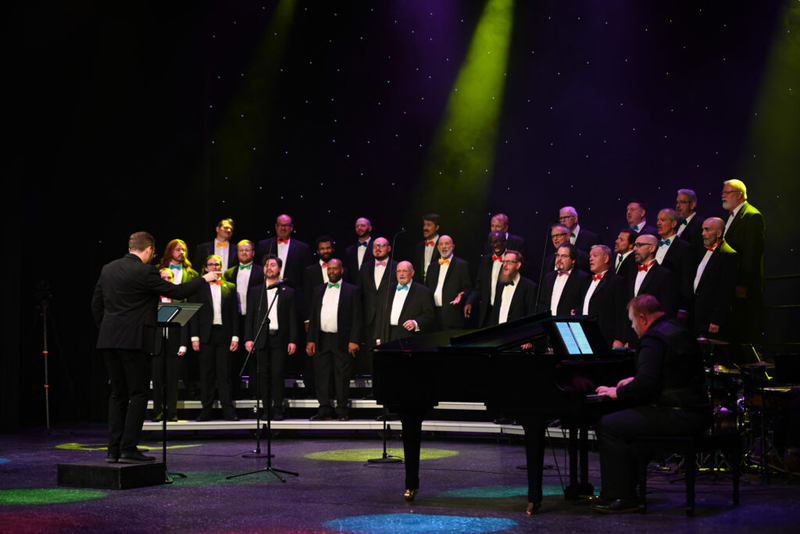
The Greenville Gay Men's Chorus, founded in 2011, consists of more than 35 tenors and basses "dedicated to artistic excellence, meaningful collaboration, and the power of choral music to build community and connection," according to the group's website. (Photo courtesy of Nakeshia Shannon)
The Greenville Gay Men’s Chorus and Proud Mary Theatre Company, two LGBTQ-related arts organizations in the Upstate, had been recommended for South Carolina Arts Commission grants through the agency’s normal review process.
The agency’s governing board approved grants for more than 170 other organizations. But commissioners singled out these two and postponed their grants until they can make another case for their artistic merit.
Why? The answer appears to have less to do with the quality of their art than with the ideas commissioners believe the organizations represent.
That should concern anyone who believes an arts commission ought to promote the arts rather than police the ideas expressed through them.
South Carolina law says that state arts policy should encourage and assist the arts “rather than limiting the freedom of artistic expression that is essential for the well-being of the arts.”
That language is bold and inspiring. It specifically tells the state to encourage artistic expression rather than limit it.
It is difficult to imagine a more direct statement of what an arts commission is supposed to do — and what it is not supposed to do.
The commission’s recent resolution says it may require grant recipients to certify that no Arts Commission money will be used for “expression that promotes an ideology.”
That raises a rather obvious question: What, exactly, is ideology?
If it means that art expresses ideas about the world, human beings and how we ought to live, then virtually all serious art becomes “ideological.”
Consider some of the greatest works in the Western artistic tradition.
Mozart’s “Requiem” expresses a profoundly Christian understanding of death, judgment, sin, mercy and redemption. So do Handel’s “Messiah,” Verdi’s “Requiem,” and Mahler’s “Resurrection Symphony.”
Walk through any museum filled with Old Master paintings. Michelangelo, Caravaggio and Rembrandt created works expressing ideas about God, humanity, suffering, salvation and the sacred.
Would we say that a symphony orchestra should not receive a state arts grant because the music it performs promotes “the ideology of the sacred”?
Of course not.
There is a perfectly sensible reason: The government supports the art because it is artistically meritorious, not because it agrees with the theology expressed in it.
The same principle applies across the artistic spectrum.
Beethoven’s Symphony No. 9 expresses a vision of universal brotherhood. “Les Misérables” explores poverty, justice, mercy and redemption.
Great art routinely asks us to think about what is right and wrong, beautiful and ugly, just and unjust, sacred and profane.
Indeed, what makes much great art great is precisely that it means something — often something profound.
If expressing ideas makes a work “ideological,” then virtually every serious arts organization in South Carolina would have to defend itself for expressing ideas that make us think.
And that is why the question before the Arts Commission shouldn’t be whether it approves of the ideas associated with the Gay Men’s Chorus of Greenville or Proud Mary Theatre Company.
The question should be much simpler: Is the art good?
The commission’s own grant-review process answered that question in the affirmative.

According to published reports, the organizations were among those recommended for funding ($13,050 for the chorus, less than $4,000 for the theatre company) before commissioners intervened.
Both organizations have also received Arts Commission grants in the past, without an apparent concern over ideology.
An arts grant is not an endorsement of everything an organization believes. It is an investment in the state’s cultural life.
South Carolina is enriched by having a broad range of artistic organizations — orchestras and theater companies, dance troupes and museums, gospel choirs and chamber ensembles, traditional artists and artists who challenge traditional ideas.
We don’t make our culture stronger by narrowing that range.
There is also a larger American principle at stake. We are a nation built on freedom of speech and artistic expression. Those freedoms aren’t reserved for ideas that happen to be popular with the people holding political power.
Government doesn’t have to agree with an artist to recognize the artist’s right to create.
As someone who has watched the South Carolina Arts Commission for three decades, I have seen it stay above the culture wars that have increasingly poisoned our public life.
That has been one of the commission’s strengths — and one of the reasons its current course is so disappointing.
The Arts Commission has an important role in South Carolina’s civic life precisely because it has generally resisted turning the arts into another battlefield in our culture wars.
Its current course is a departure from that tradition — and a reminder of why the commission’s independence matters.
The state should judge art on its merits and leave the ideas to the artists and their audiences.

Columbia