Rogers, El-Sayed clash over Iran, healthcare and Muslim Brotherhood during second debate
Oct 21, 2026 | 9:42 pm ET
Description
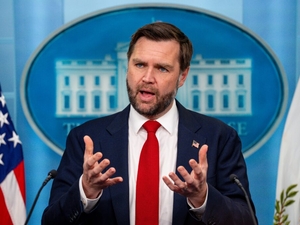
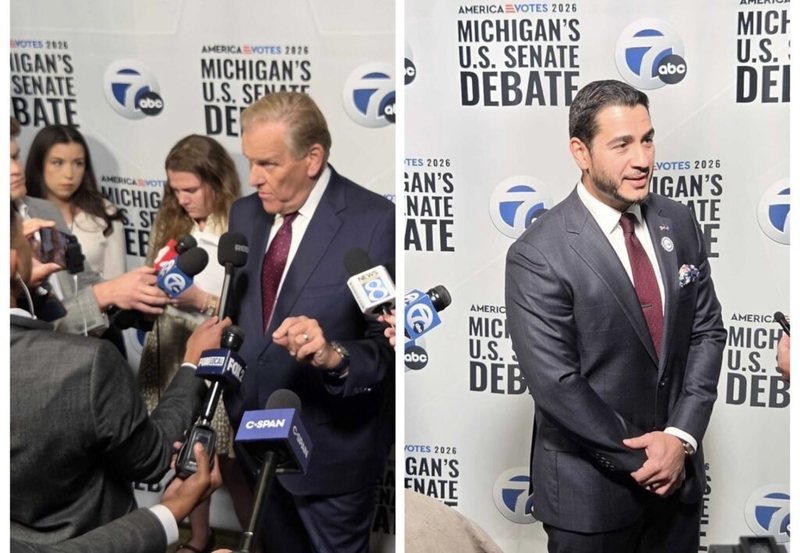
Republican nominee for U.S. Senate Mike Rogers, right, and Democratic nominee for U.S. Senate Abdul El-Sayed, left, talk with reporters after a televised debate at WXYZ-TV, on Wednesday, Oct. 21, 2026, in Southfield, Mich. (Photos by Ben Solis/Michigan Advance)
SOUTHFIELD — In the wake of a fiery first debate that saw more punches thrown than policy points argued, Michigan’s U.S. Senate nominees, Abdul El-Sayed and Mike Rogers, faced off once again on Wednesday evening during a forum hosted by WXYZ-TV in Southfield.
El-Sayed and Rogers are in a toss-up race, according to Cook Political Report, and the growing animosity between them on the campaign trail has dominated the contests’ fourth-quarter dynamics.
Rogers has tried to frame El-Sayed as a communist for his more progressive-leaning platforms, including Medicare for All, and has claimed that El-Sayed had donors with ties to the Muslim Brotherhood. Meanwhile, El-Sayed has painted Rogers as an out-of-touch millionaire who would be a “sock-puppet” in lock-step with the agenda of President Donald Trump if elected to the Senate. El-Sayed has also hammered Rogers about his support of Trump’s tariffs, the One Big Beautiful Bill Act, the administration’s immigration enforcement tactics and the war in Iran.
The first debate between the two, hosted by WOOD-TV in Grand Rapids, was an exercise in political bloodletting, with few opportunities to discuss the most pressing issues in the race. Instead, El-Sayed and Rogers aired their grievances against each other on the west Michigan broadcast.
Wednesday’s debate was no less contentious but allowed for space so the nominees could dig deeper into policy issues — likely a choice made by both candidates given the nature of the previous forum. That didn’t stop El-Sayed and Rogers from trading jabs.

For weeks, Rogers has said El-Sayed had ties to extreme Islamic movements abroad and that his donors supported those movements. Rogers has used El-Sayed’s sister’s past remarks on the Muslim Brotherhood, as well as his mother’s activism with the group, as reasons why voters shouldn’t trust him.
El-Sayed has denied that he has any ties to the movement, and questioned why he, as the potential first Muslim to serve in the U.S. Senate was fielding so many questions about dual loyalties.
In response to a question about police funding, Rogers again brought up the Muslim Brotherhood, prompting El-Sayed to say it was “shameful” that Rogers kept resorting to Islamophobic rhetoric in the race.
“To bring into question my commitment to the Constitution is really just beneath you,” El-Sayed said. “I’m proud to be an American. I’m proud of our Constitution that guarantees all of us the right to pray as we choose to pray, and the question that you would ask that, I think, is actually really quite shameful. As somebody who’s actually served under that Constitution, it is shameful.”
Rogers said his criticism wasn’t about El-Sayed’s religion — it was about the ideology that comes along with Islamic extremism.
“I wore the uniform of the United States proudly, as my son did, my wife served, my brother served, my father served, so you could pray any way you want,” Rogers said. “And I know you want to make this about you being a victim. This is about an ideology; an ideology that’s banned in five Muslim countries; an ideology that’s banned in another six different countries; an ideology that is very concerning to law enforcement in the United States because they use it for funding overseas operations. That’s the difference.”
Iran’s threat to America a key question in the race
The candidates were asked if Iran still posed a threat to the United States and how the conflict was affecting prices on gasoline and goods, especially after Trump claimed earlier this year that U.S. attacks have greatly curtailed Iran’s offensive and defensive capabilities, including its nuclear program.
El-Sayed said Iran remains a threat and that it was Trump’s fault for that nation’s new confidence in fighting a war with the U.S.
“That threat had been contained back during the Obama administration when he used diplomacy and not war to contain the threat. It was called the JCPOA, and Donald Trump, when he came in his first term, decided to rip that agreement up,” El-Sayed said. “And then, in his second term, he decided to make war. Now, mind you, Mike Rogers has been promoting this war since before he was in Congress. He’s got a war for everything, and he won’t back off the war now. He supports this war.”
El-Sayed said the consequences of the war are that Americans are now paying nearly $5 in gas, and more in groceries because of the high price of diesel. He cautioned voters from buying into Rogers’ campaign rhetoric on ending the war and distancing itself from Trump on Iran.
“If you don’t believe me, I want you to pay attention on Sunday when Donald Trump comes here at the invitation of Mike Rogers to remind you that in fact Donald Trump is on the ballot through Mike Rogers,” El-Sayed said.
Rogers said that Iran remains a threat because it will still endeavor to seek a nuclear weapon — which is different from Trump’s position that Iran’s nuclear capabilities had been “completely obliterated” in the first salvo of the new war.
“My opponent can’t even condemn the Islamic Revolutionary Guard Corps, which is the terrorist enforcement arm of Iran, and doesn’t believe Iran is any more dangerous than Israel,” Rogers said of El-Sayed. “This is an absolute non-starter if you’re going to send somebody back to the United States Senate. I left Congress in 2014. At that time, they had all three components of a nuclear program. The big debate was how do you put those things together, and how long would it take them to do that? Obviously, something triggered that where they needed to stop them from developing and putting those three pieces together to get a nuclear weapon.”
On the price impact of the current war, Rogers said that he “absolutely” believed that “if you want to pay $8 a gallon of gas, let Iran get a nuclear weapon.”
“You lose control of that whole region,” Rogers added.
ACA’s fate may be up for grabs depending on control of the Senate
On the topic of the Affordable Care Act, the nominees were asked if they would support expanding the law or further rolling back its provisions, which have occurred in Congress since the act was passed during President Barack Obama’s first term.
El-Sayed said he would support its expansion, and that his Medicare for All plan was the expansion that the program needed most.
Rogers said that the act needed reform, but pivoted to attack El-Sayed’s healthcare plan as just another big government program meddling in people’s healthcare decisions.
“Medicare for All … takes away your private health insurance. Five million Michiganders will lose their health care, and it will destroy Medicare for seniors,” Rogers claimed. “That’s what he’s talking about, and that’s why UAW for Rogers, they’re coming to our campaign. People understand just how ridiculous this is. There are other Democrats that will not support this plan because it’s outrageously expensive. It would be about $7 trillion a year in new expenses, about $20,000 per family in new taxes.”
Rogers has not been endorsed by the UAW; El-Sayed has. What Rogers was referring to was a group of autoworkers who supported Trump during his 2024 contest, led by conservative Ford retiree Brian Pannebecker.
El-Sayed capitalized on the moment to note that Rogers did not have auto workers’ support, and by saying that, “nobody knows better about denying people health insurance than Mike Rogers.”
“He voted against expanding health insurance for kids. For kids! Voted against it. Why? Because he’s in bed with big insurance,” El-Sayed said. “He took a million dollars from big insurance. He’s about to deny it, of course, but this is his record.”
Lansing, MI