R.I. tax revenue projections are up. Lawmakers are still down on FY27 budget outlook.
Nov 12, 2025 | 4:50 pm ET

Description
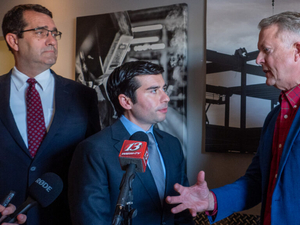
Rhode Island tax revenue projections rose $29 million for fiscal 2026 according to updated numbers adopted by state budget analysts at the biannual Revenue and Caseload Estimating Conference. (Photo by Alexander Castro/Rhode Island Current)
The gap between Rhode Island revenue and spending appears to have closed ever-so-slightly, though the outlook for the state’s fiscal 2027 budget remains bleak.
An extra $29.2 million is expected to flow into state coffers by June 30, 2026, equal to 3.3% of the $5.8 billion in general revenue expected for the year, according to new estimates adopted by state budget analysts Monday. The conclusion to the biannual Revenue and Caseload Estimating Conference also hiked revenue projections for fiscal 2027 by $173 million, assuming the state maintains the existing hospital tax rates.
An unexpected $202 million over the next two years is hardly sofa cushion change. But it’s little reassurance for state officials already facing a $300 million deficit heading into the year that starts July 1 alongside costly consequences from federal budget cuts to Medicaid, food assistance and other social programs.
“The results of the Revenue Conference are a welcome, albeit only slightly positive, update to our budget picture,” Speaker K. Joseph Shekarchi said in a statement Wednesday. “Our budget is otherwise significantly impacted by federal actions that limit access to affordable healthcare and critical services for many Rhode Islanders.”
Senate President Valarie Lawson also spoke to concerns over the impact of federal policy changes, which include bigger business tax breaks expected to diminish state revenue collections next year.
“Serious budget challenges lie ahead, particularly due to the impact of federal changes to health care, SNAP, and other vital services upon which Rhode Islanders rely,” Lawson said in a statement Wednesday.
A series of state commissioned reports unveiled in October offered a broad and dire account of the human and financial losses that federal budget cuts will create in Rhode Island, where more than one-third of the state’s annual spending plan comes from federal dollars.
But the projected financial fallout still requires more analysis, and further federal guidance. Actions by Congress could reverse some expected losses, such as the Dec. 31 expiration of federal tax credits under the Affordable Care Act.
Job losses and spending cutbacks amid the record government shutdown could also drag down Rhode Island’s economy well after the federal government reopens, with consequences worsening the longer the shutdown drags on, a Moody’s analyst warned state budget analysts in October.
Lawmakers are expected to devote much of the 2027 legislative session to understanding and compensating for federal funding cuts. The annual jigsaw act commences in earnest in January, when Gov. Dan McKee unveiled his version of a state budget, based on the newly updated revenue estimates.
McKee responded late Wednesday that he remains focused on “responsible fiscal management” and “an economy that supports stable employment and raising incomes for all Rhode Islanders.”
The $29.2 million revenue boost for the current fiscal year is driven by higher than expected personal income tax revenue, now coming in $55.5 million, or 4.4%, higher than projections from five months earlier.
Revenue from estate taxes contributed another projected $15.2 million.
The higher property tax revenue forecast does not account for a more controversial change to state property taxes that adds an extra tax on non-owner occupied homes over $1 million. The “Taylor Swift tax,” referred to because of its application to the pop star’s Westerly home, does not begin until July 1, 2026.
Lottery revenue also rose $10.3 million, or 4.1%, compared to prior expectations, driven primarily by video lottery and iGaming activity. In-person table gaming revenue and sports betting through Bally’s Corp’s two Rhode Island casinos slipped downward versus prior estimates.
The largest downward revision now expected in fiscal 2026 shows up in business taxes, now expected to come in at $33.4 million, or 4.7%, lower than five months ago.
Federal expansion of business tax deductions set to start in January, halfway through Rhode Island’s fiscal year, are expected to shrink state tax rolls by $79 million a year, according to state analysis. However, this could change if state lawmakers move to decouple state tax code from federal requirements, as they did for the 2025 tax year.
Tax revenue collected from financial institutions is now poised to be $9.7 million, or 51.2% less, while cigarette sales taxes are expected to drop $4.6 million, or 2.3%.
And, amid warnings of inflationary pressures and recession fears suppressing consumer spending, sales tax revenue projections have fallen 3.2%, or $581,707.
- November 13, 202510:03 amUpdated to include a response from Gov. Dan McKee and to clarify the revenue projections for estate taxes.

Providence, RI