As RI elections officials race to certify signatures by deadline, Arizona might offer a better way
Jul 16, 2026 | 5:15 am ET
Description
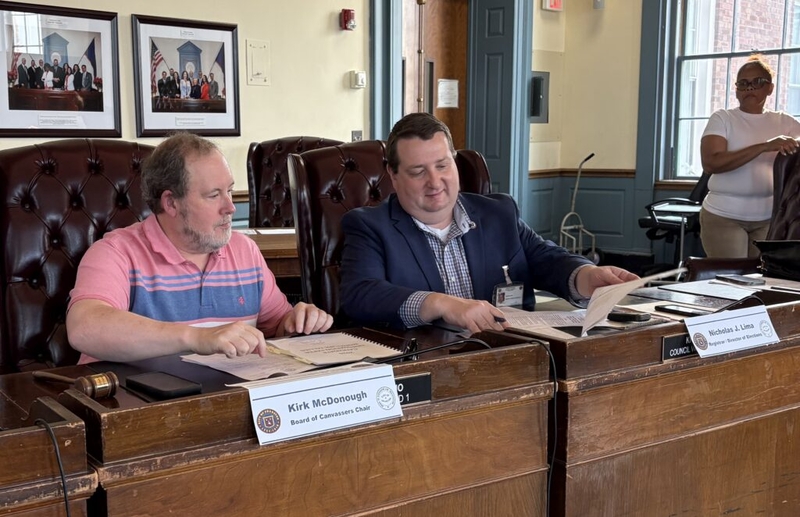
Kirk McDonough, left, chair of the Cranston Board of Canvassers, and Nick Lima, right, Cranston registrar and elections director, review nomination papers on Tuesday, July 14, 2026. (Photo by Nolan Page/Rhode Island Current)
Candidates braved sweltering temperatures and persistent rain on a tight deadline to get enough voters to sign their nomination forms to qualify for the ballot. Now someone has to count those tens of thousands of signatures.
That’s why Kirk McDonough said his hand was aching Tuesday night. The Cranston Board of Canvassers chairperson spent three hours with fellow board members sifting through stacks of nomination papers. It was their third meeting in seven days dedicated to certifying signatures candidates submitted up to the July 10 deadline.
Local canvassing boards have until 4 p.m. Thursday to verify the signatures of voters registered in their respective municipalities and deliver nomination forms to the Department of State Elections Division.
Independents running for governor in ‘do-or-die’ race to collect signatures
Even before those papers could reach the board for verification, four Cranston canvassing office staffers had to scrutinize each signature, matching them with voter databases to ensure their validity.
“For this two-week period, we come in early every day, we leave late every day, we skip lunch every day,” Nick Lima, Cranston’s registrar and elections director, said. “Your eyes can start to glaze over after eight hours.”
Cranston election officials had verified around 7,350 signatures and rejected up to 2,000 in the past eight working days as of Tuesday night. Each signature takes around 30 to 60 seconds to check, Lima added. That comes out to as many as 155 hours of verifying between four people over two weeks.
Lima said his four-person staff has reviewed upward of 1 million signatures and has more than 75 years of combined experience. Cranston is the state’s second most populated city. Smaller towns in the state may not have a full-time staff to validate nomination papers, he added.
To qualify for Rhode Island’s ballots, candidates for governor, president and U.S. senator must collect 1,000 validated signatures. Other statewide offices and U.S. representatives require 500, while state senators need 100 and state representatives need 50.
Signature verification is just one step in the election process. Lima said he and his team are consumed with the process from the declaration period in June to election certification in November and even into early December in case of recounts.
“We’re just jumping from priority to priority,” Lima said. “Yeah, it’s a little brutal for us.”
Is there a better way?
Signature-gathering is intended to weed out candidates and avoid a confusing, cluttered ballot, said John Marion, executive director of Common Cause Rhode Island. To trim candidate lists, he noted that courts have favored requiring candidates to prove they have enough support to make their place on the ballot worthwhile.
“Signatures aren’t a perfect proxy for support, but they are probably the best proxy we have,” Marion said. “No one has invented a better way than signatures.”
Every state uses signatures as a preballot measure for support, Marion said. Still, gripes with the current system have left candidates and officials questioning if there isn’t a better way.
Among them is Secretary of State Gregg Amore, who has been trying to make Rhode Island the third state to let voters sign nomination papers online instead of only on paper.
Amore first pitched that proposal to the General Assembly in 2025. It would make Rhode Island the first state in the nation to combine its online voter registration system with a candidate nomination signature portal.
Amore suggested integrating signature collection into a digital platform could add an extra layer of protection against security concerns. That could have prevented problems like the discovery of forged signatures on nomination forms submitted by Lt. Gov. Sabina Matos’ campaign for Rhode Island’s 1st Congressional District in the 2023 special election. Two campaign staffers were sentenced to felony charges for the fake signatures. Matos, who had been an early frontrunner in the race, was never charged and finished fourth in the primary.
Amore’s proposed portal would also only let users sign for candidates they are eligible to vote for in their district. Currently, nomination papers are designated for a specific municipality, and candidates must ask for a voter’s hometown to ensure they sign the correct sheet, raising the risk of valid signatures being tossed because they are on the wrong piece of paper.
Sponsored by Sen. Matt LaMountain and Rep. Brandon Voas, the legislation passed the House in both 2025 and 2026 but failed to advance out of committee in the Senate.
Arizona introduced its E-Qual system in 2012. E-Qual similarly lets voters sign nomination sheets online through a secure government portal. Candidates in the state still collect signatures on paper, but “E-Qual really is the bulk of it,” said Tony Cani, a Democratic political consultant in Phoenix. Arizona has a separate portal for online voter registration.
Online systems like Amore’s proposal, E-Qual and the portal New Mexico introduced in 2023 can reduce the burden on election workers.
Candidates or party chairs in Rhode Island can challenge the validity of individual signatures over a signature being unidentifiable or a voter being unregistered or not registered in the correct district. Those challenges can slow the verification process and become tools to try to knock competitors off a ballot, Cranston’s Lima said. Digital portals can largely eliminate those issues.
“You really can’t challenge an electronic signature,” said Constantin Querard, a Republican political consultant also from Arizona. “The usual reasons you might have for challenging the signature are all resolved.”
The proposed portal in Rhode Island faced outrage from some legislators, with House Minority Leader Mike Chippendale calling it “absolutely absurd” at the bill’s floor vote on April 30, 2026. He and other opponents said it would make it too easy to qualify for the state’s ballots and hold political power.
Arizona didn’t see significantly more or fewer governor candidates on its last three ballots since E-Qual was introduced in 2012. In 2002, 2006 and 2010, the state had an average of almost nine different gubernatorial candidates on at least one of its primary or general election ballots. That number decreased to almost eight after E-Qual in 2014, 2018 and 2022.
Cani and Querard said that online signature collection lowers the barriers for candidates to make the ballot, but doesn’t totally remove them. Someone taking the time to log in to a digital portal and sign a nomination paper can be “a more deliberate action” than signing a physical sheet, Cani said.
“At the end of the day, somebody still has to like you enough to log in and do it,” Querard said.
‘Beat the Clock’
Aaron Guckian, the endorsed Republican gubernatorial candidate, had the most validated signatures in the race at 1,864 as of Wednesday afternoon, according to a tracker on the Secretary of State’s website. In a phone interview, Guckian called holding office “an honor” that demands a rigorous qualification process.
“If you make it easy, then any Tom, Dick or Harry will get on the ballot,” Guckian said. “You have to earn it, and it shows people, especially your supporters, ‘Alright, this guy’s in it to win it.’”
On the same signature tracker, there was a blank space next to Steven “Wil” Gregersen. The Democrat dropped out of the governor’s race last week because he didn’t expect to clear the signature minimum, but he still supported a process to weed out candidates who are not serious contenders. He just wasn’t sure the current approach is right, saying it’s “like ‘Beat the Clock’” and particularly difficult for candidates with full-time jobs and without big-money campaigns.
“I would favor having people have more access and for it to be easier for people to get on the ballot and to be voted for,” Gregersen said. “I think it would help our democracy.”
Lima and McDonough both were in favor of Amore’s electronic signature proposal. Lima said an online portal would modernize the process and avoid “disenfranchising and disqualifying” candidates “because the bar is set arbitrarily or artificially high.”
Asked if an online portal could lower the bar to qualify for the ballot, McDonough had a simple response: “Why would we want to limit democracy?”
“People want to get out and they have something to say. They should be able to,” McDonough said.
Providence, RI