RI attorney general makes final push to boost enforcement powers against pharmaceutical middlemen
May 11, 2026 | 5:30 am ET

Description
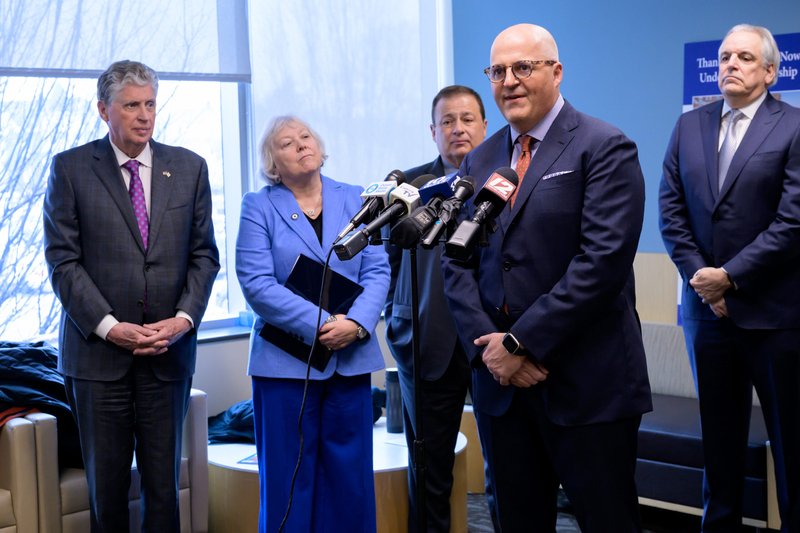
Prescription drug costs and pharmacy benefit managers are central concerns in several health care bills backed by Rhode Island Attorney General Peter Neronha this legislative session. (Photo by Alexander Castro/Rhode Island Current)
With his term ending in early January 2027, Rhode Island Attorney General Peter Neronha has less than eight months in the Ocean State’s highest lawkeeping post.
But there’s less than two months in Rhode Island’s lawmaking session, and the AG still has some legislation he’d like to see cross the finish line — namely a quartet of bills aimed at improving healthcare delivery, access and pricing for Rhode Islanders.
One bill seeks to slash prescription drug prices via pool purchasing, another would expedite a receivership process for struggling hospitals via Superior Court intervention, and the other two bills extend Neronha’s ongoing battle against pharmacy benefit managers, or PBMs as they’re known, by bolstering his office’s enforcement powers against the pharmaceutical middlemen.
“Last year, working with the General Assembly, we made significant strides by increasing primary care reimbursements and reducing burdensome and unnecessary prior authorization requirements,” Neronha said in a May 7 statement. “Yet our problems persist.”
Neronha helped to steer the state’s two safety net hospitals toward new ownership, has consistently advocated for higher Medicaid reimbursement rates for primary care physicians, and has used his powers to more tightly regulate healthcare mergers in the state. He has also filed lawsuits against PBMs, like Express Scripts and CVS Caremark, as well as their purchasing organizations
The latest tranche of bills he’s promoting continue to unspool these threads, Neronha said in his statement, noting that “Reimbursement rates are still too low” and that “Rhode Islanders are paying far too much for essential, life-saving medications.”
He added that his office will soon debut additional “proposals to structurally reorganize and reform the state’s health care agencies, including the creation of a new agency which will prioritize data-driven change.”
The four pieces of legislation have duplicates in both chambers of the state legislature, and all have been heard and held for further study (as is procedural standard) in their respective House committees. The Senate bills were still awaiting hearings as of Friday, May 8.
Here are the bills Neronha wants to see pass before this year’s legislative session ends in June.
Amending deceptive trade practices law
H8360 and S3260
Sponsors: Rep. Mia Ackerman and Sen. Robert Britto
The legislation would amend Rhode Island’s current law on deceptive trade to include certain practices performed by PBMs by defining them as unfair or deceptive. Examples of these suboptimal practices include redirecting patients toward PBM-chosen pharmacies, shackling pharmacies to do business with certain wholesalers, manipulating early refill limits, making the maximum allowable costs for drugs untenable, and restricting some uses of prescription data.
The legislation would also ban spread pricing, which is when PBMs pocket the difference between what a health insurer pays for a drug and what the PBM charges a pharmacy.
PBM Prime Therapeutics submitted testimony during the House bill’s hearing on April 14 that denied the core tenets behind the legislation.
“Spread pricing, network management, and tools to support patient medication adherence and monitor waste and abuse are all standard industry practices put in place to provide options for plan sponsors and support for members,” Prime’s Michelle Crimmins, a government affairs liaison, wrote in her letter to the House Committee on Corporations.
Sam Hallemeier, senior director of government affairs for the Pharmaceutical Care Management Association, wrote in his testimony, “Many small and mid-sized employers select spread pricing because it gives them predictable, stable drug costs without big month-to-month swings.”
“The ‘spread’ is simply the difference between what the PBM pays the pharmacy and what the employer pays the PBM,” Hallemeier wrote. “That difference can be either negative or positive – it transfers all the risk onto the PBM.”

PBM audit regulation
H8382 and S3258
Sponsors: Rep. Rebecca Kislak and Sen. Linda Ujifusa
The legislation builds on successful legislation from last year that increased the AG’s powers over PBMs. That legislation, also sponsored by Kislak and Ujifusa, was used by Neronha for the first time earlier this year, when he took action against unannounced PBM audits of independent pharmacies.
The bill would further narrow how PBMs can use claims of fraud, waste or abuse to perform audits that are exempt from certain state laws. PBMs are already limited in the number of audits they can perform annually, but can perform audits outside those quotas by claiming exceptions. Under the proposed legislation, PBMs would need to write their specific justifications and factual bases for any exempt audits and make the documents available to the Attorney General upon request.
Auditors showed up unannounced at 3 independent pharmacies. This RI law was ready for them.
Auditors could not rely on a common owner to justify investigating several independent pharmacies at once — an issue that occurred with the audits which spurred Neronha’s earlier investigation — and they would also need to notify the AG in advance of any exceptional audits. The bill would also authorize the AG to bring legal action and impose civil penalties of up to $10,000 each against PBMs that violate the law.
When the bill went before the House Committee on Health and Human Services on April 16, a mix of proponents and opponents similar to the deceptive practices bill submitted written testimony, with Hallemeier again decrying the proposal.
“In a time when the cost of health care continues to rise, it is more important than ever that fraudulent activity be prevented to keep these costs down,” Hallemeier wrote, citing audits as an essential tool against pharmaceutical fraud.
A state-managed drug purchasing pool
H8383 and S3257
Sponsors: Rep. Tina Spears and Sen. Lou DiPalma
This legislation would forge a state-run prescription drug purchasing pool via the Department of Administration (DOA), and allow municipalities, self-insured private employers and health insurance carriers to join a program that would allow them to take advantage of the state’s drug-purchasing power and realize additional discounts.
The Department of Administration, the AG’s office notes, would set the rules for eligibility, enrollment, payment, and participation. It would also allow the department to enter into multistate purchasing agreements to further rebates and price reductions. The legislation would also permit stop-loss coverage, which would prevent self-insured entities from being financially ruined by unpredictably excessive costs.
According to the National Conference of State Legislatures, as of 2023, there were five multi-state consortia which band their purchasing power together to buy in bulk. Three of these programs are Medicaid-based, while the other two involve state and local governments. Those involved in the Medicaid purchasing pools typically saved between 3 and 5% on drugs.
A similar logic of negotiation has animated President Donald Trump’s salvoes against drug pricing. Trump’s May 2025 executive order which laid the groundwork for TrumpRX argued that U.S. purchasing power alone should make pharmaceutical companies comply with his demands.
A process for hospital receivership
H8364 and S3244
Sponsors: Rep. Susan Donovan and Sen. Melissa Murray
With a petition from the AG or state health department, this legislation would authorize the Superior Court to take up and appoint a receiver over a hospital for mismanagement, financial distress, insolvency, illegal or fraudulent conduct, risk of losing assets, or threats to patients’ health and safety, to name a few.
The court could also liquidate hospital assets and business operations in some circumstances, and the receiver, with court supervision, could take over operations, preserve assets, begin litigation, or sell or dispose of property.
Neronha’s proposal likely derives from his experience and involvement in the multiyear saga to find new owners for Roger Williams Medical Center in Providence and Our Lady of Fatima Hospital in North Providence, two safety-net hospitals formerly owned by Prospect Medical Holdings. After federal bankruptcy proceedings held thousands of miles away in Texas, the Centurion Foundation ultimately closed the deal in March 2026 with a little help — about $18 million worth — from the state to help close the deal.
The price of saving Roger Williams and Fatima hospitals? $408M over 30 years
While the proposal is meant to reduce the likelihood of such a debacle in the future, several groups had concerns about the legislation when it went before the House Committee on Health and Human Services on April 9.
Lisa Tomasso, vice president of the Hospital Association of Rhode Island, wrote that, under the legislation, “a hospital could be placed into receivership and subject to asset liquidation based on broadly defined and subjective standards.”
“Hospitals in Rhode Island are operating under sustained financial pressure driven by reimbursement shortfalls, workforce constraints, and rising costs,” Tomasso wrote in her testimony. “Creating a mechanism that allows for court-directed takeover and liquidation in response to these conditions does not solve underlying challenges; it amplifies instability and uncertainty across the entire healthcare system.”
Providence, RI