Rhode Island lawmakers move at lightning speed on last night of session
Jun 11, 2026 | 8:29 pm ET

Description
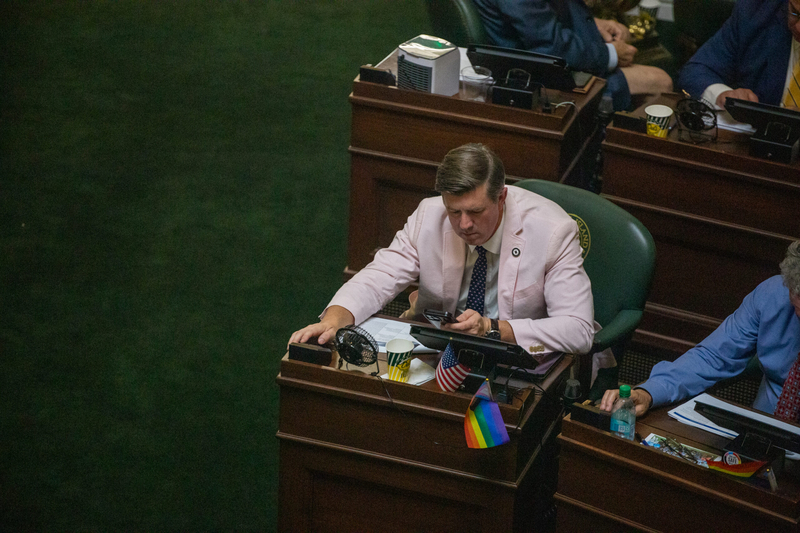
Rep. Brian Newberry, a North Smithfield Republican, takes a breather on the House floor during the final day of session on Thursday, June 11, 2026. (Photo by Christopher Shea/Rhode Island Current)
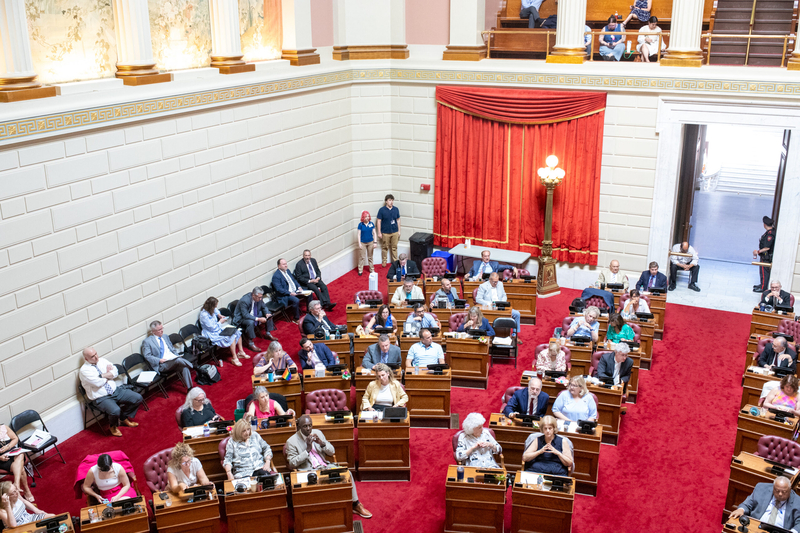
With controversial topics like charter schools and sex abuse claims against the Roman Catholic Diocese of Providence already decided — or preemptively killed in the case of a state Voting Rights Act — lawmakers whipped through the final day of the 2026 legislative session with unusual speed and agreement.
The initial calendars concluded by 6:30 p.m., though there may be more action following Senate committee gatherings later Thursday night.
The final session focused on the ceremonial approval by which one chamber rubber stamps the other’s identical bill, a process known as concurrence.
The lack of fiery debate contrasted with the steamy temperatures in the airless State House, inspiring Senate Majority Leader Frank Ciccone to replace his usual business attire with a pair of shorts for a second year in a row.
More in vogue than Ciccone’s fashion choices are measures that respond to and protect state residents from federal overreach, including restricting immigration authorities at state courts and polling places.
No new charter schools for the next three years
A three-year moratorium on new charter schools received final affirmation by a 30-6 vote from the Senate Thursday night, sending the legislation to Gov. Dan McKee’s desk.
The teachers union-backed bill has two parts: blocking new charter school approvals for three years and reducing the statewide cap on charter schools from 35 to 28.
Whether the embattled governor facing a tough reelection path will agree to both those provisions remains in question. McKee’s office said Thursday he was still reviewing the bill. During an unrelated event Wednesday, he told reporters he was fine with the moratorium, but uncertain about reducing the cap.
Still, the moratorium — which proponents have called temporary, and which opponents have described as more permanent than it might appear on its surface — did not exit the General Assembly without one more attempt to corral the legislation.
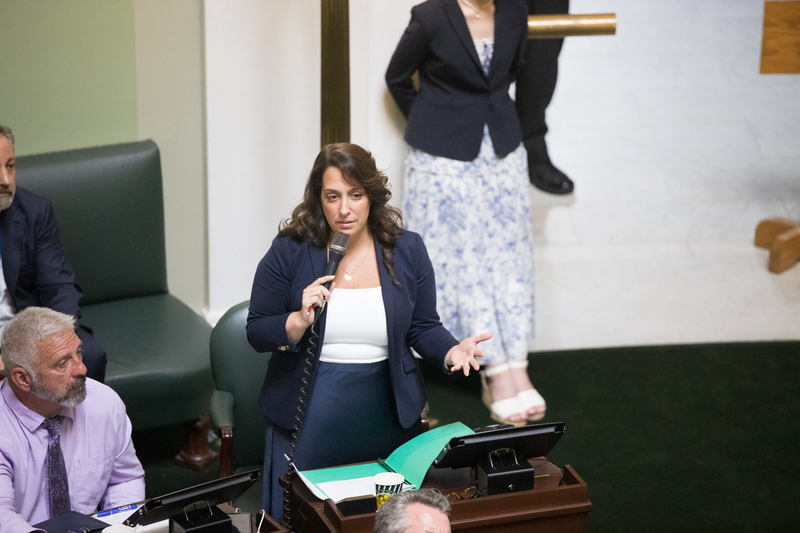
Senate Minority Leader Jessica de la Cruz introduced a floor amendment which attempted to tweak the bill to allow the opening of De La Comunidad Bilingual Charter School, a school that received preliminary approval from the Council on Elementary and Secondary Education in January. The planned K-12 dual-language charter school would serve students from Providence, Pawtucket and Cranston, but without final approval, it is ineligible for a Senate carveout added last week for charter school openings and expansions that have received the final OK.
“This amendment is about fairness, it’s about good governing, it’s about honoring the process that existed when the application was submitted,” de la Cruz, a North Smithfield Republican, said.
“The state told them, ‘Continue,’ the state encouraged them to invest, and then at the eleventh hour pulled the rug out from underneath 600 students and families without warning,” de la Cruz added.
Sen. Melissa Murray, the Woonsocket Democrat who sponsored the Senate moratorium bill, told her colleagues to reject the amendment.
“Preliminary approval is just that, it is preliminary,” Murray said,
The amendment still garnered 15 votes of support from progressives and Republicans, who were outnumbered by the centrist Democratic majority.
Freezing out ICE
U.S. Immigration and Customs Enforcement (ICE) officers cannot enter Rhode Island’s courthouses without a judicial warrant, nor can they be within 200 feet of any polling place in the state.
Lawmakers voted mostly along party lines Thursday to give final approval to “Protect Our Courts Act” filed in direct response to recent incidents where federal immigration officers tried to detain people from court buildings in Providence.
Under the bill, law enforcement officers who enter a courthouse must identify themselves to security and promptly present any arrest warrant or judicial order for review. Violators of the law could be found in contempt of court and open to civil action.
Another bill approved by lawmakers Thursday would let people sue federal immigration officials in state courts for violating the U.S. Constitution, recouping attorneys fees in addition to damages and injunctions if they win. The statute of limitations would be three years.
A one-day change in the maximum sentence for a misdemeanor crime — from 365 to 364 days — also secured long-awaited approval after five years of stalling in the House. The “364 bill” protects immigrants from being detained or deported for minor offenses, serving as a workaround to federal law, which exposes undocumented residents and green card holders to detention and deportation if sentenced to one year or more.
The House and Senate also voted along party lines to pass each others’ versions of legislation to prohibit federal immigration enforcement within 200 feet of polling places. Blue states across the country have started to beef up election security ahead of the November midterm elections.
Protecting candidates for office
As election season kicks into high gear, candidates will get an extra way to spend their campaign cash under bills given final approval Thursday. Personal security, including home and office alarm systems and surveillance cameras, are now among the list of authorized expenditures for candidates, effective as soon as Gov. Dan McKee lends his signature.
The measure comes amid a wave of violence, and threats of violence, against state and federal lawmakers nationwide, including Rhode Island Senate leaders who received emailed bomb threats last fall, though the threats were later determined to be a hoax.
At least 20 states, including Minnesota and Massachusetts, let candidates for office spend campaign funds on security, either via formal legislation or opinions via attorneys general, ethics panels or secretaries of state. The Federal Election Commission codified a 15-year practice, previously considered on a case-by-case basis, to let federal candidates spend money on security devices, personnel and software in September 2024. Rhode Island’s new policy does not include personnel or cybersecurity.
So much sludge, so few places to put it
Solid sewage — and specifically, where to put it — remains a lingering question across the state amid the promised closure of Woonsocket’s regional wastewater treatment facility.
To that end, lawmakers gave final approval Thursday to a resolution creating a 21-member joint legislative panel to study and recommend solutions to Rhode Island’s sewage problem. Among the options awaiting panel review: high-heat waste processing, or pyrolysis, which is how a North Kingstown energy company has proposed solving the sewage problem.
Even though QSS Biosolids, a subsidiary of Green Development, already has a preliminary approval from the Quonset Development Corporation Board of Directors to open the $225 million project in Quonset Business Park, the project was paused amid community backlash over the lack of transparency in the review process.
A separate set of companion bills also given final approval by both chambers Thursday cements the project pause, banning any thermal waste conversion facilities in the industrial park until June 1, 2027. That’s the same date that the study commission will expire, though its reported recommendations are due to the legislature on April 1.
Expanding expungement, strengthening other penalties
Rhode Islanders with nonviolent felony convictions could have up to four offenses expunged from their records, following overwhelming passage of legislation in the Senate Thursday, despite reluctance among progressives that the measure made beneficiaries wait too long for a clean slate.
The House of Representatives already approved identical legislation on Tuesday.
Existing law allows a person to expunge one nonviolent felony conviction 10 years after completing their sentence, provided they have no subsequent criminal convictions. Up to five misdemeanor convictions can be expunged five years after completion of the person’s most recent sentence.
The updated measure approved Thursday extends the forgiveness options for criminal records 15 years after sentences are completed, providing people can prove “good character.”
Crimes such as child endangerment, elder abuse and driving under the influence would be ineligible for expungement. What would be expungeable: attempting to disarm a police officer, which is poised to become a felony — rather than a misdemeanor — with approval by lawmakers Thursday.
The legislation was introduced in the wake of a September 2023 brawl on Bowen’s Wharf in Newport that led to a half dozen arrests, including a woman shown on video attempting to disarm two officers who responded to the fight that broke out after a wedding.
Penalties have also been strengthened for motor vehicle incidents involving road rage, with rare explicit backing from McKee. “Casey’s Law,”is named for Casey Bassignani, a 23-year-old Johnston woman killed last November after another driver forced her car off Route 295 in Cranston, witnesses said.

More flexibility for independent primary care
One proposed legislative answer to the shortage of primary care physicians in the Ocean State: the Primary Care Preservation Act, which passed the House Thursday on a 64-8 vote after a 30-minute debate — one of few points of discussion among lawmakers on their final day. At issue was whether the measure would help keep independent primary care practices open, or expose patients to new kinds of fees. But, the Senate never took up the bill during its final hours of debate, effectively killing the measure.
The bill would have modified contract language law and prevents insurers or other payers from barring physician practices from charging “reasonable” fees related to “non-clinical services…and other administrative functions,” such as reception, scheduling, care coordination, referral management, communications systems and record handling, per the bill text.
It would allow “only the independent providers to charge back to the house reasonable fees, so that they can stay in business,” bill sponsor Rep. Marie Hopkins, a Warwick Republican, said on the House floor. She said the bill was intended to help keep small practices afloat and prevent them from being pushed toward concierge models or closure.
Opponents of the bill raised concerns about a lack of caps on fees. Defenders noted the bill stops insurers from using contract language to block providers from charging fees that are otherwise legal at the federal level.
“Everyone agrees if we don’t provide some lifeline, some tiny lifeline, access is done to shut down altogether,” Hopkins, a nurse, said of independent providers.

Disclosure of use of AI tools during medical visits
Health care providers who use AI tools to document medical visits would need to divulge the tools’ use to patients under legislation given final passage Thursday. House sponsor Teresa Tanzi, a South Kingstown Democrat, said in a press statement that the measure responds to an increase in AI-driven documentation of patient visits.
These tools might decrease provider burden and the tedious tasks of documenting visits, but that benefit is compounded with some risk, “particularly in a sensitive field like health care,” Tanzi said.
Every drink needs a lid
Grabbing a drink at any of Rhode Island’s bars? You could soon ask for a protective lid to prevent spiking under legislation approved Thursday.
The bill mandates that bars and nightclubs offer tamper-proof lids with a seal upon a customer’s request starting Jan. 1, 2027. A previous version would have required businesses to put signs in a “prominent and conspicuous location” to let people know, but the provision was stricken amid opposition from the hospitality industry.


- 10:22 pmUpdated to clarify that the Primary Care Preservation Act was never approved by the Rhode Island Senate, and therefore did not advance out the legislature.

Providence, RI