Rhode Island law strengthens penalties for leaving kids in hot cars
Jun 26, 2026 | 3:53 pm ET

Description
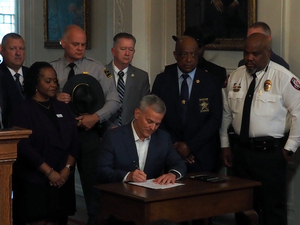
Legislation strengthening penalties for those who leave children unattended in hot cars was signed into law by Rhode Island Gov. Dan McKee this week. (Getty photo)
Rhode Island state law has long been inconsistent when it comes to how police can charge individuals who leave young children or pets in an unattended motor vehicle. Not anymore after Gov. Dan McKee on Tuesday signed legislation passed during the 2026 session by the General Assembly.
State law allows police to charge someone with a misdemeanor for leaving an animal in a vehicle. Misdemeanors are punishable by up to a $1,000 fine and one year in jail.
But a 1997 law prohibited fines, sanctions or record-keeping in instances involving children left in unattended vehicles. Police could only issue a verbal warning on the dangers of kidnapping and extreme temperatures for unattended children.
McKee signed into law legislation that now gives law enforcement officers discretion in issuing a verbal warning or a misdemeanor or criminal charge. The companion bills (S3135/H8094), sponsored by Sen. Leonidas Raptakis, a Coventry Democrat, and Rep. Matthew Dawson, an East Providence Democrat, apply to cases involving children under 7 years old. The law took effect immediately.
Almost 40 children die every year of vehicular heatstroke, with peaks in July and August, according to No Heat Stroke. Children under 3 years old have made up 73% of those deaths since 1998.
“It’s time we protect our children,” Raptakis said in a June 4 press release.
Raptakis sponsored the legislation on behalf of the Rhode Island Office of Attorney General, where Farren Fuquea works as a policy analyst. She highlighted the paradox in existing state law at the bill’s April 9 hearing in the Senate Judiciary Committee.
In one case last July that “sparked discussion,” Fuquea said a 15-month-old child and dog were left alone in a hot car for more than half an hour at a casino. The attorney general’s office could only bring charges for the dog, not the child, she said.
“The statute, as it stands, is an impediment to charging more egregious cases,” Fuquea said in April.
AAA Northeast voiced support for McKee’s signing of the legislation in a press release Friday.
“Giving our law enforcement officers the discretion to issue verbal warnings accompanied by education or pursue criminal charges when appropriate will better protect children from these potentially deadly incidents,” Mary Maguire, the group’s vice president of public and government affairs, said.
Raptakis has tried to revise the law for over a decade, first introducing legislation to strike the provision requiring only a verbal warning as penalty in 2015.
He has since sponsored nine similar bills, some simply removing the language and some replacing it with punishments like fines, suspended licenses and imprisonment.

Providence, RI