Researchers expect ‘biggest year yet’ for energy siting bills in 2027
Aug 26, 2026 | 6:51 pm ET
Description
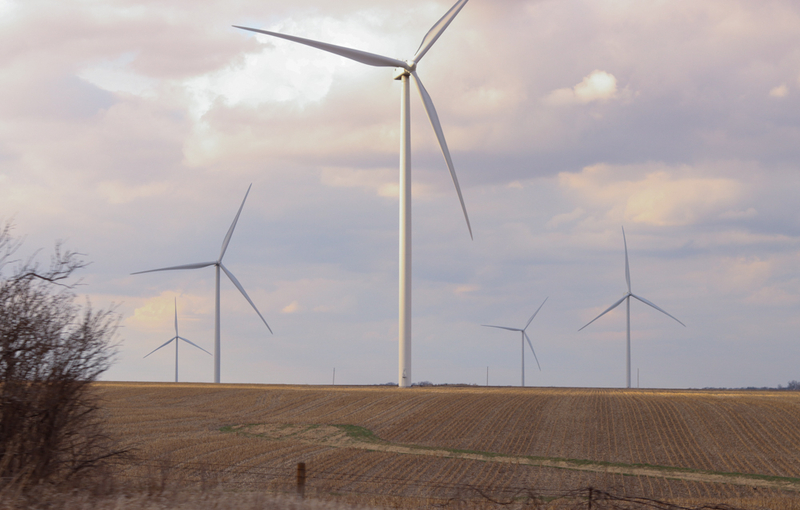
Wind turbines along west-bound Interstate 80 on March 29, 2025. (Photo by Cami Koons/Iowa Capital Dispatch)
An analysis of renewable energy siting bills across the U.S. during 2026 legislative sessions found the majority of introduced bills were aimed at restricting renewable energy infrastructure, though most of the enacted bills were permissive to the industry.
Researchers who worked on the report with the Siting Solutions Project, a nonpartisan initiative focused on energy siting and permitting, said in a webinar Wednesday they anticipate data center growth and continued concerns around energy affordability will make 2027 the “biggest year yet” for state bills related to energy siting.
The policy analysts anticipate Iowa renewable energy advocates will have to take a defensive position on siting policy at the Statehouse in 2027.
The Siting Solutions Project looks at bills that pertain to renewable energy regulation and categorizes the bills as either very restrictive, somewhat restrictive, neutral, somewhat permissive or very permissive.
Of the more than 200 bills tracked this legislative session, 43% were restrictive and 36% would have “had a positive impact” on renewable energy deployment. The project’s report from 2025 similarly showed a trend toward restrictive bills, but a smaller share, 22%, of 2025 bills were permissive.
Less than 30 of the bills tracked by the organization have been enacted, and of those, just two were categorized as restrictive policies.
Nelson Falkenburg, one of the authors on the report and a siting policy manager with Clean Tomorrow, the parent organization of the Siting Solutions Project, said this means that defensive strategies protecting renewable energy are “adept and strong” or some of the proposed bills were used as political messaging.
“It’s possible that many of the restrictive bills introduced in 2026 were messaging bills, where legislators were scoring political wins for their constituents by beating up on wind and solar,” Falkenburg said, noting that these bills often don’t make it out of committee.
Utah enacted a bill that removes incentives for solar on agricultural land and took a “restrictive approach” to decommissioning standards. In Kentucky, a new law creates “punitive” siting standards for renewable energy projects in unzoned counties, according to Falkenburg.
Permissive bills that were enacted updated standards for renewable energy siting and decommissioning, or streamlined permitting for co-located battery storage laws. Lawmakers in Alabama passed a law that made it easier to convert oil and gas wells into renewable energy sites.
In the 2026 report, each U.S. state that had an active legislative session was similarly categorized based on the consequences of each introduced energy siting bill.
Some states, like Missouri, Oklahoma, Arizona, Mississippi, Alabama and New York, had predominantly “very restrictive” policy proposals, including outright or de facto moratoriums on renewable energy projects. Washington, Oregon, California, Maine, Virginia and New Jersey had mostly permissive policies, though researchers said the permissive policies only made “incremental progress” whereas restrictive policy tended to propose more drastic changes.
States with a balance of restrictive and permissive policies, like Iowa and several other Midwestern states, were labeled as “neutral” for the 2026 legislative session.
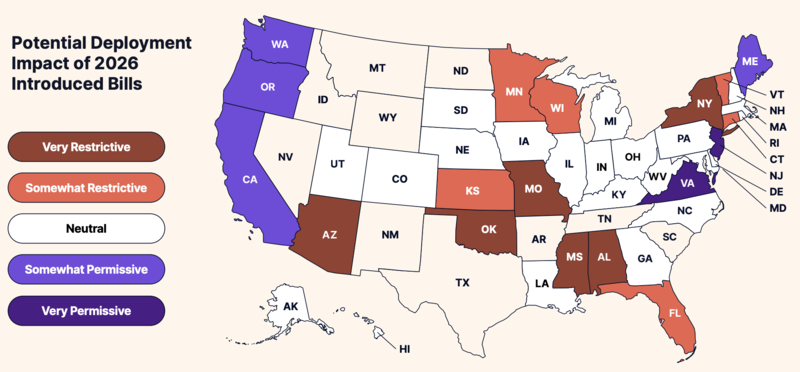
This categorization, based on 2026 introduced legislation, does not necessarily correlate with the overall nature of renewable energy siting in a state, according to Zona Martin, an analyst with Siting Solutions and author on the report.
For example, Martin said that while Oregon and Washington passed and introduced mostly permissive energy siting bills this session, the permitting and development processes for renewable energy projects are still “very slow” and “costly.”
How did Iowa stack up?
Martin noted states with significant renewable energy infrastructure, like Iowa, Arizona and Oklahoma, had legislation that reflected a “backlash” to renewable energy project buildout. She said these states proposed policies like restrictive statewide standards, capping development to preserve farmland and expanding local control.
The analysis flagged seven bills in Iowa, three that were considered permissive, three that were restrictive and one neutral bill. None of the Iowa bills tracked by the project were enacted in 2026.
Iowa’s restrictive bills fit similar descriptions, including a bill that would have required certain environmental studies, insurance and proof that the project would be a benefit to the community. A neutral bill from the Statehouse would have addressed landowner complaints about blinking red lights on wind turbines by requiring the structures to have aircraft detection lighting systems.
A notable permissive bill would have created renewable energy siting language for counties to adopt which would set a standard for initiatives like moratoriums, setbacks, property tax and other considerations. While similar bills advanced from committees in both chambers, neither was heard on the floor.
The report said Iowa’s siting policy was “turned on its head” following a decision from the Iowa Utilities Commission to approve the generation certificate for a solar project in Cerro Gordo County, which preempted the county’s ban on wind, solar and battery storage projects.
Falkenburg said because of the IUC’s decision on this case, he anticipates renewable energy advocates will shift their focus in 2027 from pushing for more permissive policies, to trying to defend the right of the IUC to preempt local ordinances.
2027 projections
The report notes that clean energy advocates will be “on the defense” in Iowa and Texas this year to “shore up” permitting paradigms in the state.
Falkenburg said he anticipates it will be effective to “make the business case” to Republican leadership in Iowa about renewable energy projects.
“Advocates are going to have to be really closely tracking any renewable energy legislation that’s introduced or advancing in the state, and making the case to the IUC, to Iowans, and to the Legislature that the projects that are coming online in Iowa, are addressing the needs of Iowans and the business community,” Falkenburg said.
While the report shows that Republicans tended to introduce more restrictive bills and Democrats tended to introduce mostly permissive bills, Alex Brekel, the senior director of programs for Clean Tomorrow, said there’s a “poor correlation” between the voting color of a state and its clean energy policy.
“Or at least the partisanship of a state tells you very little about the quality of the wind, solar, battery siting policy regime,” Brekel said.
Falkenburg said Texas is a “prime example” of a Republican-dominant state that has a lot of renewable energy and “very little” siting regulation.
In other red states, Falkenburg said bills to “constrain” local governments from enacting restrictive ordinances have been common. States with a mostly Democratic base tend to favor clean energy policies that create an “effective state siting regime.”
The report said notable permissive bills are anticipated in Pennsylvania, Virginia, and Indiana and restrictive bills that didn’t make it across the finish line this year in Oklahoma, Alabama and Arizona are expected to return in 2027.
Overall, researchers on the call said data centers and energy affordability will likely drive conversations around renewable energy siting policy.
“2027 is going to be the biggest year yet for renewable energy siting and permitting legislation, considering both the trends of data center buildout and the rising electricity bills that Americans are seeing that are affecting their wallets,” Falkenburg said.
The Siting Solutions Project maintains a legislative tracker that is updated weekly with renewable energy siting policies across the country. The interactive tracker also shows more state specific information, down to the bills the project is watching.
Des Moines, IA