Recent land returns give Wabanaki Nations more authority over conservation, ancestral territory
Sep 17, 2026 | 11:45 am ET
Description
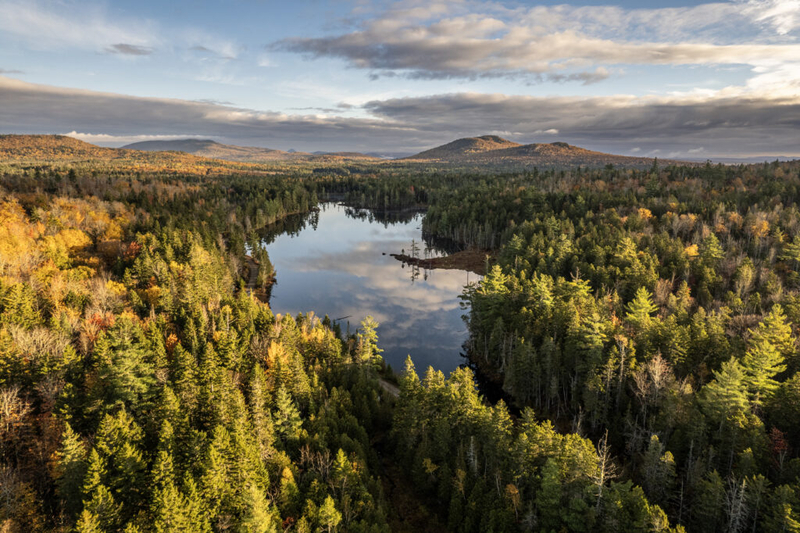
Trout Pond located within Katahdin Woods and Waters National Monument. (Photo courtesy of Trust for Public Land)
The Penobscot Nation received 11,000 acres of ancestral land back this week, the first phase of what is expected to be one of the largest land returns ever between a U.S.-based nonprofit and a tribe.
Located near the base of Katahdin, the land return affords the Penobscot Nation access to a culturally significant area, natural resources for hunting and harvesting, and more authority to expand its longstanding conservation work, said Penobscot Nation Natural Resources Director Chuck Loring. While specific plans are still being developed, one goal is to create an access route to the Katahdin Woods and Waters National Monument.
The 11,297 acres are part of a broader 30,000+-acre property surrounding Wáhsehtəkʷ — the East Branch of the Penobscot River — that a national nonprofit, Trust for Public Land, purchased from timber harvesters three years ago with the intent to return it to the Penobscot Nation.
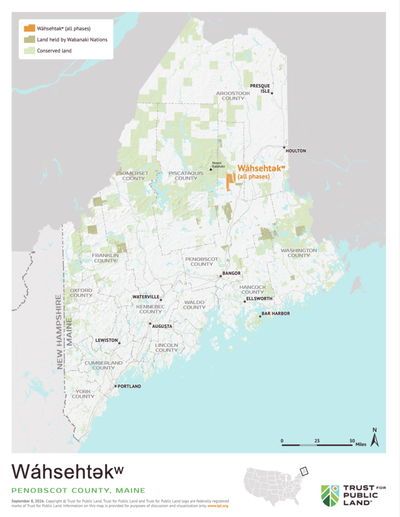
(Image courtesy of Trust for Public Land)
The Trust for Public Land, which took out loans to pay for the property, and the Penobscot Nation are working together to raise funds for the buy back. With an overall goal of $32.5 million, the $20.7 million raised so far allowed for the first phase to be initiated on Wednesday. The rest of the land will be returned after the remaining $11.8 million is raised.
The first phase brings the total land that the Penobscot Nation now stewards to approximately 140,000 acres. However, the Wabanaki Nations – the Penobscot Nation, Mi’kmaq Nation, Houlton Band of Maliseet Indians and Passamaquoddy Tribe – only hold 1% of their ancestral lands in what is now the state of Maine.
The Wáhsehtəkʷ effort is part of a larger push to return more than 50,000 acres to Wabanaki communities through 11 different projects in collaboration with conservation organizations.
“There have been a lot of decisions that conservation organizations have made over the past few decades that have not taken tribal nations and indigenous communities’ perspective and leadership into the picture,” said Betsy Cook of Trust for Public Land, which nationally has returned more than 200,000 acres of land to over 70 different tribal and indigenous communities.
One of the other projects in Maine completed in June doubled the amount of land owned and stewarded by the Mi’kmaq Nation with the return of 3,400 acres. And in September, the Mi’kmaq Nation, in partnership with Trust for Public Land, secured an additional 83 acres that abuts its existing tribal housing and community space, allowing for infrastructure upgrades, such as septic systems, to improve safety and environmental health.
Cook sees the land return efforts as evidence of “a real shift and recognition of the strong leadership that tribal nations bring to caring for lands and waters.”
The returned and to-be-returned land is categorized as fee land, or private property for which the owner owns the title. Loring said the Penobscot Nation will be working to transfer it to trust land, which is held by the U.S. government on behalf of a tribe and therefore affords tribes more authority over what can be done with it.
Still, the Wabanaki Nations have less sovereignty than other federally recognized tribes because of a 1980 land settlement agreement, under which Maine claimed roughly two-thirds of land in the state.
Wabanaki leaders have said that their Tribes signed the Maine Indian Claims Settlement Act to get fair compensation for stolen lands, not to give up the level of sovereignty that has been interpreted by the state and courts to date.
The Wabanaki Nations have worked with state lawmakers and Gov. Janet Mills in recent years to pass piecemeal reforms, such as expanding Wabanaki authority over prosecuting crimes, permitting the Tribes to handle and reap profits from sports betting, and aligning the tax code with the rules that apply to other tribal nations throughout the country. But Mills blocked multiple attempts for sweeping overhauls of the Tribal-State relationship.
“The ability for the Wabanaki Nations and Wabanaki people to be able to connect with land, take care of land and interact with their land in a way that is free and honors the sovereignty of the tribal nations is critically important,” Cook said. “These things — the tribal sovereignty push and land returns — they are not disconnected.”
Augusta, ME