Public health advocates pitch New Mexico lawmakers on heat, climate change initiatives
Sep 30, 2026 | 12:39 pm ET
Description
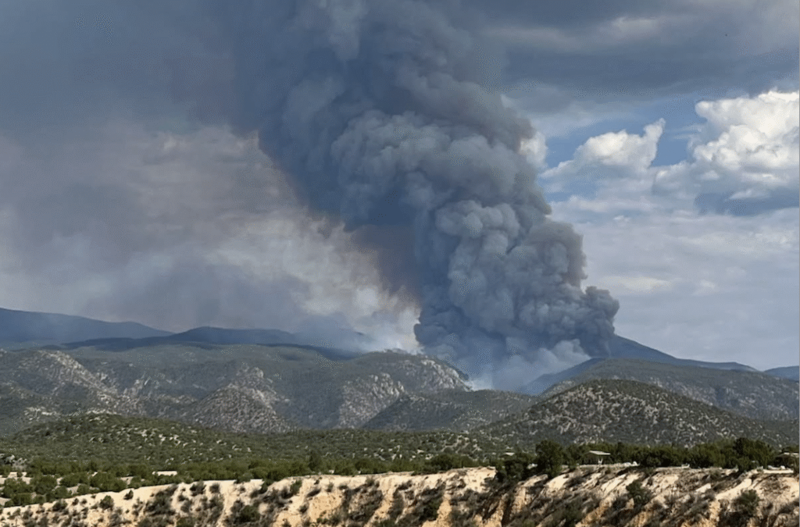
Advocates from Healthy Climate New Mexico proposed initiatives to legislators on Sept. 29, 2026, to help the state track health impacts from heat and wildfire smoke. Above: The Frijoles Fire burning in the Pecos wilderness, pictured Aug. 8, 2026. (Photo courtesy Santa Fe National Forest)
Public health advocates on Tuesday proposed initiatives to state lawmakers to help track the impact of heat and wildfire smoke on residents’ health, and help fund communities’ responses to threats from climate change.
Two-thirds of all counties in New Mexico recorded their warmest temperatures to date this summer, Eva Gulin, a technician for the ZiaMet weather system operated by New Mexico State University, told lawmakers in the interim Legislative Health and Human Resources Committee.
And since April, a total of 1,086 New Mexicans visited emergency rooms throughout the state for heat-related illnesses.
Healthy Climate New Mexico, a nonprofit collective of health care professionals concerned about climate change, presented proposals to lawmakers that aim to improve preparedness and adaptation to extreme weather driven by human-caused climate change.
The first proposal would be to reintroduce the Public Health and Climate Program, which died during the 2025 session. The $1.1 million initiative would create a climate health program at New Mexico Department of Health to track health impacts from heat, wildfire smoke, drought, flooding, dust and severe storms.
The Extreme Weather Resilience Fund, the second proposal, offers grant funds for local and tribal governments to respond to public health risks and impacts from extreme heat, wildfire smoke and other climate change threats. Healthy Climate officials requested $13 million in funding for the program.
Communities that receive grant money could use it to procure heat sensors, air quality monitors, or air conditioners to create cooling centers, Ashley Proud, executive director of Healthy Climate New Mexico, told lawmakers.
Presenters also cited a study that showed unhoused people are 10 times more likely to end up in the emergency room from heat-related illness. Proud noted that grant funds could also be used to purchase personal cooling kits and shade structures for the population.
Proud added the fund will be “equitably targeted” with at least 50% of grant funds dedicated to small communities with populations under 100,000.
“It seems our most vulnerable and impoverished areas of our state are really the ones who are being harmed the most or being exposed,” Sen. Harold Pope (D-Albuquerque) said. “We have to change that.”
While both proposals failed to make it through the 2025 session, Charles Goodmacher, policy advisor for Healthy Climate, told Source NM the temperature in the Legislature has changed.
Goodmacher said his group has “a strong indication from people on the budget committees that at least the Extreme Weather Resilience Fund will likely get passed” during next year’s session.
State Rep. Elizabeth Thomson (D-Albuquerque), who chairs the House Health and Human Services, underscored her support for the climate proposals.
“We lose lives and New Mexicans suffer lifelong health issues from heat and wildfire smoke —it’s a no-brainer as far as I’m concerned,” Thomson told Source NM. “Yes it will cost some money, but it is money well spent and the return on investment will be well worth it.”
Santa Fe, NM