Public dollars belong in public schools
Jul 01, 2026 | 7:00 am ET
Description
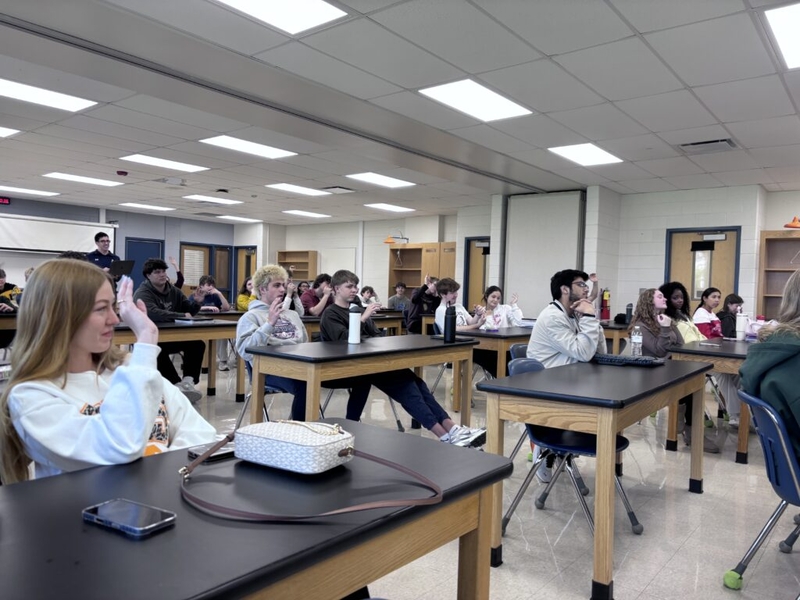
Students in Trenton High School's AP Government class raise their hands indicating how many of them bring their cellphones to school during a discussion about Michigan's new school cellphone ban on Tuesday, April 7, 2026. | Photo by Martin Slagter/Michigan Advance
A proposed scholarship tax-credit program would divert resources, reduce accountability, and deepen educational inequities.
Michigan families deserve strong public schools that welcome every child and prepare all students for success. That is why Governor Whitmer should reject efforts to divert public resources into private education through the federal tax-credit voucher scheme, which lays the foundation for privatization and would weaken public schools across Michigan.
While supporters describe this program as expanding “school choice,” in reality, it creates a system where only some students benefit, often in the wealthiest communities, while the majority are left behind.
Only public schools are required to educate every child who walks through their doors. They serve students regardless of disability, religion, family income, race, sexual orientation, or gender identity. Private schools simply do not have the same legal obligation. They can deny admission, limit enrollment, or decline to provide services, particularly for students with disabilities.
Public schools are also accountable to taxpayers. Their budgets, performance data, school board meetings, and educational outcomes are subject to public scrutiny. Private schools receiving indirect public subsidies through scholarship programs are not held to the same standards of transparency or accountability, oftentimes with problematic results.
Vouchers have racist origins, and they continue to perpetuate segregation as intended. When public dollars are used to subsidize private education, students become more separated by income, race, and disability status. Rather than bringing communities together, these programs divide them.
The federal voucher program is often presented as something public schools can participate in as well. In practice, it is far more complicated and limited in scope. Local school districts are government agencies and must provide services at no cost. They cannot simply become scholarship granting organizations (SGOs) themselves, since SGOs must be nonprofit charities.
To access these funds, districts would need to create an intermediary organization or work with established foundations (often only found in wealthier districts), creating new layers of administration and overhead. Districts would also need to identify services they could charge for, which the scholarships could offset. Then they would need to hope that individual taxpayers donate to their SGO rather than the many competing ones already being formed.
Rather than investing directly in classrooms, schools would be forced to build out and maintain separate organizations simply to compete for funding that is awarded to individual students, not to school programs.
The result is a troubling incentive structure: schools would be pushed to privatize themselves from the inside out, creating selective, fee-based opportunities rather than investing in programs that benefit all students. SGOs retain up to 10% for administration, while public districts face significant barriers to accessing funds. The family income limits for the scholarships are so high as to be meaningless. The structure is designed to expand privatized education, not strengthen public schools.
The consequences of opting-into the federal voucher program threatens to undermine progress Michigan has made to funding our public schools in recent years. While vouchers may not immediately reduce funding for local school districts, they create powerful incentives for students to leave public schools.
In Michigan, school funding largely follows student enrollment. When students leave, districts lose revenue. Yet the costs of operating schools — transportation, facilities, utilities, staffing, and student services — do not disappear when a handful of students transfer elsewhere. The financial losses nearly always exceed any savings.
The national budget is also a very real concern. Families in the middle tax bracket would have to give over $14,000 to charity to receive the same tax credit this program offers. The Congressional Budget Office estimates that this program could eventually cost the federal government billions of dollars annually.
With no cap on program growth, these expenditures could rival existing investments in programs such as Title I and the Individuals with Disabilities Education Act (IDEA), both of which provide critical support to public schools. It is difficult to imagine such a large new expenditure emerging without pressure to reduce existing federal education investments.
Michigan should not help build a system that increases segregation, reduces accountability, and diverts resources away from schools that serve everyone.
At a time of teacher shortages, rising costs, and growing student needs, the state should invest directly in the public schools that educate nearly every child — schools that strengthen our communities, expand opportunity, and ensure that children of every race, faith, ability, and background can learn and grow together.
Lansing, MI