Proposal could boost FEMA’s response to domestic violence after disasters
Sep 22, 2026 | 1:18 pm ET
Description
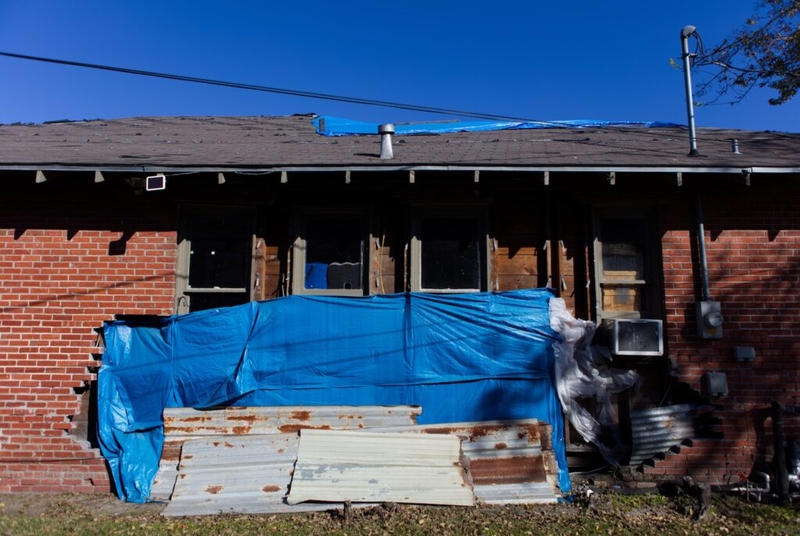
Tarps cover the damage Hurricane Laura inflicted in 2020 upon a home in Lake Charles. (Photo by Chris Vinn for Louisiana Illuminator)
This story was originally reported by Jessica Kutz of The 19th. Meet Jessica and read more of their reporting on gender, politics and policy.
After a deadly wildfire tore through Maui in August 2023, community organizer Khara Jabola-Carolus set out to ask women how they were faring after the disaster. She teamed up with fellow community organizer Nadine Ortega to co-found Tagnawa, a grassroots recovery organization to meet the needs of Filipinos and other marginalized groups on the island.
There are plenty of statistics and anecdotes documenting the abuse and violence women have had to endure following natural disasters. Still, what Jabola-Carolus learned was startling: Of the 70 Filipino women Tagnawa surveyed, one in six said they felt forced to engage in “survival sex,” which involves the exchange of sexual acts for food, housing and other basic necessities.
Mental health experts also shared stories of child sexual abuse going unreported to keep a family unit together amid the uncertainty and instability caused by the fires. At Women Helping Women, a local domestic violence organization, the number of calls doubled to 550 per month in the first two months after the disaster.
“We tried to gather as much as we could in that short window of time in order to generate action,” said Jabola-Carolus, a former executive director of the Hawai’i State Commission on the Status of Women whose family is from the Philippines, where hurricanes and typhoons have been linked to increased violence against women.
Three years later, Reps. Laurel Lee, a Florida Republican, and Lucy McBath, a Georgia Democrat, have introduced legislation directing the Federal Emergency Management Agency, or FEMA, to strengthen safety at evacuation shelters and establish reporting protocols for issues like domestic violence and sexual assault.
The bill also requires training for FEMA personnel in how to identify and support survivors of gender-based violence, as well as changes to how the agency conducts household check-ins after a disaster. Currently, FEMA workers meet only with the head of household, typically a man. If the bill becomes law, they would have to meet with all adults in the family, something that advocates say could help women report abuse post-disaster.
In an email to The 19th, McBath said that FEMA’s own advisory council found in a 2024 report that the agency should do more to address gender-based violence and exploitation, and to stop human trafficking in the wake of disasters. “Our bill turns that expert recommendation into law.”
She added: “Our legislation addresses gaps in disaster response that impact survivors of natural disasters the most — being without their homes and their support systems. As a survivor of gun violence myself, the journey to recovery from any trauma is already incredibly difficult. This is our way of doing our part to ensure that every survivor is seen, heard, and protected.”
Lee has previously worked on legislation aimed at tackling human trafficking; Florida ranks third for human trafficking among U.S. states — and it faces the threat of hurricanes every year. She could not be reached for comment.
Though limited in scope, Tagnawa’s survey, “Equality in Flames,” echoed longstanding patterns of abuse following natural disasters. After Hurricane Katrina in 2005, one study found that women in Mississippi who had live-in partners were twice as likely to report physical abuse after the hurricane; a separate survey found that intimate partner violence was nearly three times higher the year after the storm among people who were displaced and living in trailer parks in Louisiana and Mississippi.
More recently, after a severe winter storm impacted Texas in 2021, domestic violence calls went up. One national organization that provides cash assistance to survivors of gender-based violence noted that for one in four applicants, the abuse either began or worsened during the disaster, The Texas Tribune reported.
Under the Trump administration, the domestic violence services infrastructure has been destabilized through delayed and canceled grants and shifting priorities, forcing a number of organizations to lay off workers and reduce services, like hotlines that were previously available 24/7.
President Trump’s budget for fiscal year 2027, released in April and not yet approved by Congress, includes significant cuts to housing and legal assistance programs under the Office on Violence Against Women. In a statement at the time, the National Network to End Domestic Violence called federal funding “the backbone of our nation’s response to violence and our commitment to survivors’ safety, stability, and recovery.” Any reduction, the statement added, “jeopardizes vital services and risks the lives of victims and their children.”
It is against this backdrop that the bill was introduced, though it remains unclear whether it will advance to a committee hearing during a final sprint to end the legislative session after the midterms recess. Regardless of whether the legislation moves forward this time, Yasmin Vafa, co-founder and executive director of Rights4Girls, an advocacy organization that helped raise awareness among lawmakers on Capitol Hill, said there’s value in bringing the topic of gender violence and natural disasters into the national conversation. “That’s one of the important principles of doing federal policy advocacy is that even the mere introduction of a bill at the federal level can get states thinking about it,” she said.
She provided an example of another bill introduced in the House, and for which she lobbied, that would allow for shorter minimum sentences in cases where victims are convicted of harming their abusers: It has yet to pass in Congress, but it has led to similar laws at the state level in California, Hawaii, Illinois, Oklahoma, Tennessee and Virginia.
Jennifer Horney, a professor at the University of Delaware who has researched disasters and gender-based violence, said the FEMA bill has some of the same recommendations made in reports she has co-authored. One of the findings “was to think about ways that people whose primary job is in emergency response and emergency management could be more aware of the increased risk for violence post-disaster,” she said. “The fact that the legislation calls out the importance of trauma-informed care is really critical to providing these services.”
Beyond passing the legislation, Horney said the federal and state governments could allocate more money to domestic violence organizations, which would, in turn, increase support for survivors after disasters.
The Trump administration has moved in the opposite direction, though: It has slashed funding to these same organizations, which has already led to reduced services.
Globally, there is widespread recognition that disasters lead to an increase in gender-based violence, with most research and policy-making on the topic being produced abroad. Still, the U.S. State Department has recognized this is an issue, at least internationally, said Vafa, of Rights4Girls. In 2022, in its annual “Trafficking in Persons” report, the department acknowledged that climate change and extreme weather displace populations and can lead to an increase in trafficking of women and children.
The National Science Foundation, the federal government’s most prominent scientific agency, also released a report in 2024 finding that public health emergencies, like natural disasters, are associated with an increase in the severity and frequency of intimate partner violence.
Jabola-Carolus said that if the FEMA legislation passes, the United States would at least come closer to other countries that are already dealing with the impacts of climate disasters. Countries like the one her family is from. “Filipinos are essentially people from the climate future,” she said. They are already confronting the ways women are affected by climate disasters.
In 2016, the Philippines passed disaster reform legislation that integrated sex trafficking response and prevention into disaster recovery and planning. The United States, she said, can learn from them.
Baton Rouge, LA