As a potential Democratic wave looms, Trump's DOJ angles for last-minute power over midterms
Nov 02, 2026 | 4:29 pm ET
Description
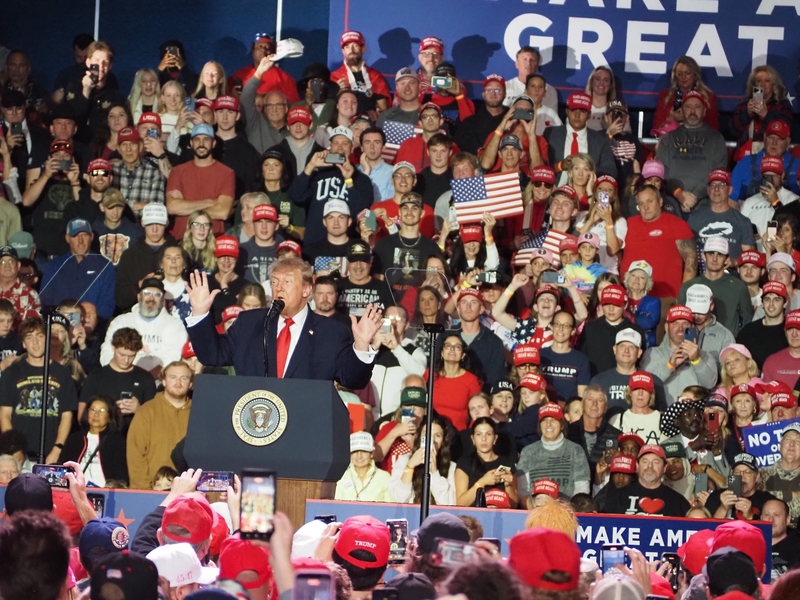
President Donald Trump rallied with Iowa Republicans at the Five Flags Center in Dubuque on Nov. 1, 2026, two days before Election Day. (Photo by Robin Opsahl/Iowa Capital Dispatch)
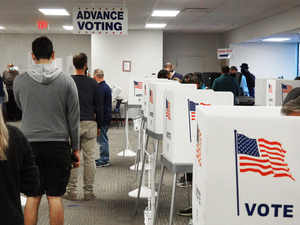
American democracy faces one of its biggest stress tests of the modern era, as President Donald Trump’s sprawling campaign for power over elections encounters a firewall of judges, state election workers and voting rights leaders heading into Election Day.
A cascade of courtroom losses over the weekend dealt a major blow to the Trump administration’s last-minute efforts ahead of Tuesday to assert authority over voting and hold the prospect of prosecutions over the heads of state election officials.
But another round of last-minute court hearings was set for Monday — and the U.S. Department of Justice asked the U.S. Supreme Court to require California to set aside the ballots of 20,000 suspected noncitizens.
Democrats, voting rights groups and even some former Trump administration officials have said they are braced for a range of possible disruptions and interference, especially as the president stares down the prospect of a blue wave that could wash away Republican control of Congress. Elections forecasters have said Democrats are on track to win control of the U.S. House and possibly the Senate, amid voter unhappiness with rising consumer costs.
“I fully expect my former boss, Donald Trump, to try to steal this election,” Miles Taylor, a deputy Department of Homeland Security chief of staff during the first Trump administration who became an outspoken Trump critic, told reporters last week.
Trump and his supporters have said the federal government’s actions are necessary to protect against noncitizen voting, which they warn cancels out the votes of Americans.
While researchers have consistently found that noncitizen voting is rare and doesn’t impact the outcome of elections, Homeland Security has arrested dozens of noncitizens on allegations of election crimes in recent weeks, part of a concerted effort by the Trump administration to ramp up enforcement ahead of the election.
The last-minute push, Trump allies note, comes after the Senate didn’t advance Trump’s signature election legislation, the SAVE America Act, which would have imposed stringent requirements on voters to show proof of citizenship. The legislation passed the House but faced bipartisan opposition in the Senate.
“They voted against proof of citizenship so they can cheat,” Trump said during a rally in Salina, Kansas, on Sunday.
In the past four days, a federal judge ordered the list of 20,000 suspected noncitizens in California shared with an immigrant rights group, which said Saturday it found major problems with its veracity.
Another judge blocked the Justice Department from threatening election workers with prosecution. In Alaska, a judge dismissed a lawsuit that preemptively sought to question the certification of the results of Alaska’s U.S. Senate race. An appeals court also upheld limits on preelection field operations by Homeland Security.
On Monday, judges were expected to weigh requests to restrict federal law enforcement agents from serving as election monitors and additional limits on armed federal personnel at polling locations. Federal law broadly prohibits armed federal troops or agents at election sites.
Planning for ‘every single scenario’
As the court losses pile up, Democrats, civic leaders and election experts have watched with a wary eye toward how Trump will respond.
Election preparations by critics of the Trump administration have been underway for months. Congressional Democrats have mapped out dozens of scenarios, including the possibility that Trump will falsely point to a foreign threat against U.S. elections as an excuse to disrupt voting or seize voting machines.
They have also assembled a field army of volunteers to assist voters and monitor polling locations for signs of federal interference. Teams of lawyers have drafted a range of possible lawsuits that can be quickly filed if problems arise.
Virginia Kase Solomón, president and CEO of the nonpartisan watchdog Common Cause, said her organization is deploying more than 21,000 election protection volunteers sporting bright yellow shirts. Common Cause has also trained 3,000 volunteers to work a voter hotline.
“Common Cause is prepared for every single scenario and we are refusing to let fear win,” Kase Solomón said during a recent press briefing.
Noncitizen voters
The Trump administration’s actions follow a refusal by dozens of states, including California, to share their full voter roll that includes sensitive personal data — information the Trump administration says would allow it to identify noncitizen voters.
“California could, but refuses to, provide the unredacted list, which would resolve this entire dispute in a matter of hours,” Bill Essayli, first assistant U.S. attorney for the Central District of California, wrote on social media over the weekend.
But Trump has spent years promoting falsehoods about stolen elections, long before the more recent focus on noncitizen voting. After he lost the 2020 election, the president and his allies waged an extensive pressure campaign in a bid to overturn his losses in key battleground states.
Some supporters advanced baseless conspiracy theories about voting machines. As the midterm elections approach, Trump has again begun casting a cloud of suspicion over voting machines.
He spoke about alleged vulnerabilities in the machines during a primetime speech in July, though in every state except Louisiana, machines produce paper records that can later be checked. In the final hours of the election, the president is returning to the theme.
“You know the paper ballots cost 9% of what these crooked machines cost,” Trump said at a rally in Dubuque, Iowa, on Sunday.
Trump’s intensifying rhetoric has been matched by the Justice Department’s rapid-fire legal challenges over the past several days seeking to influence elections, which under the U.S. Constitution are run by the states.
With polls set to open in a matter of hours, federal judges have blocked the Trump administration at every turn.
Threats to election workers
Late Friday, Judge Trina Thompson, an appointee of President Joe Biden in U.S. District Court for the Northern District of California, issued a temporary restraining order preventing the Trump administration from threatening election workers nationwide with prosecution.
The order came after Essayli, during a court hearing last week, raised the possibility that California election officials could face “criminal liability” if they count the ballots of noncitizens.
The Justice Department on Thursday also sent a letter to election officials nationwide that reiterated requirements under federal law to preserve election-related records and listed the criminal consequences of noncompliance.
When election officials perform the work in the manner required by state and federal law, “they do not violate federal criminal law even if a particular ballot belongs” to an ineligible voter, Thompson wrote.
The Justice Department has appealed the order to the U.S. 9th Circuit Court of Appeals.
“Reminding election officials to follow federal law is a civic service, not a ‘threat,’” Acting Deputy Attorney General Trent McCotter said on X.
Supreme Court weighs ballots case
Weeks after the Justice Department sued California in an effort to force election officials to set aside and not count the ballots of 20,000 voters it said were suspected noncitizens, the case reached the Supreme Court on Monday.
“If it turns out that those individuals cast ballots but are not, in fact, U.S. citizens, then California’s counting of their votes will violate (federal law) and will debase or dilute valid votes cast by U.S. citizens,” U.S. Solicitor General D. John Sauer wrote in an emergency application to the high court.
The Justice Department has so far failed in its effort to require California to set aside ballots from individuals on the list, which was compiled by Homeland Security based on checks of government records and use of the research service LexisNexis. A district court judge and the U.S. 9th Circuit Court of Appeals have both ruled against the Trump administration.
An immigrant rights group raised serious concerns about the list over the weekend after a judge forced the Trump administration to share a copy with the organization.
The Coalition for Humane Immigrant Rights, or CHIRLA, said in a court filing Saturday that an analysis by data experts found that 42% of the names weren’t found on California’s current voter file. At least 22 names on the list are on a list of U.S. citizens compiled by the organization, the analysis found.
Judge James Boasberg, an appointee of President Barack Obama in U.S. District Court for the District of Columbia, on Monday prohibited the Justice Department from demanding that California set aside ballots — echoing previous rulings in the case now before the Supreme Court.
In Washington state, the Justice Department has demanded election officials set aside about 400 ballots from voters it alleges are noncitizens. On Sunday, several civil rights groups sued to block any segregation of ballots.
“We are days away from Election Day and these threats, again, are an attempt to sow fear and throw out eligible votes with no transparency,” Lilliane Ballesteros, executive director of the Latino Community Fund of Washington state, said in a statement.
Federal monitors at the polls
On Sunday, the NAACP asked for a temporary restraining order to prevent a wide swath of federal law enforcement agents from serving as election monitors.
The Justice Department has deployed election monitors for decades to watch polling places for compliance with federal voting rights laws. But the Trump administration has expanded the program, and plans to have roughly 1,000 monitors stationed across all 50 states on Election Day.
Justice Department lawyers typically serve as monitors, but the Trump administration this year also plans to tap federal law enforcement agents. In a court filing, the NAACP alleged the deployments are illegal and will have a chilling effect that intimidates voters.
“The law is clear — law enforcement agents can have an intimidating effect on voters, especially Black voters, and they have no role and no right to be inside our polling places,” Kristen Clarke, NAACP general counsel, said in a statement.
The Justice Department said in a court document that monitors aren’t allowed to have firearms and have been instructed not to interfere with voting and must dress in business casual clothing.
Senior Judge Reggie Walton, an appointee of President George W. Bush in U.S. District Court for the District of Columbia, held a hearing on Monday. The public docket indicated Walton would issue an order.
Alaska challenge tossed
Judge Sharon Gleason, an appointee of President Barack Obama in U.S. District Court for the District of Alaska, on Sunday dismissed a Justice Department lawsuit that preemptively sought to pause certification of the Senate race.
The DOJ wanted a certification pause if Republican Sen. Dan Sullivan lost to Democrat Mary Peltola — and if Sullivan lost by less than the number of votes received by another candidate of the same name, Dan J. Sullivan.
The New York Times reported last week that Democrats worked to recruit Dan J. Sullivan, leading Trump to call for him and Peltola to be kicked out of the election. While Alaska election officials had initially tried to prevent Dan J. Sullivan from appearing on the ballot, the Alaska Supreme Court cleared his candidacy earlier this year.
The Justice Department’s lawsuit had also asked for an order requiring all ballots for Dan J. Sullivan be set aside for further investigation. Gleason gave little credence to the request and wrote that the Trump administration had offered no explanation for how it would work.
“The absence of any explanation from the United States as to how its requested relief could redress its alleged injury while simultaneously maintaining the secrecy of the ballot is telling,” Gleason wrote.
The Justice Department immediately appealed the decision to the U.S. 9th Circuit Court of Appeals.
All States Newsroom content is free to republish. Read our republishing policy for more information.